
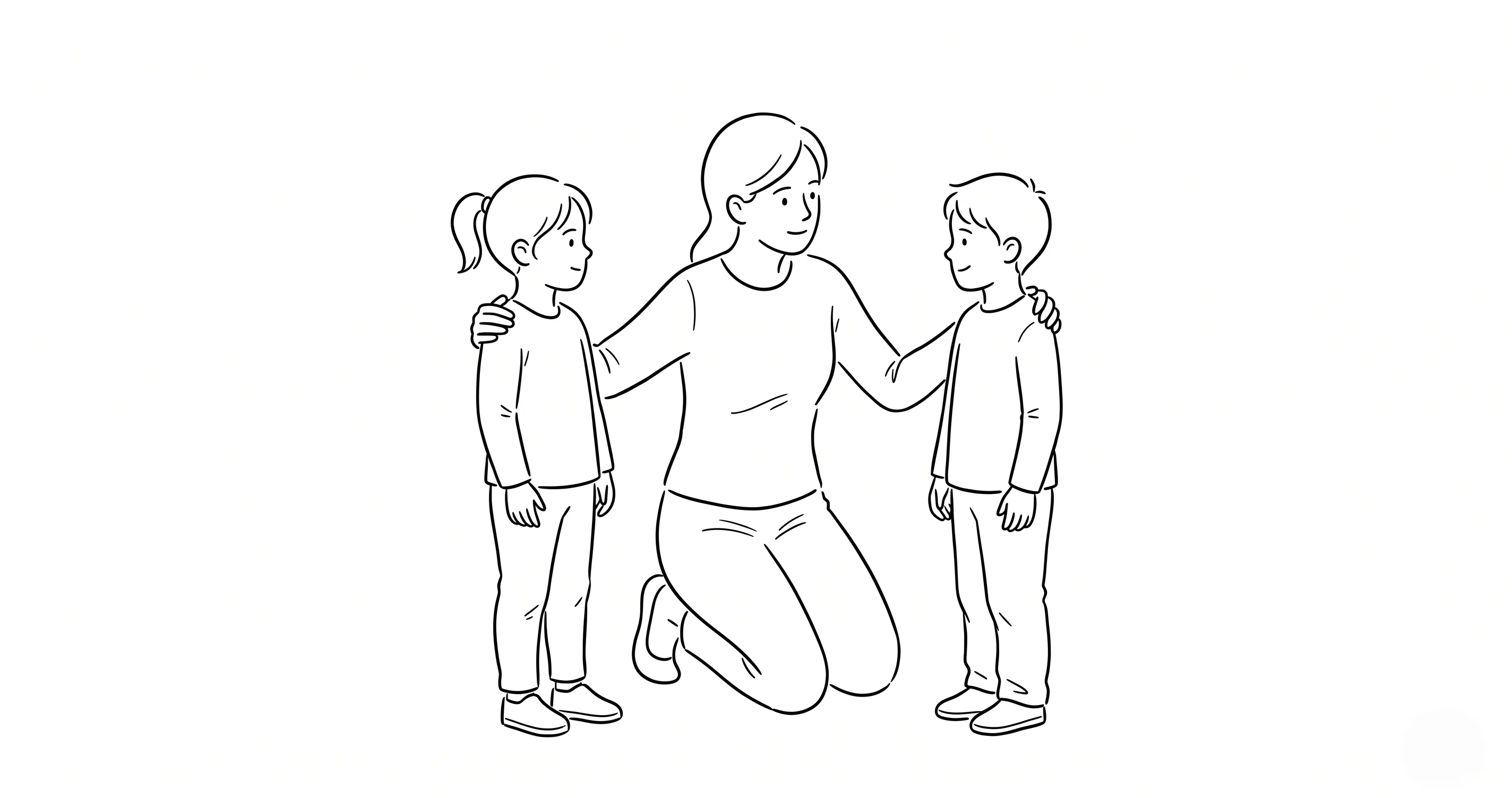
Your kids are screaming at each other again. One grabbed the other’s toy. Or someone looked at someone the wrong way. Or — the classic — it’s about whose turn it is on the iPad. You’ve tried counting to three. You’ve tried yelling. You’ve tried ignoring it. Nothing seems to stick, and you are desperate to learn how to stop siblings from fighting once and for all.
Here is the truth most parenting advice skips over: you cannot eliminate sibling fighting entirely. Research from the University of Illinois shows that siblings between ages 3 and 7 average 3.5 conflicts per hour when they are together. It is a normal, even healthy, part of development. But you can change how fights play out, how quickly they resolve, and how often they happen. This guide gives you the exact intervention steps, the sibling fighting solutions that actually work, and the prevention strategies that reduce daily battles — starting today.
If you want the deeper picture of why siblings fight in the first place, our companion guide on sibling fighting covers the developmental psychology. This article is about what to do.
What to Do Right Now (The 3-Step Intervention)
When a fight breaks out, you need a protocol — not a parenting philosophy. Something you can execute in the moment without thinking. Here is the 3-step intervention that child psychologists consistently recommend for how to stop siblings from fighting in real time.
Step 1: Separate immediately
Do not try to reason with children who are mid-conflict. Their amygdala has taken over, and the prefrontal cortex — the part of the brain responsible for reasoning and empathy — has gone offline. Trying to mediate right now is like trying to have a calm conversation during a fire alarm.
Say: “I need you both in different rooms right now. This is not a punishment. We all need a reset.”
Physical separation is non-negotiable. Different rooms, different corners, different floors of the house. The goal is to break the escalation loop. Children in proximity during high emotion will keep triggering each other.
Step 2: Let everyone calm down (minimum 5 minutes)
This is the step most parents skip. You separate them, wait 30 seconds, then try to talk it through. That is not enough time. The stress hormones cortisol and adrenaline take a minimum of 5 to 10 minutes to clear from a child’s system. Until that happens, they physically cannot engage in rational conversation.
During this cool-down period, do not lecture either child. Do not ask “What happened?” yet. If a child is crying or visibly upset, sit near them quietly. This is co-regulation — your calm nervous system helping to settle theirs. It works faster than any words.
Step 3: Mediate with structure
Once everyone is calm — and only then — bring the children together and run a structured conversation. This is not “work it out yourselves.” It is a guided process:
- Each child gets uninterrupted time to speak. “Tell me what happened from your side. Your sibling will listen without interrupting, and then they get a turn.”
- Reflect feelings, not blame. “So you felt frustrated because you were using the tablet and it got taken away. Is that right?”
- Ask for solutions. “What could you both do differently next time this happens?”
- Agree on one action. Get both children to commit to one specific change. Not a vague promise to “be nicer” — a concrete action like “I’ll ask before taking something” or “I’ll set a timer so we share equally.”
Exact Words to Say During Common Fights
Knowing the theory is one thing. Knowing exactly what to say when your children are screaming at each other is another. Here are word-for-word scripts for the five most common sibling fights, designed for how to handle sibling fights without losing your composure.
The “It’s my turn” fight
Scene: Both children want the same device, toy, or activity at the same time.
Say: “I can see you both want this right now. That’s a real problem, and I think you can solve it together. What’s a fair way to decide who goes first?”
If they cannot agree, offer a structured option: “Let’s set a 15-minute timer. When it goes off, you switch. The person waiting gets to choose what they do during their waiting time.”
The “They’re annoying me” fight
Scene: One child is intentionally provoking the other — poking, making noises, entering their space.
Say (to the provoker): “Your sibling is asking for space right now. When someone says stop, that means stop. What could you do instead of bothering them?”
Say (to the provoked child): “I hear you. It’s frustrating when someone won’t leave you alone. You did the right thing by using your words. Let’s find you a space where you can have quiet time.”
The “It’s not fair” fight
Scene: One child perceives that the other is getting more — more screen time, a bigger portion, more attention, more privileges.
Say: “Fair doesn’t always mean equal. Your sister is older, so she has a later bedtime — but when you were her age, you’ll have the same. Each of you gets what you need, and I make sure it all balances out.”
Then follow up privately: “I noticed you felt things weren’t fair today. Tell me more about that.” Often the fairness complaint is a proxy for feeling less loved or less important. The real conversation happens one-on-one.
The name-calling fight
Scene: Verbal insults are flying. “You’re stupid.” “I hate you.” “You’re the worst brother ever.”
Say: “I hear some hurtful words right now, and we don’t use those in our family. I’m going to pause this. [Separate.] When you’re ready, we’ll figure out what’s really bothering you — because ‘I hate you’ is never the real feeling.”
After the cool-down, help the child identify the actual emotion: “When you said you hated your brother, I think you were feeling really angry. What made you that angry?” This is the core of gentle parenting discipline — addressing the emotion underneath the behavior.
The screen time fight
Scene: Arguments over who gets the tablet, whose show to watch, or who has been on longer.
Say: “I can see the screen is causing a problem right now. The screen is going off for 10 minutes while we figure out a fair plan. Then we’ll decide together how to share it.”
Screen time fights are often the most frequent and the most fixable. We cover the structural solution in the screen time section below.
When Fighting Gets Physical: The Hard Line
Verbal conflict is normal. Physical aggression requires a different response. When siblings won’t stop fighting and it turns physical — hitting, biting, shoving, throwing objects — you need to intervene immediately and clearly.
The immediate response
Step between the children. If one child is hurting the other, physically block the contact. Stay calm. Say in a firm, low voice: “Hitting is never okay. I am separating you now. We will talk about this when everyone is calm, but the hitting stops right now.”
Do not yell. Yelling during physical conflict escalates the situation. Your calm voice in contrast to the chaos is what breaks through. The children need to see that the adult in the room is in control, even when they are not.
After the cool-down
Physical fighting requires a consequence, but the consequence should be logical, not punitive. Effective approaches:
- Loss of the disputed item. If the fight was over a toy or device, that item is unavailable for the rest of the day. Not as punishment — because the item caused a safety problem.
- Separation for a set period. “You two need to play in separate areas for the next hour. When you’re ready to be together without hurting each other, you can try again.”
- Repair work. The child who hit must make a genuine apology and do something kind for their sibling — draw a picture, share a snack, let them choose the next show. This teaches that damaging a relationship requires active repair.
The pattern to watch for
Occasional physical fighting between young siblings (ages 3 to 6) is developmentally normal. They are still learning impulse control. But if one child is consistently the aggressor, if the physical fighting is increasing in frequency or severity, or if one child is showing genuine fear of the other, that is a different situation. See the When to Worry section below.
5 Prevention Strategies That Actually Work
Intervention handles the fire. Prevention reduces how many fires start. These five strategies are backed by developmental research and, when implemented consistently, can reduce sibling conflict by roughly half.
1. Establish house rules together
Sit down as a family and create 4 to 5 household rules that specifically address conflict. Let the children help write them. Rules they helped create are rules they feel ownership over. Examples:
- When someone says “stop,” you stop.
- We ask before taking something that belongs to someone else.
- Hands are for helping, not hurting.
- If we can’t solve it ourselves, we ask a parent for help.
Write the rules on a poster and put it somewhere visible. When a conflict starts, you can point to the poster instead of lecturing: “Which rule does this situation fall under?”
2. Teach conflict resolution during calm moments
You cannot teach a child to swim while they are drowning. Similarly, you cannot teach conflict resolution during a fight. Practice during peaceful moments instead. Role-play scenarios at dinner: “What would you do if your brother took your toy without asking?” Let them rehearse the words and actions when their nervous system is calm and their prefrontal cortex is fully online.
3. Never compare siblings to each other
This is the single most damaging habit parents fall into, and it directly fuels sibling fighting. “Why can’t you be more like your sister?” “Your brother finished his homework already.” “She never acts like this.” Every comparison teaches one child that they are less than the other — and the resentment that creates comes out as conflict.
Replace comparison with individual recognition. Instead of “Your sister cleaned her room already,” try “I noticed you organized your bookshelf really well yesterday. Can you bring that same energy to the rest of your room?”
4. Create individual space and possessions
Sharing is important, but so is ownership. Every child needs some things that are theirs alone — a shelf, a drawer, specific toys that are not communal property. When everything is shared, every interaction becomes a potential conflict. Designated personal belongings reduce the number of disputes that are even possible. Balance that with regular activities where the whole group works toward the same goal — shared wins build the cooperative habits that reduce fighting over time.
5. Catch them being kind to each other
Parents tend to notice and react to conflict far more than cooperation. Flip that ratio. When you see your children sharing, helping each other, or playing peacefully, name it: “I love how you two figured out the rules of that game together. That’s teamwork.” Behaviors that get positive attention increase. The AAP consistently emphasizes that positive reinforcement is more effective than punishment for shaping children’s behavior.
The Screen Time Fix: Why Fair Sharing Stops Fights
If you track what your children fight about most, screens will be near the top of the list. Whose turn is it. Who has been on longer. Who gets to choose the show. Why one child has more screen time than the other. Screen-related sibling fights are so common because the underlying resource feels scarce and the rules feel arbitrary.
Why screen fights are different
Most sibling fighting solutions focus on emotional regulation. Screen fights have an additional structural component: the system for dividing screen time is often invisible or inconsistent. One child believes they have been on for 10 minutes when it has actually been 30. Another child perceives favoritism because their sibling’s turn always seems longer. Without a visible, neutral tracking system, every screen time transition is a potential argument.
The structural fix
Make screen time visible, earned, and tracked by something other than a parent’s estimate. Specific strategies:
- Use a visible timer. A physical timer or an app that both children can see removes the “but I just started” argument. When the timer is visible, the system is the enforcer — not you.
- Equal earning, not equal time. Instead of splitting screen time 50/50, let each child earn their own screen time through tasks, focus sessions, or positive behaviors. This eliminates the comparison problem because each child controls their own balance.
- Separate accounts or profiles. If your children share a device, set up individual profiles so each child’s time is tracked independently. Timily’s earn-based system does this automatically — each child sees their own earned balance and there is nothing to argue about.
One-on-One Time: The Secret Weapon Against Sibling Fights
This is the most underrated strategy in the entire sibling fighting solutions toolkit, and it is backed by substantial research. Children who get regular, dedicated one-on-one time with each parent fight less with their siblings. The mechanism is straightforward: much of sibling conflict is actually a competition for parental attention. When that attention is guaranteed through a separate channel, the urgency to compete for it drops.
How much is enough
You do not need hours. Research from the Journal of Family Psychology shows that as little as 15 minutes of focused, one-on-one time per day with each child significantly reduces sibling conflict. The key words are “focused” and “one-on-one.” Fifteen minutes where the child has your complete attention — no phone, no other sibling, no multitasking — is more powerful than an hour of distracted togetherness.
What to do during one-on-one time
Let the child choose the activity. The point is not what you do together — it is that the child feels seen, valued, and important as an individual, not just as “one of the kids.” Some effective formats:
- A short walk around the block, just the two of you
- A card game or board game of their choosing
- Reading together (even for older children who can read independently)
- Cooking or baking a simple recipe together
- Simply sitting together and talking about their day
Name it explicitly
Call it something: “special time,” “your time,” or use the child’s name — “Ella time.” When children know this time is specifically for them and happens consistently, the anxiety about competing for attention decreases. They can wait because they know their turn is coming.
The effect compounds over weeks. Families who implement daily one-on-one time consistently report that sibling conflicts decrease noticeably within two to three weeks. It is not instant, but it is one of the most reliable interventions available.
When to Worry: Fighting vs Bullying Between Siblings
Normal sibling fighting and sibling bullying look different, and they require different responses. Understanding where the line falls is critical for how to handle sibling fights that go beyond typical conflict.
Normal sibling fighting looks like:
- Arguments that both children participate in roughly equally
- Conflicts that resolve (even if they need adult help to get there)
- Both children sometimes “win” and sometimes “lose”
- The children still play together willingly outside of conflicts
- Physical contact is minor and not one-sided (pushing, grabbing)
Sibling bullying looks like:
- A clear, consistent power imbalance — one child is always the aggressor
- One child showing genuine fear, anxiety, or avoidance of the other
- Escalating severity over time — insults getting crueler, physical contact getting harder
- The target child’s self-esteem visibly declining
- Deliberate humiliation, especially in front of peers
- The aggressor showing no remorse after causing pain
What to do if you suspect bullying
Sibling bullying is more common than most parents realize — studies suggest it affects roughly 30% of children. If you are seeing the patterns described above:
- Take it seriously. Do not dismiss it as “normal sibling stuff.” Chronic sibling bullying has long-term effects on mental health comparable to peer bullying.
- Protect the target child immediately. This may mean more physical separation, supervised interactions, or changes to shared spaces and routines.
- Address the aggressor’s behavior directly. Often the aggressive child is dealing with their own emotional struggles — anxiety, difficulty at school, feeling displaced by a younger sibling. Address the root cause, not just the behavior.
- Seek professional support. A family therapist who specializes in sibling dynamics can help restructure the relationship in ways that go beyond what parents can do alone.