
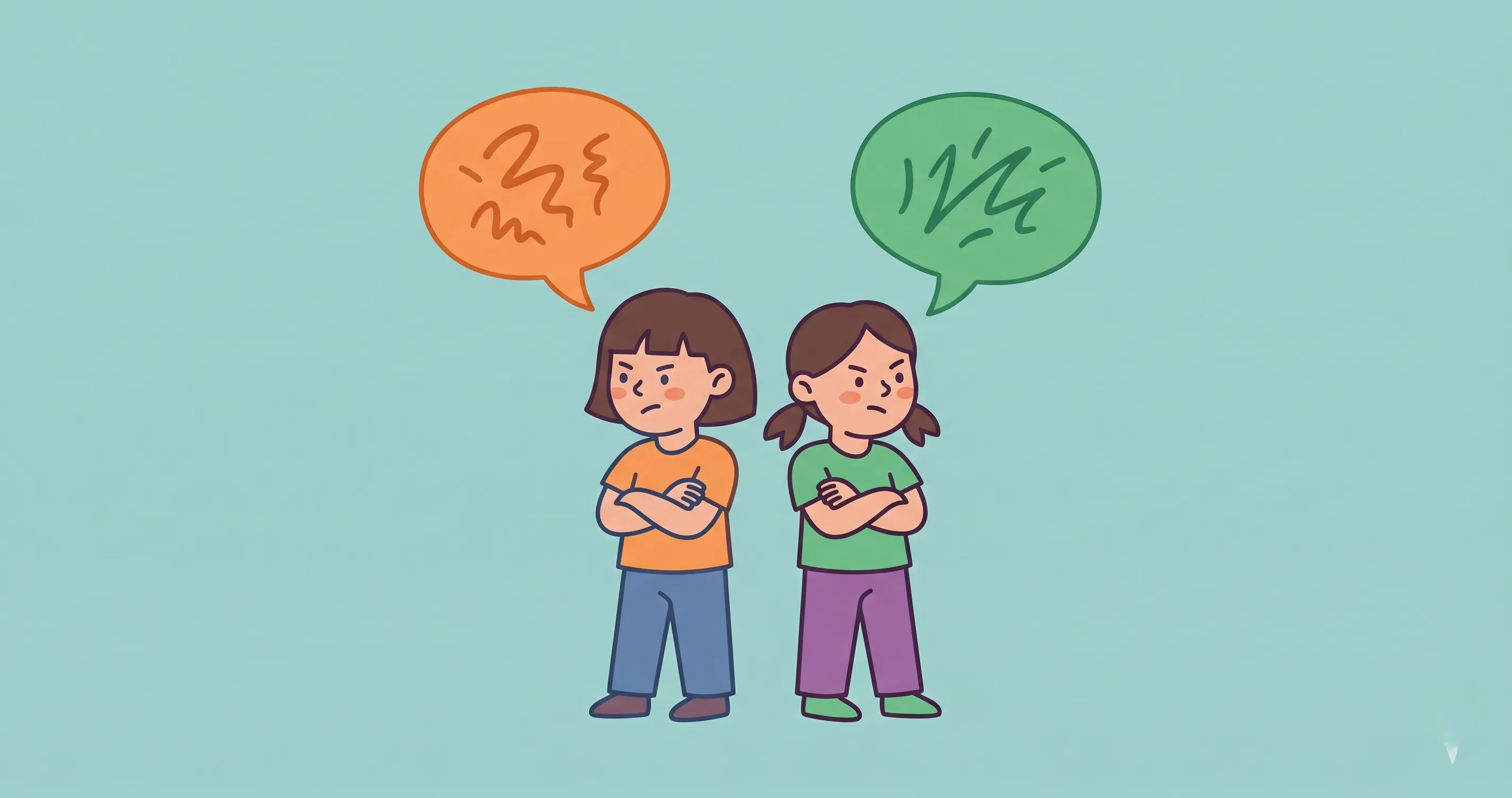
If you have more than one child, you already know the soundtrack: “She took my turn,” “He’s looking at me,” “That’s not fair.” Sibling rivalry is one of the most universal experiences in family life, and one of the most exhausting. It starts before children can articulate what they want and can persist well into adulthood if the underlying patterns are never addressed.
But here is what most articles leave out: sibling rivalry in children is not a problem to solve. It is a developmental process to manage. The conflict itself is not the enemy. What matters is how your family navigates it — and whether the patterns you establish now teach your children to resolve conflict or to resent each other.
This guide covers the real causes of sibling rivalry, the common mistakes that intensify it, and the long-term sibling rivalry solutions that research actually supports.
What Is Sibling Rivalry?
The sibling rivalry meaning is straightforward: it is the competition, jealousy, and conflict that naturally occurs between brothers and sisters. But reducing it to “kids fighting” misses the deeper picture.
Sibling rivalry is fundamentally about resources. Not toys or screen time — though those are the visible triggers — but parental attention, recognition, and a sense of belonging within the family. Every child is asking the same unspoken question: Am I valued? Do I matter as much as my sibling?
The developmental lens
Developmental psychologists view sibling rivalry as a learning laboratory. Within the safety of the family unit, children practice skills they will need for every relationship they ever have: negotiation, compromise, asserting boundaries, managing frustration, and recovering from conflict. A child who never disagrees with a sibling misses out on this practice entirely.
The American Academy of Pediatrics frames sibling conflict as a normal part of family life and emphasizes that parents play a critical role not in preventing it, but in guiding how it unfolds.
When rivalry crosses a line
Normal sibling rivalry involves bickering, competing for attention, occasional name-calling, and disagreements over fairness. It becomes concerning when it is consistently one-sided, involves physical aggression that leaves marks, results in one child being afraid of another, or causes a child to withdraw socially. The distinction is between conflict — which is healthy — and bullying, which is not.
The Real Causes of Sibling Rivalry
Understanding the causes of sibling rivalry is the first step toward managing it. Most parents focus on the surface triggers — who had the toy first, whose turn it is — but the real drivers run deeper.
Competition for parental attention
This is the single biggest driver. Children are biologically wired to secure attachment with their caregivers. When a sibling appears to receive more attention — whether through praise, time, or responsiveness — the other child experiences a genuine threat to their sense of security. This is not manipulation. It is survival instinct operating in a domestic context.
Temperament mismatch
Some sibling pairs are simply wired differently. One child is introverted and needs quiet; the other is high-energy and needs stimulation. One processes emotions slowly; the other reacts instantly. These temperament differences create friction not because either child is wrong, but because their needs directly conflict in shared spaces.
Developmental stage collisions
A 4-year-old who is learning to share and a 7-year-old who values ownership are going to clash. Not because of personality, but because they are in fundamentally different developmental stages with different cognitive capacities. The younger child does not fully understand taking turns. The older child does not understand why their sibling keeps grabbing things. Both feel wronged.
Perceived unfairness
Children are extraordinarily sensitive to perceived inequality. If one child gets a later bedtime, a bigger portion, or more screen time, the other child notices — even when the difference is justified by age or need. The perception of unfairness triggers rivalry more reliably than any other factor.
External stressors
Family transitions — a new baby, a move, a divorce, financial stress, or a parent starting a demanding job — amplify sibling rivalry because they reduce the total pool of parental attention available. When resources feel scarce, competition intensifies.
5 Things Parents Do That Make Rivalry Worse
Most parents do not realize they are fueling the fire. These five patterns are extremely common, well-intentioned, and consistently counterproductive.
1. Comparing siblings
“Why can’t you be more like your sister?” This is the single most damaging sentence in sibling rivalry dynamics. Even positive comparisons (“You’re the responsible one”) create a zero-sum framing where one child’s strength implies the other’s weakness. Every comparison, no matter how casual, teaches children that they are in competition with their sibling for your approval.
2. Assigning fixed roles
“The smart one,” “the athletic one,” “the creative one,” “the difficult one.” Role labels feel efficient because they help parents make sense of their children’s differences. But they box children into identities that limit growth and pit siblings against each other. If one child is “the artist,” the other child may feel they are not allowed to be creative — and resents the sibling who holds that role.
3. Intervening too quickly
When parents jump in to resolve every disagreement, children never develop the skills to resolve conflicts themselves. Worse, the child who gets the favorable ruling learns to involve the parent as a strategy, while the other child learns to resent parental involvement. Refereeing every dispute keeps rivalry alive because it keeps the parent at the center of the dynamic.
4. Punishing both children equally
“I don’t care who started it — you’re both grounded.” This feels fair but teaches children that the outcome is the same regardless of their behavior. The child who was defending themselves feels the injustice acutely and blames the sibling, not the parent. Equal punishment for unequal situations breeds resentment.
5. Inconsistent rules across siblings
When one child has different screen time rules, bedtime expectations, or chore responsibilities without a clear, communicated reason, the other child interprets the inconsistency as favoritism. The rules themselves are less important than whether children understand why they differ.
How Age Gap Affects Sibling Dynamics
The sibling rivalry age gap is one of the most searched aspects of this topic, and for good reason. The spacing between children significantly shapes the nature and intensity of their rivalry.
Close spacing (1–2 years apart)
Siblings close in age tend to compete more intensely because they share developmental stages, interests, and peer groups. They are often compared more directly by teachers, coaches, and extended family. The upside is that closely spaced siblings frequently develop strong bonds once the competitive phase peaks (usually around ages 8 to 12) and subsides.
Medium spacing (3–4 years apart)
This gap is often cited as ideal by parenting experts because the older child has enough developmental distance to feel secure in their role while still being close enough in age to play together. Rivalry still occurs, but it tends to be less intense because the children are not directly competing for the same milestones. The older child may also take on a mentoring role, which can be healthy when it is voluntary rather than expected.
Wide spacing (5+ years apart)
Widely spaced siblings experience less direct rivalry because they occupy such different developmental worlds. A 12-year-old and a 5-year-old are unlikely to compete for the same toy. However, the older child may feel displaced when the younger sibling demands more parental attention, and the younger child may feel they can never catch up. The rivalry here is less about direct competition and more about perceived shifts in family attention.
| Age Gap | Rivalry Intensity | Common Pattern | What Helps |
|---|---|---|---|
| 1–2 years | High | Direct competition for same resources | Separate activities; avoid direct comparison |
| 3–4 years | Moderate | Older child feels dethroned | Give older child special responsibilities (voluntarily) |
| 5+ years | Lower but deeper | Attention imbalance; different worlds | One-on-one time with each child; acknowledge the gap openly |
Strategies That Actually Reduce Rivalry
The sibling rivalry solutions that work long-term are not about stopping fights in the moment. They are about changing the family environment so that competition for parental attention becomes less urgent.
Strategy 1: Schedule one-on-one time with each child
This is the single most effective intervention, and the research is clear on it. When each child gets dedicated, uninterrupted time with a parent — even 15 minutes a day — their need to compete for attention drops significantly. The key is consistency. Sporadic one-on-one time does not have the same effect as a predictable routine that each child can count on.
Strategy 2: Describe what you see instead of judging
When conflict erupts, resist the urge to assign blame. Instead, narrate what you observe: “I see two kids who both want the same toy and are feeling frustrated.” This acknowledges both children’s feelings without taking sides and models the co-regulation approach that helps children learn to manage their own emotions.
Strategy 3: Let them solve it (when safe)
Unless a conflict involves physical aggression or a significant power imbalance, give your children the space to work it out. You can stay nearby, but resist jumping in. Children who regularly practice resolving their own disputes develop stronger conflict-resolution skills than children whose parents always intervene. The messiness of the process is the point.
Strategy 4: Celebrate individual strengths without comparison
Praise each child for their own qualities without referencing the other. Not “You’re so patient, unlike your brother,” but simply “I noticed you waited really calmly for your turn. That takes patience.” This builds each child’s identity independently rather than in opposition to their sibling.
Strategy 5: Create cooperative experiences
Siblings who share positive experiences together develop stronger bonds. Cooking a meal together, building something, completing a puzzle, or working toward a shared family goal gives children a context where they are on the same team rather than opposing sides. Our family activity ideas by age can help you pick something that works for siblings at different stages. The more cooperative memories they build, the less their default is competition.
Strategy 6: Acknowledge jealousy without dismissing it
When a child says “You love her more,” the instinct is to deny it immediately: “That’s not true, I love you both equally.” But the child does not feel heard. A more effective response: “It sounds like you’re feeling left out right now. Tell me more about what’s going on.” Validating the emotion — without agreeing with the conclusion — reduces the intensity far more than denial does.
Fair vs Equal: The Conversation Every Family Needs
“It’s not fair!” is the battle cry of sibling rivalry. And in most cases, the child is not wrong — things are unequal. The older child gets a later bedtime. The younger child gets more help with homework. One child has a medical need that requires more parental attention. These differences are real, and pretending they do not exist makes rivalry worse.
Why equal treatment backfires
Parents often try to solve rivalry by making everything identical: same bedtime, same portion sizes, same number of presents at birthdays. But equal treatment ignores that children have different needs. A 10-year-old does not need the same bedtime as a 6-year-old. A child who is struggling in school needs more homework help than one who is thriving. Forcing equality creates new unfairness.
How to explain fairness to children
The conversation sounds something like this: “Fair means everyone gets what they need, not that everyone gets the same thing. Your sister needs glasses because her eyes work differently. You don’t need glasses, so you don’t get them — but you get what you need.”
This concept is difficult for children under 7 to fully grasp, but introducing it early and reinforcing it consistently lays the groundwork. By age 8 or 9, most children can understand that different needs require different responses — and that different does not mean less loved.
Applying it to everyday friction points
- Screen time: “Your brother is older, so his screen time limit is different from yours. When you are his age, yours will adjust too.”
- Bedtime: “Your body needs more sleep right now because you’re growing faster. This is about your health, not about punishment.”
- Attention: “I spent more time helping your sister with her project today. Tomorrow evening is our time together — just you and me.”
- Privileges: “Walking to the park alone is something you earn when you show you’re ready. Your sister proved she was ready last year. Let’s talk about what readiness looks like for you.”
Screen Time and Sibling Rivalry: The Modern Trigger
Screen time has become one of the most common flashpoints for sibling rivalry in children. Who gets the iPad first. Why one child has more screen time than the other. Why the older sibling is allowed to play a game the younger one cannot. These are daily conflicts in millions of households, and they activate every rivalry trigger at once: perceived unfairness, competition for resources, and different rules for different children.
Why screens amplify rivalry
Unlike a board game or an outdoor activity, screen time is often a solo experience. This means it creates a visible divide — one child is on a screen while the other is not. The child who is off-screen watches the other child enjoying something desirable and perceives a clear imbalance. Screens also have a scarcity quality: there is usually one tablet, one TV, or one gaming console, which forces direct competition.
The dopamine element matters too. Children who are deeply engaged with a screen resist sharing or transitioning more intensely than children engaged with a physical toy. When screen time ends and a sibling’s does not, the neurological drop in reward chemicals makes the inequity feel even more acute. This is why screen-related sibling fights tend to be louder and more emotional than conflicts over other resources.
How screen time rules interact with rivalry
Different screen time allowances for different-aged children are developmentally appropriate. But without clear communication, they become the number-one “it’s not fair” complaint. A 6-year-old watching their 10-year-old sibling play for an extra 30 minutes does not care about developmental appropriateness. They care about the visible gap between their experience and their sibling’s.
The solution is not to give both children the same screen time. It is to make the reasoning visible and the system transparent. When screen time causes family arguments, the root issue is rarely the screen time itself — it is the perceived unfairness of how it is distributed.
Building a system that feels fair to everyone
Three principles reduce screen-time-related rivalry:
- Earn-based allocation. When each child earns their own screen time through tasks, focus sessions, or responsibilities, the difference in screen time feels earned rather than imposed. A child who sees their sibling with more screen time because that sibling completed more tasks perceives the system as fair — even if the outcome is unequal.
- Visible tracking. When screen time balances are visible to everyone — not hidden in a parent’s head or on a locked phone — children trust the system. Transparency reduces suspicion and “you always give her more” accusations.
- Shared screen time as a reward. Building in cooperative screen experiences — a family movie, a two-player game, a co-op gaming session — gives siblings positive screen-related memories together instead of only competitive ones.