
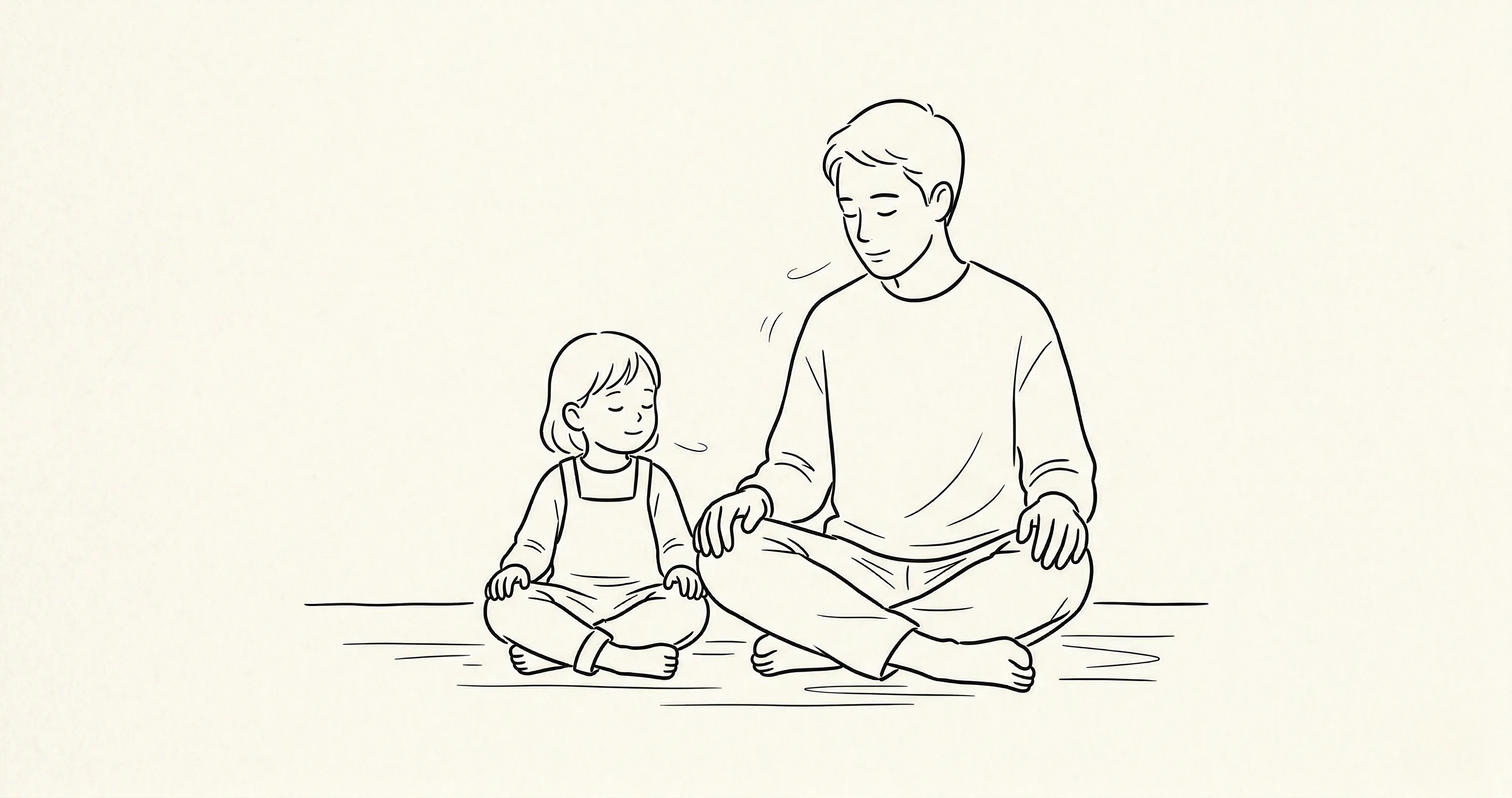
Your child is on the kitchen floor, screaming because the banana broke in half. You know it is not about the banana. But in that moment, every rational thought about child development evaporates and all you want is for the noise to stop. This is exactly where co-regulation parenting begins — not with a perfect response, but with the decision to be present instead of reactive.
Co regulation for parents is one of those concepts that sounds clinical until you see it in action. It is simply this: your child cannot manage their big emotions alone yet, so they borrow your calm to find their own. That borrowing is not weakness or dependence. It is how the human brain is wired to develop emotional skills, one steady interaction at a time.
What Is Co-Regulation in Parenting?
If you have ever searched what is co-regulation in parenting, you have probably found definitions wrapped in neuroscience jargon. Here is the plain version: co-regulation is what happens when a calm person helps an overwhelmed person settle down. Between a parent and child, it means using your voice, body language, and presence to signal safety so your child’s nervous system can shift out of alarm mode.
Picture two tuning forks. Strike one and hold it near the other — the second starts vibrating at the same frequency. Children’s nervous systems work the same way. When you are tense and reactive, their stress escalates. When you are grounded, their system gradually mirrors yours. This is not a metaphor. It is how mirror neurons and the autonomic nervous system function during close-proximity emotional exchanges.
Co-regulation is not fixing the problem
A common misunderstanding is that co-regulation means solving whatever caused the meltdown. It does not. The broken banana is still broken. The lost toy is still lost. Co-regulation addresses the emotional state, not the trigger. You are not there to make the situation better. You are there to help your child get to a place where they can think clearly enough to handle it — or accept that some things cannot be fixed.
Why it matters more than discipline in the moment
When a child is in full fight-or-flight mode, the prefrontal cortex — the part of the brain responsible for reasoning, listening, and learning — goes offline. This is why kids literally cannot listen during a meltdown. Lectures, consequences, and logical explanations are invisible to a brain in survival mode. Co-regulation brings the thinking brain back online first. Then the teaching moment can happen.
Why Kids Cannot Calm Down on Their Own Yet
The phrase “just calm down” is one of the most well-intentioned and least effective things a parent can say. It assumes a capability that children’s brains have not developed yet. Understanding why is the foundation of every co regulation strategy for parents.
The prefrontal cortex timeline
Self-regulation depends on the prefrontal cortex, which does not fully mature until the mid-twenties. In young children, this region is barely operational during stress. A three-year-old melting down over a broken cracker has the same neurological capacity to “just calm down” as you have to lower your heart rate on command during a car accident. The hardware is not there yet.
Between ages 3 and 7, the prefrontal cortex develops rapidly but is easily overwhelmed. Between 8 and 12, children start managing low-intensity frustrations independently. Teens have more capacity but still get hijacked by strong emotions — especially under social pressure or fatigue. At every stage, co-regulation fills the gap between what the child feels and what their brain can handle.
Stress responses are automatic, not chosen
When your child flips into a tantrum, they are not choosing to be difficult. Their amygdala — the brain’s alarm system — has detected a threat (even if the threat is a broken banana) and triggered a survival response. Fight, flight, or freeze. This response is automatic and happens faster than conscious thought. Telling a child to stop it is like telling someone to stop sneezing mid-sneeze.
This is where you come in. Your calm presence acts as an external regulator. Your steady breathing, low voice, and relaxed posture send signals through your child’s nervous system that say: the threat is not real. You are safe. You can come back down.
The “borrowing” concept
Developmental psychologists describe co-regulation as the child “borrowing” the parent’s regulatory system. Over hundreds of repetitions, the child begins to internalize what they have been borrowing. The calm they received from you becomes a calm they can generate on their own. This is the biological pathway from co-regulation to self-regulation — and there are no shortcuts through it.
Co-Regulation Strategies for Parents During Meltdowns
Theory is useful. But when your child is screaming in the cereal aisle, you need co regulation techniques for kids that work in the moment. These co regulation strategies for parents are listed in order of priority — start with the first one and add more as you have capacity.
Strategy 1: Regulate yourself first
You cannot co-regulate from a dysregulated state. Before you do anything for your child, notice your own body. Is your jaw clenched? Are your shoulders up by your ears? Is your breathing shallow? Take three slow breaths. Drop your shoulders. Unclench your hands. This is not selfish — it is the prerequisite. You are the tuning fork. If you are vibrating with anxiety, your child will match it.
Strategy 2: Get low and get close
Physical positioning matters more than words. Kneel or sit so you are at your child’s eye level. Move closer if they will allow it. This signals safety. Standing over a screaming child while telling them to calm down sends the opposite signal — it reads as dominance, which escalates the threat response.
Strategy 3: Use fewer words, spoken slowly
During a meltdown, your child’s auditory processing is compromised. Long explanations are noise. Short phrases, spoken slowly, in a lower pitch than your normal voice, are what gets through. “I am here.” “You are safe.” “I can see this is hard.” That is enough. Save the conversation for after the storm passes.
Strategy 4: Offer presence, not solutions
The instinct to fix is strong. Resist it during the peak. “Do you want me to get you a new banana?” sounds helpful, but it asks a dysregulated brain to make a decision — which adds cognitive load to an already overloaded system. Instead, just be there. Sit beside them. Wait. The meltdown has a biological arc, and your calm presence shortens it.
Strategy 5: Match energy down, not up
If your child is at a 10, do not meet them at 10 and do not drop straight to a 1. Aim for a 6 or 7 — close enough that they feel understood, but calm enough to pull them in your direction. A quiet “wow, that is really upsetting” acknowledges the intensity without amplifying it. Over the next few minutes, gradually lower your energy further. They will follow.
Co-Regulation Activities for Everyday Practice
The biggest mistake parents make with co-regulation is only attempting it during a crisis. Meltdowns are the final exam. You need practice during the easy moments so the skill is available when it counts. These co regulation activities for kids build the connection and neural pathways when the stakes are low.
Breathing games
Make deep breathing playful. “Smell the flower, blow out the candle” for younger children. Box breathing (inhale 4 counts, hold 4, exhale 4, hold 4) for older kids. The key is doing it together, not instructing them to do it alone. When you breathe alongside your child, they feel the rhythm in your body and match it unconsciously.
Parallel quiet time
Sit together and do calm activities side by side — drawing, building with blocks, reading separate books in the same room. This teaches children that being calm together is a normal state, not just something that happens after a meltdown. It also gives them a reference point: “Remember when we sat and drew together? That feeling is what we are trying to get back to.”
Narrate your own emotions out loud
Say what you are feeling and what you are doing about it. “I am feeling frustrated because I cannot find my keys. I am going to take a deep breath and think about where I last had them.” This is not performance. It is modeling. Children learn emotional regulation primarily by watching the adults around them do it in real time.
Physical co-regulation
Rocking in a chair together. Gentle back rubs. Walking at a slow pace side by side. Rhythmic physical movement regulates the nervous system directly. For children who resist verbal engagement during stress, physical co-regulation is often the most accessible entry point.
Connection rituals before transitions
Transitions are the most common meltdown trigger for young children. A brief co-regulation moment before a transition — a hug, a shared deep breath, a quiet countdown — primes the nervous system for change. This is especially useful before screen time ends, before leaving a friend’s house, or before bedtime.
What Co-Regulation Looks Like at Different Ages
Co-regulation is not one technique applied identically from toddlerhood to teenagehood. The principle stays constant — lend your calm — but the delivery changes as your child’s brain and social world evolve.
| Age | What They Need | What It Looks Like |
|---|---|---|
| 1–3 years | Physical closeness, rhythmic soothing | Holding, rocking, humming, gentle narration (“You are sad. I am here.”) |
| 4–6 years | Validation + simple choices | Getting low, naming emotions, offering two options after the peak passes |
| 7–10 years | Acknowledgment + space | Sitting nearby, letting them process, checking in with “I am here when you are ready” |
| 11–14 years | Respect + availability | Staying calm during pushback, not taking bait, circling back after cooling |
| 15+ years | Presence without pressure | Being available without hovering, listening more than advising |
Toddlers: mostly physical
For children under 3, co-regulation is almost entirely physical. Words are secondary. Holding, rocking, skin-to-skin contact, and a calm voice are the primary tools. A toddler does not need you to explain why they are upset. They need to feel your heartbeat slow down next to theirs.
Preschool and early school age: the narration window
Between 4 and 10, children begin understanding their emotions when someone helps name what is happening. “It looks like you are really frustrated that the tower fell.” This is not telling them how to feel. It is giving language to an experience they do not have words for yet. Emotion naming, paired with a calm presence, is one of the most effective gentle parenting tools in this age range.
Tweens and teens: the art of not fixing
Older children and teenagers often resist the physical closeness that worked when they were younger. Co-regulation at this stage means staying emotionally available without being intrusive. It means not reacting when they say something hurtful during a high-emotion moment. It means circling back an hour later with “That seemed really hard. Want to talk about it?” The biggest co-regulation mistake parents make with teens is trying to solve the problem before the teen feels heard.
When You Cannot Stay Calm: Repair After You React
Here is the truth that every article about co-regulation parenting should say upfront: you will lose your calm. Regularly. You will yell when you meant to whisper. You will slam a door when you meant to take a breath. You will say something you regret while your child is mid-meltdown. This does not make you a failure at co-regulation. It makes you a human being with your own nervous system.
Why repair matters more than perfection
Research on attachment shows that what matters most is not whether ruptures happen — it is whether they are repaired. A parent who loses their temper and then comes back to say “I yelled, and I should not have. I was feeling overwhelmed. I am sorry” is actually teaching their child something more valuable than a parent who never loses control. They are teaching that emotions are recoverable. That relationships survive conflict. That adults make mistakes and take responsibility.
The repair process
- Calm yourself first. You cannot repair while you are still activated. Take whatever time you need — five minutes, an hour, whatever it takes.
- Go back to your child. Do not wait for them to come to you. You are the adult. You initiate.
- Name what happened without excuses. “I raised my voice. That was not okay.” Not “I raised my voice because you were not listening.”
- Acknowledge the impact. “That probably felt scary” or “I do not want you to feel like my anger is your fault.”
- Reconnect. A hug, a quiet activity together, or simply being in the same room. The goal is re-establishing safety.
Your own regulation toolkit
You need your own co-regulation strategies — adult versions. A partner, a friend, a therapist. Physical exercise. A moment alone in the car before walking into the house. Co-regulation flows downhill: someone has to be the calmest person in the room, and that person is you. But you cannot pour from an empty cup. Building your own regulation capacity is not optional — it is the foundation of everything described in this article.
Co-Regulation vs Self-Regulation: The Development Path
Parents sometimes worry that co-regulation creates dependence. If I always help them calm down, will they ever learn to do it themselves? The answer from developmental science is clear: co-regulation is the pathway to self-regulation, not a barrier to it.
The developmental sequence
Self-regulation does not appear spontaneously. It develops in a predictable sequence:
- External regulation — the parent manages the child’s emotional state entirely (infancy)
- Co-regulation — the parent and child manage the emotional state together, with the parent doing most of the work (toddler through early childhood)
- Guided self-regulation — the child begins managing on their own with the parent as backup (middle childhood)
- Independent self-regulation — the child manages their emotions autonomously most of the time (adolescence and beyond)
Skipping co-regulation does not accelerate this timeline. It stalls it. Children who are told to “figure it out” before they have the neural architecture to do so learn to suppress emotions rather than regulate them. Suppression looks like self-control on the outside, but it leads to anxiety, emotional numbness, or explosive outbursts later.
What the bridge looks like in practice
The transition from co-regulation to self-regulation happens gradually, in small moments you might not even notice. Your six-year-old takes a deep breath before asking for help instead of screaming. Your nine-year-old walks away from a frustrating game and comes back when they are ready. Your twelve-year-old says “I need a minute” instead of slamming a door. Each of these is a moment where the co-regulation you have been providing for years shows up as a skill they now own.
Applying co-regulation principles beyond meltdowns
The same philosophy extends to everyday challenges like building self-control around screen time. When parents and children set goals together rather than imposing rules from above, they are practicing co-regulation in a different domain. Timily’s Weekly Focus Challenges work on this principle — parent and child choose a goal together, the child works toward it with support, and the accomplishment belongs to the child. It is the same “borrowing calm” concept applied to daily habits instead of crisis moments.
The long view
Every time you co-regulate with your child, you are making a deposit into their future self-regulation account. The three-year-old who needs you to hold them through every tantrum becomes the eight-year-old who takes a deep breath on their own. The eight-year-old becomes the teenager who can name their emotions and ask for help. The teenager becomes the adult who can sit with discomfort without being destroyed by it. That is the arc. And it starts with you, sitting on the kitchen floor next to a child who is crying about a banana, choosing to breathe instead of react.