
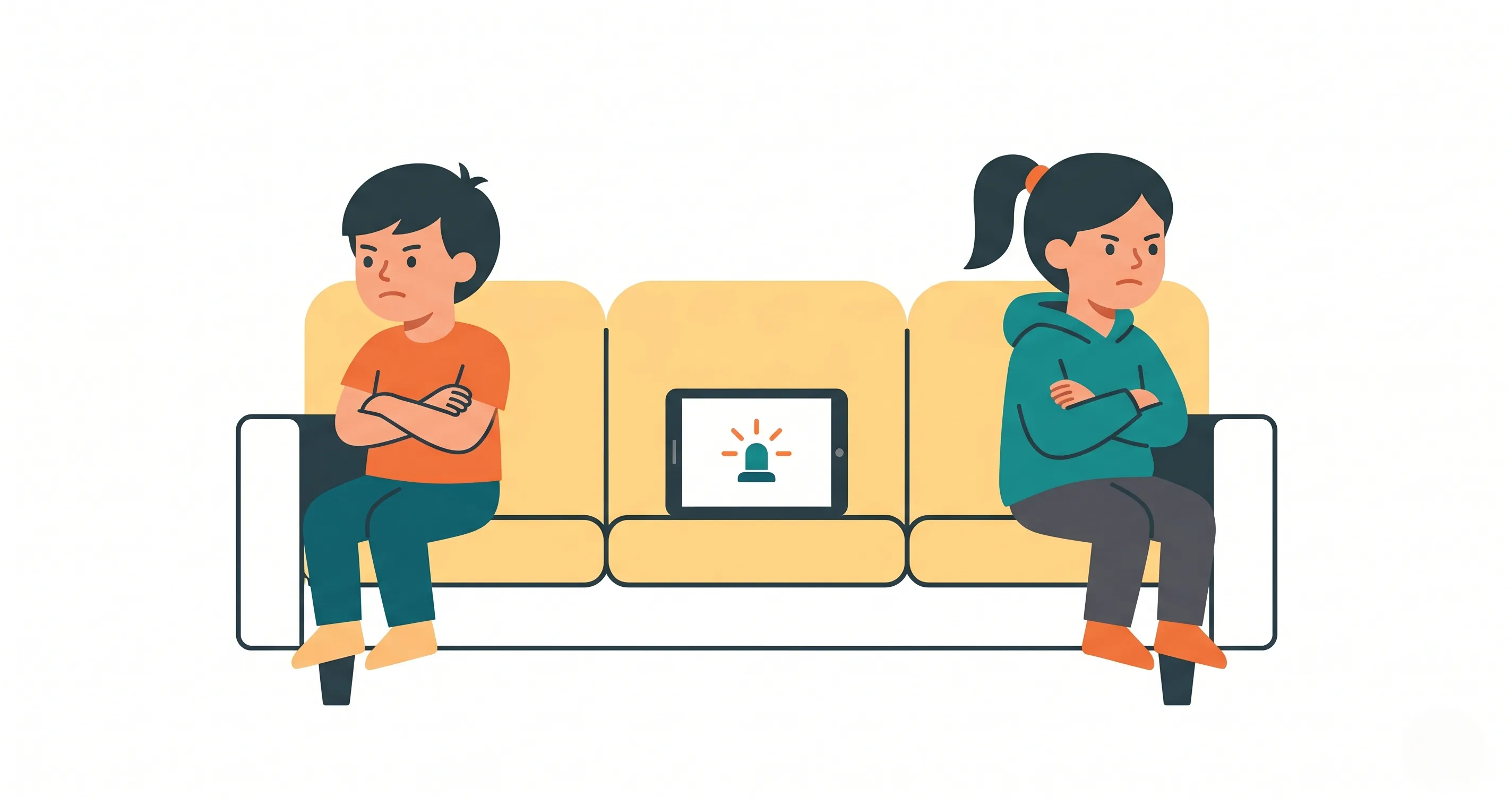
Sibling fighting is one of the most universal parenting experiences — and one of the most exhausting. Your kids are fighting constantly over toys, turns, attention, and especially screens. The yelling from the other room. The “he started it.” The tears that seem to come from nowhere. If this is your daily reality, you are not failing as a parent. You are raising siblings.
But here is what most parenting advice gets wrong about sibling fighting: the goal is not to stop it entirely. The goal is to understand why it happens, know when to step in, and build a family system that makes the fights less frequent and less intense. This guide covers all of it — from the science behind why siblings fight to the exact scripts you can use in the moment.
Is Sibling Fighting Normal?
Yes. And not just normal — expected. Research from the University of Illinois found that siblings between ages 3 and 7 have an average of 3.5 conflicts per hour when they are together. That is not a sign of dysfunction. That is child development in action.
Sibling conflict is one of the primary ways children learn negotiation, compromise, perspective-taking, and emotional regulation. Unlike conflicts with peers (where a child can simply walk away or end the friendship), sibling relationships are permanent. Children cannot “unfriend” a brother or sister. This permanence creates a unique training ground: siblings must figure out how to coexist, which forces them to develop social skills they will use for the rest of their lives.
When it crosses the line
Normal sibling fighting looks like bickering, arguing over whose turn it is, complaining that something is unfair, or brief shoving matches that resolve quickly. What is not normal:
- Sustained physical aggression — hitting, kicking, or hurting that goes beyond a momentary push
- Emotional cruelty — deliberate name-calling, humiliation, or exclusion designed to wound
- Power imbalance — one child consistently dominating, controlling, or intimidating the other
- Fear — one child is genuinely afraid of their sibling
If you are seeing these patterns consistently, it is worth talking to your pediatrician or a family therapist. But for the vast majority of families, siblings fighting is a normal, manageable part of raising more than one child.
The Top Triggers (Screen Time Is #1)
Understanding what triggers sibling fighting is the first step toward reducing it. While every family is different, certain triggers show up consistently across research and clinical practice.
1. Screen time and devices
Sibling fighting over screen time has become the single most common trigger in modern families. Devices are a scarce, high-dopamine resource. When two children want the same tablet, or when one child’s screen time ends while the other’s continues, the perceived unfairness is explosive. Add in the emotional dysregulation that comes from screen time transitions, and you have a perfect recipe for conflict.
The problem is not screens themselves. The problem is ambiguity. When rules about who gets the device, for how long, and when are unclear or inconsistently enforced, siblings will fight to fill that vacuum. Clear rules eliminate the thing they are actually fighting about: uncertainty.
2. Parental attention
Children are wired to compete for their parents’ attention. This is not selfishness — it is survival instinct. When one child perceives that a sibling is getting more attention (even if the reality is balanced), jealousy drives conflict. This is especially common after a new baby arrives, during homework time when one child needs more help, or when a parent is distracted by work.
3. Boredom and proximity
Siblings who are stuck in the same space with nothing to do will fight. It is almost guaranteed. Unstructured time is healthy in moderation, but extended periods of boredom combined with physical proximity are a recipe for conflict. This is why kids fighting constantly tends to spike during school breaks, rainy weekends, and long car trips.
4. Perceived unfairness
Children have an extremely sensitive radar for unfairness. If one child gets a bigger piece of cake, stays up later, or has fewer chores, the other child will notice — and protest. This is especially intense between siblings close in age, where the developmental gap is small but the privilege gap feels enormous to the younger child.
5. Developmental mismatch
A 5-year-old and a 9-year-old have fundamentally different cognitive abilities, emotional regulation skills, and play styles. The older child gets frustrated because the younger one “ruins” their game. The younger child feels excluded because they cannot keep up. This mismatch is nobody’s fault, but it generates constant friction.
When to Intervene and When to Let Them Work It Out
This is the question every parent of multiple children asks daily: do I step in, or do I let them figure it out? The answer depends on what kind of conflict you are hearing.
Let them work it out when…
- The argument is verbal and both children are roughly equal in power
- No one is being physically hurt or emotionally targeted
- Both children are capable of negotiating (generally age 4+)
- The stakes are low (who gets the blue cup, whose turn it is)
Stepping back in these moments is hard, but it is essential. Every time you solve a conflict for your children, you rob them of the chance to develop the skill themselves. Think of it as letting them lift the weight. You spot them, but you do not lift it for them.
Step in immediately when…
- The conflict becomes physical (beyond a brief push)
- One child is being emotionally cruel or deliberately hurtful
- There is a significant age or power imbalance
- One child is visibly distressed, scared, or shutting down
- The same child is consistently the aggressor or the victim
The coaching approach
When you do step in, resist the urge to play judge. Instead, coach from the sideline. Your job is not to determine who was right. Your job is to help both children name their emotions, hear each other, and find a solution together. This takes longer than issuing a verdict, but it builds skills that last.
The classic parenting move — “Who started it? You’re both in trouble” — teaches children nothing except that fighting leads to punishment for everyone. A coaching approach teaches them that conflict is solvable and that their feelings matter.
What to Say: Parent Scripts for Common Fights
Knowing how to deal with sibling fighting in theory is one thing. Having the right words in the moment is another. Here are scripts for the five most common sibling conflicts.
Fight: “It’s MY turn with the tablet!”
Why it works: It validates both children’s desires, points to an external system (the schedule or timer) as the authority, and removes you from the role of the person who decides. The timer becomes the referee, not you.
Fight: “She got more than me!”
Why it works: It acknowledges the feeling without getting trapped in the measurement game. Teaching children the difference between “equal” and “fair” is one of the most valuable lessons you can give them.
Fight: “He’s looking at me! / She’s in my space!”
Why it works: These fights are rarely about the stated issue. They are about overstimulation, proximity fatigue, or a need for autonomy. Offering space addresses the real need without engaging with the surface complaint.
Fight: “He hit me!” / “She hit me first!”
Why it works: It sets a clear boundary (no hitting), creates a cooling-off period, and defers the problem-solving conversation until everyone is regulated. Trying to resolve a physical conflict while emotions are still running high never works.
Fight: “I don’t want to play with her!”
Why it works: It validates the child’s right to choose their own activities while holding the line on respectful communication. Children need to learn that wanting space is okay — but being cruel about it is not.
How Fair Screen Time Rules Reduce Sibling Conflict
Sibling fighting over screen time is so common that it deserves its own section. In survey after survey, parents rank device-related conflicts as the number one source of sibling tension in their homes. The good news: this is one of the most fixable triggers.
Why screens create so much conflict between siblings
Screens are different from other shared resources because they combine three conflict accelerants:
- High dopamine value — devices are the most rewarding thing in most children’s environment, making them worth fighting over
- Scarcity — most families have fewer devices than children, creating competition
- Transition difficulty — coming off a screen triggers emotional dysregulation, and that frustration often gets redirected at a sibling
When you add ambiguous rules on top of these three factors, conflict is inevitable. “You’ve had enough” feels arbitrary. “Let your sister have a turn” feels unfair if the child does not know when their own turn will come back.
The fix: transparent, individual rules
The most effective approach is giving each child their own screen time balance that they earn independently. This eliminates the zero-sum dynamic that drives most siblings fighting over devices.
- Individual balances — each child earns and tracks their own screen time, so one child’s usage does not affect the other’s
- Visible timers — both children can see exactly how much time they have left, removing the “that’s not fair” argument
- Earn-based system — screen time is earned through tasks, chores, reading, or focus sessions, so the rules feel fair because effort determines outcome
- Clear turn-taking — for shared devices, a posted schedule or timer-based rotation removes parental judgment from the equation
When each child knows exactly how much screen time they have, how they earned it, and when their turn is, there is nothing left to fight about. The ambiguity that fuels the conflict disappears.
Fighting Patterns by Age (4–7, 8–12, Teens)
Sibling conflict looks different at every developmental stage. Understanding what is typical for your child’s age helps you calibrate your expectations and your response.
Ages 4–7: The physical years
At this age, sibling fights tend to be physical, frequent, and short-lived. Children in this range have limited verbal skills for expressing frustration, so they default to grabbing, pushing, and shouting. Conflicts center on concrete issues: toys, turns, food portions, and who sits where.
What helps:
- Teach feeling words: “You are frustrated because…”
- Use visual timers for turn-taking
- Keep shared play sessions short (20–30 minutes) before offering a break
- Praise cooperation when you see it — catch them being kind
Ages 8–12: The fairness obsession
School-age children develop an intense sense of justice. Fights shift from physical to verbal and center on perceived unfairness: who has more screen time, who has fewer chores, who gets to stay up later. The phrase “that’s not fair” becomes a daily fixture.
What helps:
- Involve children in creating family rules so they feel ownership
- Use transparent systems (charts, apps, posted schedules) so rules are visible
- Acknowledge that “fair” does not mean “equal” — a 10-year-old’s bedtime is later than a 7-year-old’s, and that is appropriate
- Give each child individual time with you — even 10 minutes of undivided attention reduces competition
Teens: The emotional distance
Teenage sibling conflict looks different. Physical fights become rarer, but emotional conflicts intensify. Teens may use words as weapons, engage in deliberate exclusion, or simply withdraw from the sibling relationship entirely. Privacy becomes a major flashpoint — a younger sibling entering a teen’s room without permission can trigger an outsized reaction.
What helps:
- Respect privacy boundaries — teach the younger child to knock and wait
- Do not force togetherness — teens need space, and that is healthy
- Address unkind words directly: “You can be frustrated with your brother, but calling him stupid is not okay in this family”
- Create low-pressure shared experiences (family dinners, car rides, movie nights) where connection happens naturally without being forced
| Age | Typical Conflicts | Parent Role | Key Strategy |
|---|---|---|---|
| 4–7 | Physical (grabbing, pushing), turns, toys | Active supervisor | Teach feeling words, visual timers |
| 8–12 | Fairness arguments, screen time, privileges | Coach & rule co-creator | Transparent systems, individual attention |
| Teens | Emotional, privacy, withdrawal | Boundary setter & connector | Respect privacy, low-pressure connection |
Building a Sibling Relationship That Lasts
The fighting will not last forever. But the relationship will. Research consistently shows that the sibling relationship is the longest relationship most people will ever have — outlasting friendships, marriages, and even the parent-child bond in terms of duration. What you do now, in the middle of the daily squabbles, shapes whether your children will be close as adults.
Focus on the repair, not just the fight
The most important part of any sibling conflict is not the conflict itself — it is what happens afterward. Teaching children to apologize, to check in on each other after a fight, and to reconnect is more valuable than preventing the fight in the first place. A family where conflicts happen but are consistently repaired produces children with stronger relationship skills than a family where conflict is suppressed.
Create shared positive experiences
Siblings who have a bank of positive shared memories are more resilient to conflict. Family traditions, inside jokes, collaborative projects, and shared adventures all build what researchers call the “positive sentiment override” — a baseline of goodwill that helps siblings bounce back from fights faster.
This does not have to be elaborate. Cooking dinner together, building a fort, or a weekly family game night all count. The key is consistency and shared joy.
Avoid comparison
Nothing fuels sibling rivalry faster than comparison. “Why can’t you be more like your sister?” is one of the most damaging sentences a parent can say. It pits children against each other and teaches them that they are in competition for your approval. Instead, celebrate each child’s individual strengths without ranking them against their sibling.
Protect one-on-one time
Children who get regular individual time with a parent fight less with their siblings. This is one of the best-established findings in family psychology. Even 10 to 15 minutes of undivided, phone-free attention per child per day significantly reduces the competition for attention that drives so much sibling conflict.
Trust the process
The American Academy of Pediatrics notes that sibling conflict typically peaks between ages 6 and 8 and gradually decreases through adolescence. If you are in the thick of it right now, know that it gets better. Your children are not broken. They are practicing the hardest skills humans ever learn — how to live closely with someone you love but sometimes cannot stand.
The families that come through this stage with the strongest sibling bonds are not the ones who eliminated fighting. They are the ones who taught their children that conflict is normal, repair is essential, and fairness is worth building systems around. That is the work. And it is worth it.