
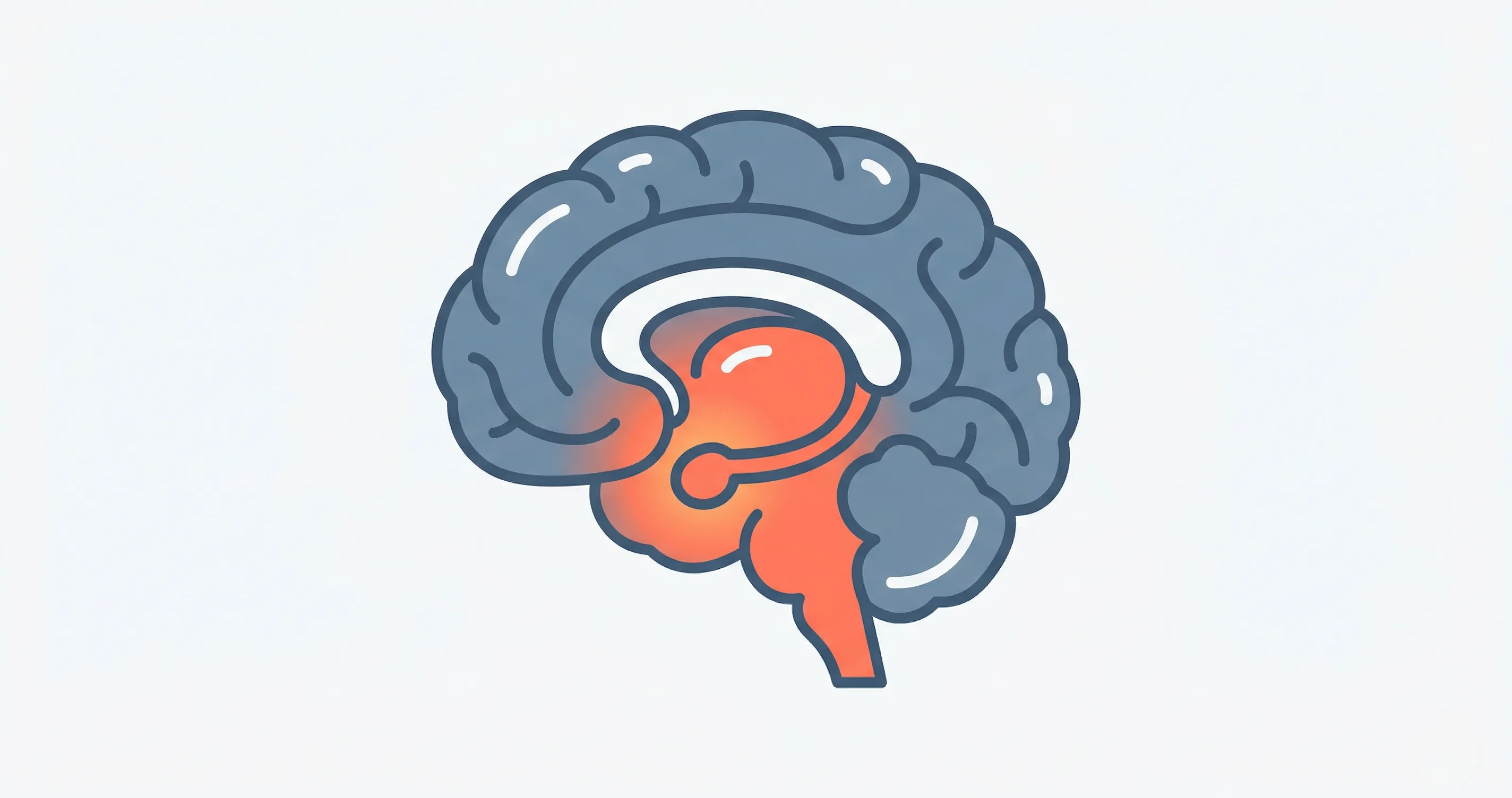
Your child is on the floor, screaming. You kneel down and try to explain why they need to stop. You use your most reasonable voice. You lay out the logic. And nothing gets through. It is like talking to a wall — except the wall is sobbing. If you have ever wondered why kids can't listen during a meltdown, the answer is not about willpower, defiance, or bad parenting. It is about neuroscience. Their brain has temporarily rewired itself for survival, and your perfectly reasonable words cannot reach them until it switches back.
This article explains what happens in a child's brain during a meltdown, why your instinct to reason with them backfires, and what actually works instead. This is the "why" behind the behavior. For the full discipline framework, see our guide on gentle parenting and discipline. For hands-on co-regulation techniques, see co-regulation parenting.
What Happens in a Child's Brain During a Meltdown
To understand why a child won't listen during a tantrum, you need to understand two parts of the brain and how they interact under stress.
The prefrontal cortex: the thinking brain
The prefrontal cortex sits behind the forehead and handles everything we associate with rational behavior: language processing, logical reasoning, impulse control, emotional regulation, and decision-making. When you ask your child to "use their words" or "think about what they did," you are asking them to use this part of the brain.
Here is the problem: in children, the prefrontal cortex is still under construction. It does not fully mature until the mid-twenties. In a young child, it is like a building with the scaffolding still up — functional under calm conditions, but fragile under stress.
The amygdala: the alarm system
The amygdala is the brain's threat-detection center. It operates faster than conscious thought. When it perceives danger — or what feels like danger to a child, such as losing a toy, being told no, or an unexpected transition — it triggers the fight-or-flight response. Stress hormones flood the body. Heart rate spikes. Muscles tense. The entire nervous system shifts into survival mode.
The flip: when the thinking brain goes offline
Here is the critical piece. When the amygdala fires at full intensity, it effectively shuts down the prefrontal cortex. Neuroscientists sometimes call this an "amygdala hijack." The brain diverts resources away from reasoning and toward survival. Your child is not choosing to ignore you. Their brain has literally lost access to the part that processes your words.
Dr. Dan Siegel, a clinical professor of psychiatry at UCLA, describes this as "flipping your lid." Imagine a fist with the thumb tucked inside and the fingers wrapped over it. The thumb is the amygdala. The fingers are the prefrontal cortex. During a meltdown, the fingers fly open — the lid flips — and the amygdala is exposed and running the show.
This is not a metaphor for how it feels. Brain imaging studies show reduced prefrontal activity during acute emotional distress in both children and adults. The difference is that adults have decades of neural pathways to fall back on. Children do not.
Why Logic and Reasoning Make Things Worse
Understanding why logic doesn't work during tantrums changes how you respond to them. Most parents default to reasoning because it feels like the responsible thing to do. But during a meltdown, logic is not just ineffective — it actively makes things worse.
Words become noise
When the prefrontal cortex is offline, language processing drops dramatically. Your carefully constructed sentence — "I understand you're upset, but we need to leave the playground because we have a doctor's appointment" — registers as an undifferentiated wall of sound. Your child hears tone, volume, and emotional energy. They do not hear meaning.
Questions increase cognitive load
"Why are you crying?" "What do you need?" "Can you tell me what happened?" These questions require the prefrontal cortex to retrieve information, organize it into language, and deliver a coherent response. During a meltdown, that is like asking someone to solve a math problem while they are being chased by a bear. The brain cannot do both at once.
Lectures signal threat
When you stand over a dysregulated child and explain why their behavior is wrong, your body language and vocal energy register as confrontational to the amygdala. Even when your words are gentle, the upright posture, direct eye contact, and steady stream of language can feel overwhelming to a nervous system already in overdrive. The amygdala reads this as more threat, not less — which keeps the meltdown going longer.
Demands for compliance require executive function
"Stop crying." "Calm down." "Take a deep breath." Each of these instructions requires the child to override their current emotional state using the exact part of the brain that is currently unavailable. Telling a child to calm down during a meltdown is neurologically equivalent to telling someone with a broken leg to walk it off. The tool they need to comply is the tool that is broken.
The Connect-Before-Correct Approach
If logic makes things worse, what brings the brain back online? Connection. This is the foundation of co-regulation — the idea that a calm nervous system can help regulate a dysregulated one.
How connection resets the brain
When a child feels physically and emotionally safe, the amygdala begins to stand down. Cortisol levels drop. The prefrontal cortex gradually comes back online. This does not happen through words. It happens through sensory signals: a warm touch, a low and steady voice, a calm physical presence, predictable breathing.
Research on attachment and emotional regulation consistently shows that children regulate their emotions through their caregivers before they learn to regulate independently. A parent's calm nervous system literally models the state the child's brain is trying to reach. This is not abstract theory. It is measurable: studies using heart-rate monitors show that when a caregiver's heart rate stays steady, the child's heart rate returns to baseline faster.
Why connect-before-correct is not permissive
Some parents worry that comforting a child during a meltdown rewards the behavior. It does not. You are not reinforcing the tantrum. You are helping the brain exit survival mode so that learning can happen afterward. Boundaries and consequences still apply — they just come after the storm, when the prefrontal cortex is back online and the child can actually process them.
Think of it as triage. You do not lecture someone about fire safety while their house is burning. You put out the fire first. Then you talk about prevention. The meltdown is the fire. Connection is the water. The conversation about behavior comes after. For a complete framework on setting boundaries while staying connected, see our guide on gentle parenting and discipline.
What connect-before-correct looks like in practice
- Get low. Kneel or sit so you are at the child's eye level or below. This signals safety, not authority.
- Reduce words. Instead of a paragraph, try a single phrase: "I'm here." "You're safe." "I'm not going anywhere."
- Offer touch if welcome. A hand on the back, an open lap, a gentle hug — if your child does not pull away. Some children need space during a meltdown, and that is okay too.
- Match energy, then lead down. Start with a tone that acknowledges the intensity ("I can see this is really hard"), then gradually slow and soften your voice to model the regulation you want them to reach.
What to Do (and Not Do) During a Meltdown
Knowing the brain science is one thing. Knowing what to actually do when your child is mid-meltdown — in the grocery store, at pickup, right before dinner — is another. Here is a practical breakdown.
What to do
- Stay calm (or fake it). Your child's nervous system is scanning yours for safety cues. If you escalate, they escalate. If you can keep your voice low and your body relaxed, you become the anchor. If you cannot stay genuinely calm, pretend — your body language still sends the right signals.
- Ensure physical safety. If they are hitting, throwing things, or in a dangerous location, gently move them or remove hazards. Do not restrain unless absolutely necessary for safety.
- Validate the emotion, not the behavior. "You are so angry right now" is different from "it is okay to throw things." Naming the emotion helps the brain begin to categorize the experience, which is the first step toward regulation.
- Wait. Most meltdowns have a natural arc: escalation, peak, and gradual wind-down. Trying to short-circuit the process usually extends it. Sometimes the most powerful thing you can do is simply be present and let the wave pass.
- Offer a sensory anchor. A favorite stuffed animal, a blanket, a cold glass of water, or a change of environment (stepping outside) can give the nervous system something concrete to orient around.
What not to do
- Do not lecture. Save the life lesson for later. Right now, the brain cannot absorb it.
- Do not threaten consequences. "If you do not stop, you are losing screen time" requires the child to project into the future, weigh options, and make a rational choice — all prefrontal cortex functions that are currently unavailable.
- Do not demand eye contact. Forced eye contact feels confrontational to a nervous system in fight-or-flight. Let them look away.
- Do not take it personally. "I hate you" from a dysregulated 5-year-old is the amygdala talking, not the child. They do not mean it. They cannot filter it. It will pass.
- Do not compare. "Your sister never acts like this" adds shame to an already overwhelmed system. Shame does not help regulation — it blocks it.
After the Storm: How to Reconnect
The meltdown is over. Your child is sniffling. You are exhausted. Now what? This is when the real work happens — and it is also when most parents either skip ahead too fast or miss the opportunity entirely.
Wait for the window
After a meltdown, there is a quiet window when the child is calm but still emotionally open. This is the ideal time for connection — not immediately, but within the next 15 to 30 minutes. If you wait too long, the moment passes and the child moves on without processing what happened. If you jump in too early, you risk reigniting the stress response.
Reconnect before you redirect
Before talking about what happened or what they should do differently, reconnect physically and emotionally. A hug. A few minutes of quiet together. A glass of water and a snack. This signals that the relationship is intact — that the meltdown did not break anything between you.
Children often feel ashamed after a meltdown, even if they do not have the vocabulary to express it. Reconnection before redirection communicates: "I still love you. We are still okay. Now let us figure out what happened."
Name it to tame it
Once your child is settled, help them narrate the experience. "It seems like you got really frustrated when we had to leave the park. Your body felt so angry that you could not use your words." This technique — sometimes called "name it to tame it" — activates the left hemisphere of the brain (language and logic) and integrates it with the right hemisphere (emotion and sensation). Over time, this builds the neural pathways your child needs to recognize and manage their emotions independently.
Problem-solve together
After the emotion is named, you can collaboratively think about what might help next time. "What could we try when you start feeling that angry?" This is when teaching happens. This is when the prefrontal cortex is online and ready to learn. Not during the meltdown. After it.
Keep the conversation short and concrete. A 4-year-old does not need a ten-minute debrief. A single idea — "next time, you can squeeze my hand when you feel the big feelings starting" — is more than enough.
When Meltdowns Happen Too Often
All children have meltdowns. But if your child is melting down multiple times a day, every day, or if the intensity seems to be increasing rather than decreasing over time, it is worth looking beneath the surface. Frequent meltdowns are rarely about the thing that appears to trigger them. They are usually about something deeper.
Common hidden triggers
- Sleep. This is the single most underestimated factor. A child who is sleeping 30 minutes less than they need will have a measurably lower frustration threshold. Before anything else, audit sleep.
- Hunger and blood sugar. The "hangry" phenomenon is real and amplified in children. Meltdowns that cluster around late morning or late afternoon often have a nutritional component.
- Transitions. Some children struggle with any change in activity, especially when the transition is unexpected. If meltdowns consistently happen at transition points (leaving the house, ending an activity, switching tasks), the issue may be the transition itself, not the destination.
- Sensory overload. Loud environments, scratchy clothing, bright lights, or too many stimuli at once can push a sensitive nervous system past its threshold. Meltdowns that happen in specific environments (grocery stores, birthday parties, after school) may point to sensory overwhelm.
- Unmet emotional needs. A child who is not getting enough one-on-one attention, who is dealing with a new sibling, a move, or parental conflict, may not have the vocabulary to express what they need. The meltdown becomes the only language available.
Track patterns before seeking solutions
Before changing strategies or seeking professional help, spend one to two weeks tracking meltdowns. Note the time, what happened before, what they ate last, how much they slept, and what was going on in the environment. Patterns almost always emerge. Maybe the meltdowns cluster after screen time ends. Maybe they happen every day at 4:30 p.m. Maybe they spike on days with less outdoor play.
Once you see the pattern, you can address the root cause rather than just managing the symptom.
When to talk to a professional
Consider consulting your pediatrician or a child psychologist if:
- Meltdowns are increasing in frequency or intensity after age 5
- Your child cannot recover from a meltdown within 20 to 30 minutes
- Meltdowns involve self-harm or harm to others
- Your child seems to have no awareness of the meltdown afterward
- The meltdowns are significantly affecting school, friendships, or family life
These are not signs of failure. They are signs that your child may need additional support that goes beyond what parenting strategies alone can provide. Early intervention — whether through occupational therapy, behavioral support, or simply a professional assessment — can make a significant difference.