
Your child is on the kitchen floor, screaming. You kneel down and explain, clearly and rationally, why they cannot have another cookie. Nothing happens. Not a flicker of understanding. This is why kids can't listen during a meltdown — and it is not what you think.
You are not doing it wrong. And your child is not choosing to ignore you. The reason kids can’t listen during a meltdown is neurological, not behavioral. Their brain has temporarily shut down the exact circuits that process language, logic, and reason. Understanding what is actually happening inside their head changes everything — not just how you respond in the moment, but how you feel about yourself as a parent while it is happening.
What Happens in a Child’s Brain During a Meltdown
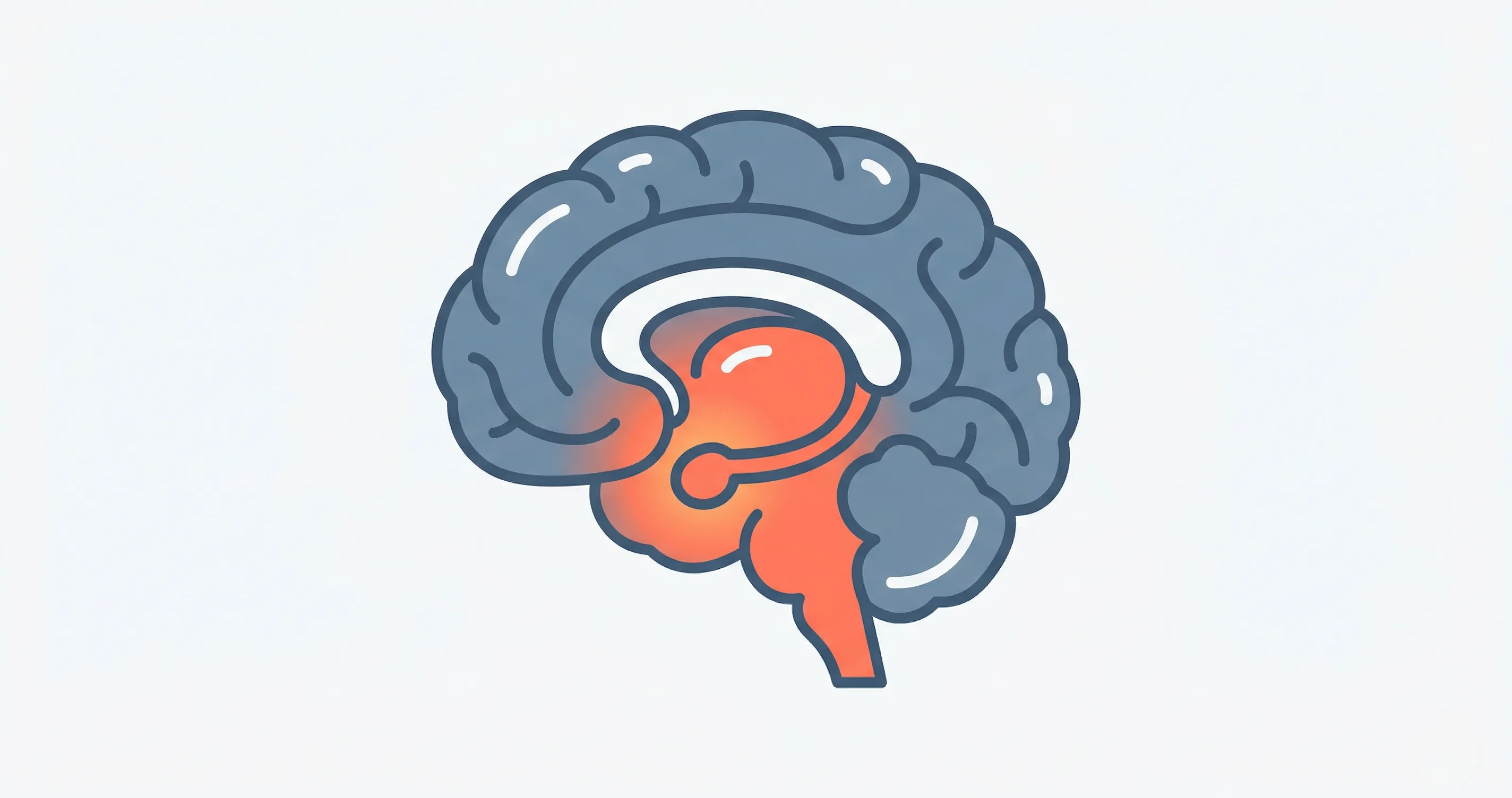
To understand what happens in a child’s brain during a meltdown, picture the brain as a house with two floors. The downstairs brain — the brainstem and limbic system — handles survival instincts and big emotions like fear, anger, and panic. The upstairs brain — the prefrontal cortex — handles everything we think of as “reasonable” behavior: listening, thinking through consequences, controlling impulses, using language to express feelings.
In a calm child, these two floors work together. The downstairs brain sends an emotional signal (“I’m frustrated”), and the upstairs brain processes it (“I’m frustrated, but I can use my words to ask for help”). The connection between the two is like a staircase — information flows up and down.
During a meltdown, that staircase collapses. The downstairs brain floods with stress hormones — cortisol and adrenaline — and essentially locks the upstairs brain out. The prefrontal cortex goes offline. Not dimmed. Not sluggish. Offline.
This is why your child cannot listen when they are in the grip of a tantrum. The part of the brain that processes your words, weighs your logic, and formulates a calm response is temporarily unavailable. It is not a choice. It is neuroscience.
The developmental piece
Here is the part that makes this even harder to accept: the prefrontal cortex is the last part of the brain to fully develop. It is not complete until the mid-twenties. For a three-year-old, the upstairs brain is still under construction. For a six-year-old, it is a little more developed but still wildly inconsistent. This means the staircase between the two floors is not just temporarily blocked during a meltdown — it was never fully built in the first place.
That is not a flaw in your child. It is normal human development. And it is the single biggest reason why kids can’t listen during a meltdown — the hardware they need to process your words is still being installed. Reasoning with a melting-down toddler is like trying to have a logical debate with someone in the middle of a fire alarm.
Why Logic and Reasoning Fail in the Moment
Every parent has tried some version of this: “If you stop crying, we can talk about it.” “You need to calm down so I can help you.” “Use your words.” These are all reasonable requests. And they all fail during a meltdown for the same reason — they are directed at a part of the brain that is not currently accepting calls.
Why logic doesn’t work during tantrums comes down to one biological fact: the brain prioritizes survival over reasoning. When the limbic system perceives a threat — even if that “threat” is a broken cracker or the wrong color cup — it activates the stress response. And the stress response does not care about your explanation. Its only job is to keep the child safe by shutting down everything that is not essential for survival.
Language processing is not essential for survival. Logical reasoning is not essential for survival. Impulse control is not essential for survival. So all three get deprioritized.
What your child actually hears
When you speak to a child mid-meltdown, they do not hear your carefully chosen words. They hear tone. They sense proximity. They register whether the adult near them feels safe or threatening. Research on stress and auditory processing shows that elevated cortisol levels literally reduce the brain’s ability to distinguish and process speech. Your child hears sound, but the meaning does not land.
This is why volume does not help either. Speaking louder does not fix a processing problem. It often makes it worse, because a raised voice registers as a threat signal to a brain already in defense mode. The fact that kids can’t listen during a meltdown is not about willpower or respect — it is about biology.
The trap of parental logic
There is a deeper reason parents default to logic in these moments: it feels like the responsible thing to do. We were taught that good parenting means explaining, teaching, setting expectations. And it does — but not when the child’s learning brain is offline. Explaining during a meltdown is not teaching. It is talking to a locked door. The teaching moment comes later, after the storm passes and the upstairs brain comes back online.
The Amygdala Hijack: Fight, Flight, or Freeze
Neuroscientist Daniel Goleman coined the term amygdala hijack to describe what happens when the brain’s emotional alarm system overrides rational thinking. In children, this happens frequently — and intensely — because the amygdala matures early while the prefrontal cortex that regulates it develops slowly.
During an amygdala hijack, the brain triggers one of three survival responses:
- Fight — hitting, kicking, screaming, throwing things. The child’s body is trying to push away the perceived threat.
- Flight — running away, hiding under furniture, refusing to come out of a room. The body is trying to escape.
- Freeze — going silent, staring blankly, becoming rigid or limp. The body has decided that neither fighting nor fleeing will work, so it shuts down.
Parents often recognize fight and flight but miss freeze. A child who goes completely still and stops responding is not being “stubborn” or “giving you the silent treatment.” They are in a freeze state, which is the nervous system’s last-resort survival strategy. It requires the same patient, co-regulatory response as a screaming meltdown.
Why the trigger seems “small”
The broken cracker. The wrong spoon. The seam on a sock. Parents often say: “It was such a small thing — why this enormous reaction?”
Because the cracker is not the point. The amygdala does not evaluate the objective severity of a situation. It responds to the cumulative load on the child’s nervous system. A full day of holding it together at school, sensory stimulation, transitions, social demands, fatigue, hunger — all of this accumulates. The cracker is just the last straw. The meltdown is not about the cracker. It is about everything that happened before the cracker.
Understanding this changes your response. Instead of “It’s just a cracker, calm down,” you can think: “Something has been building all day, and this was the moment their system could not hold it anymore.”
What to Do Instead of Explaining
Now you understand why kids can't listen during a meltdown. If logic and language do not work when kids can't listen when upset, what does? The answer is co-regulation: using your own calm nervous system to help settle theirs. Here is what that looks like in practice.
Step 1: Regulate yourself first
You cannot calm a dysregulated child from a dysregulated state. Before you do anything, take one slow breath. Drop your shoulders. Unclench your jaw. This is not about being a perfect Zen master. It is about getting your own nervous system out of fight-or-flight so that your child’s brain can pick up on your calm instead of your stress.
Children’s nervous systems are wired to mirror the adults around them. If you are tense, frustrated, and speaking through a clenched jaw, their system will escalate to match. If you are calm, slow, and grounded, their system will eventually begin to follow. Not instantly. But the process cannot start until you go first.
Step 2: Get low and get close
Physically lower yourself to your child’s level. Sit on the floor next to them. This is not about eye contact — a melting-down child often cannot handle direct eye contact, which can feel confrontational. It is about proximity and a non-threatening posture. A parent standing over a screaming child is a very different sensory experience than a parent sitting quietly beside them.
Step 3: Use fewer words, not more
Resist the urge to explain, narrate, or problem-solve. The fewer words you use, the better. Short, simple, warm phrases:
- “I’m here.”
- “You’re safe.”
- “I’m not going anywhere.”
- “This is hard.”
That is it. No lectures. No questions. No “Can you tell me what happened?” Their brain cannot answer that question right now. It will be able to later.
Step 4: Offer sensory grounding (if they accept it)
Some children respond well to physical co-regulation: a hand on the back, a tight hug, being wrapped in a blanket. Others cannot tolerate touch during a meltdown. Follow your child’s cues. If they push you away, respect it and stay nearby without touching. If they lean in, hold them.
Other sensory strategies that can help: offering a cold glass of water (the temperature shift activates the vagus nerve), dimming the lights, moving to a quieter space, or providing a weighted stuffed animal. These are not magic fixes. They are small inputs that nudge the nervous system toward calm.
Step 5: Wait
This is the hardest part. There is no shortcut through a meltdown. The stress hormones need time to metabolize. The emotional wave needs to crest and recede. Your job during this phase is to be a steady, calm, boring presence. Not interesting. Not exciting. Not angry. Just there.
Most meltdowns in young children last 5 to 20 minutes. It feels like an hour. It is not. And each time you ride it out with calm presence instead of escalation, you are teaching your child’s nervous system that big feelings are survivable.
How to Reconnect After the Storm Passes
The meltdown is over. Your child is sniffling, tired, maybe a little embarrassed. This is the moment most parents skip — and it is the most important moment of all.
Name what happened (simply)
Once your child is calm and the upstairs brain is back online, use simple language to name the experience: “Your body had some really big feelings. That was hard.” This is not a lecture. It is narration. You are helping your child build a vocabulary for what their body just went through.
Avoid shaming language: “That was a big overreaction” or “You need to learn to control yourself.” They cannot control it yet. That is the entire point. What you can do is help them understand it, which is the first step toward eventually managing it.
Validate, then teach
Validation sounds like: “It makes sense that you were upset. You really wanted that cookie and it’s frustrating to hear no.” Teaching sounds like: “Next time, you could say ‘I’m really frustrated’ instead of throwing. I’ll help you practice.”
Notice the order: validate first, teach second. If you skip validation, the teaching does not land. The child needs to feel understood before they can absorb a lesson. This is the core principle of gentle parenting discipline — holding boundaries while honoring feelings.
Repair if needed
If you lost your own composure during the meltdown — raised your voice, said something sharp — repair it. “I raised my voice earlier, and I’m sorry. I was frustrated too, and I didn’t handle it the way I wanted to.” This is not weakness. It is the single most powerful thing you can model for your child: that adults make mistakes, take responsibility, and try again.
Why Meltdowns Are Actually a Sign of Trust
Here is something that might reframe your entire experience of your child’s meltdowns: children melt down most with the people they feel safest with.
Teachers often tell parents: “They were fine at school all day.” And then the child walks through the front door and immediately falls apart. This is not a coincidence. At school, the child was using every ounce of their developing self-regulation to hold it together in a public, structured environment. They held the big feelings in a clenched fist all day — and when they got home, to the person they trust most, they finally opened that fist.
Your child is not melting down at you. They are melting down with you. Because you are the person who makes it safe to fall apart.
Reframing the after-school meltdown
The after-school meltdown is one of the most common scenarios where parents wonder why their child suddenly cannot listen to a simple question like “How was your day?” The child has been holding their nervous system together for six or seven hours straight. They are depleted. The transition from school structure to home freedom releases all the pressure at once.
Instead of immediately engaging with questions or instructions, try offering a quiet landing pad: a snack, a few minutes of silence, physical closeness without conversation. Let their system decompress before asking anything of their upstairs brain. The screen time transition meltdown follows a similar pattern — the child’s nervous system is reacting to a shift, not deliberately defying you.
What this means for your self-talk
The next time your child has a meltdown, notice the story you tell yourself. If it sounds like “I’m failing,” or “My child is manipulating me,” or “This should not be happening” — pause. Replace it with: “My child feels safe enough to fall apart in front of me. That is evidence that something is going right, not wrong.”
Building a Faster Recovery Over Time
Understanding why kids can't listen during a meltdown changes the goal. The goal is not to eliminate meltdowns. That is not a realistic or even healthy goal. Children need to experience big emotions in order to learn how to navigate them. The real goal is faster recovery — shortening the time between the emotional explosion and the return to baseline.
Co-regulation builds the wiring
Every time you co-regulate with your child through a meltdown — staying calm, staying present, not punishing, not lecturing — you are literally helping build the neural pathways between their downstairs and upstairs brain. Each repetition strengthens the staircase. Over months and years, the child internalizes the regulation you have been providing externally. This is how self-regulation develops. Not through being told to calm down, but through being helped to calm down, hundreds of times, until the brain learns to do it independently.
Predictability reduces intensity
Children who know what to expect have fewer and shorter meltdowns. Predictable routines, consistent boundaries, advance warnings before transitions (“Five minutes until we leave the park”), and a reliable daily structure all reduce the baseline stress load on a child’s nervous system. When the baseline is lower, the threshold for a meltdown is higher. Fewer cracks in the cracker, so to speak.
Tools that make routines visible and consistent can help. A visual schedule on the wall. A consistent bedtime sequence. Or a structured system like Timily that lets kids see their tasks and transitions coming, so the shift from one activity to the next does not feel like a surprise attack on their nervous system.
Name the pattern together
As your child gets older (roughly ages 4 and up), you can start naming the pattern collaboratively: “I notice that after school you often have a really hard time. I think your body is tired from holding it together all day. What if we try a quiet snack time when you get home before we do anything else?”
This is not asking the child to prevent their meltdowns. It is inviting them into the process of understanding their own nervous system. Over time, children who can identify their patterns (“I get really angry when I’m hungry” or “Transitions are hard for me”) develop metacognitive skills that serve them for the rest of their lives.
Track progress, not perfection
If your child’s meltdowns used to last 25 minutes and now they last 12, that is enormous progress — even if they are still having meltdowns. If your child used to hit during a tantrum and now they scream but keep their hands to themselves, that is growth. If you used to yell back and now you manage to stay quiet most of the time, that is growth too.
The families who feel the most defeated are the ones measuring against zero meltdowns. The ones who feel the most empowered are tracking recovery time, intensity, and their own response. Those are the metrics that actually matter.