
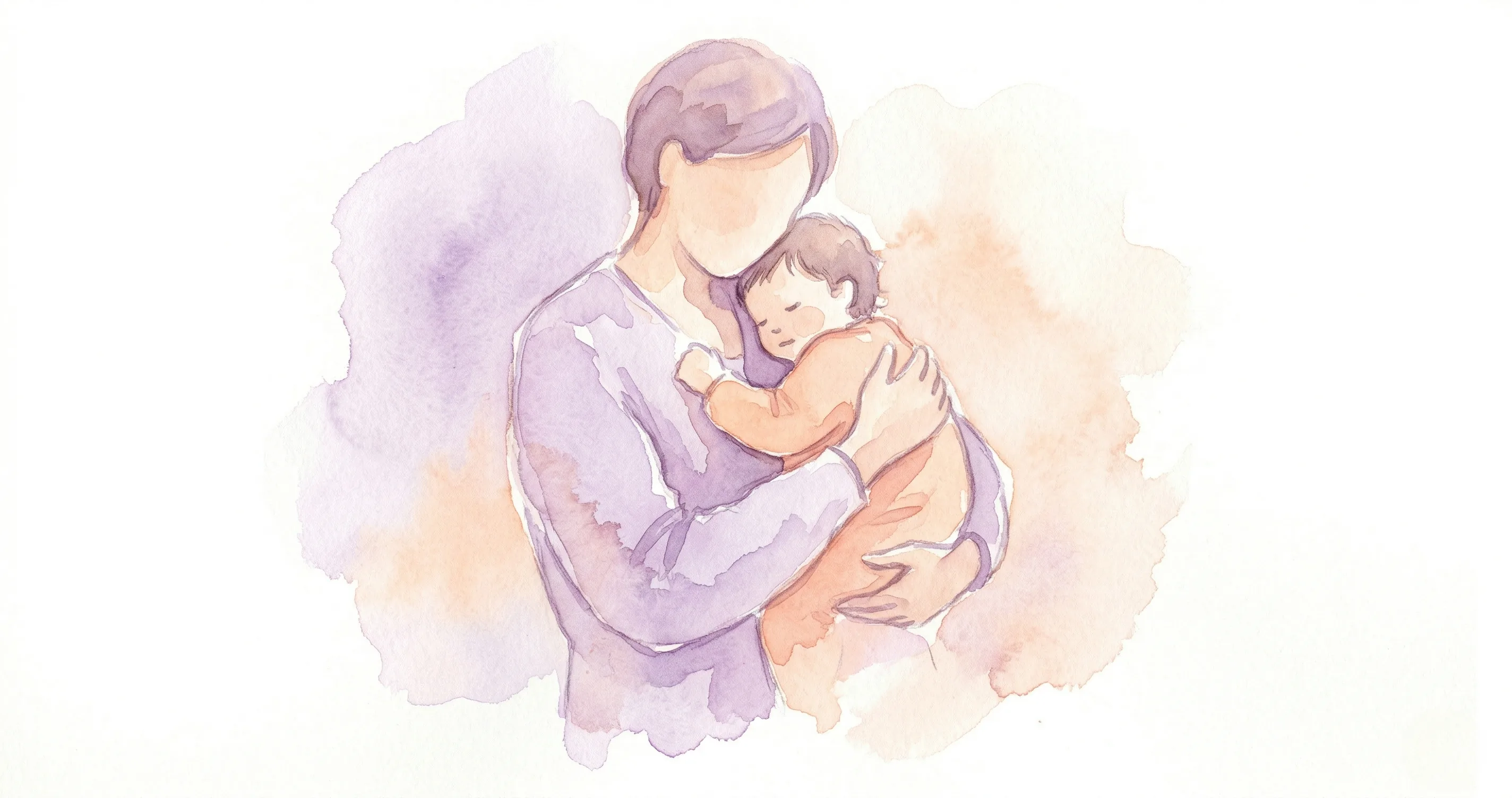
You have said it. Probably more than once. Your child is crying — loudly, inconveniently, in the middle of a grocery store — and the words come out: “Stop crying.” If you are here searching for what to say instead of stop crying, you already suspect what the research confirms: telling a child to stop crying does not teach them to manage their emotions. It teaches them to hide them.
This guide is different from the generic phrase lists you have seen elsewhere. Instead of giving you a flat list of 10 things to say instead of stop crying, we organize replacement phrases by the emotion your child is actually experiencing — because a scared child needs a fundamentally different response than a frustrated one. Each script includes why it works, so you can adapt what to say instead of stop crying in the moment rather than memorizing lines.
Why “Don’t Cry” Backfires: What It Actually Teaches
When a child is crying and an adult says “don’t cry” or “you’re fine,” the adult’s intention is usually comfort. But the child hears something different. They hear: what you are feeling right now is wrong.
Understanding why you shouldn’t tell kids to stop crying starts with how children learn emotional regulation. They cannot regulate what they are not allowed to feel. Decades of research in developmental psychology show that emotional suppression — learning to hide feelings rather than process them — is associated with higher rates of anxiety, difficulty in relationships, and weaker coping skills later in life.
The three hidden messages in “stop crying”
- “Your feelings are too much for me.” Children are acutely tuned to their caregiver’s capacity. When you signal that their emotion is overwhelming you, they learn to shrink themselves to protect the relationship.
- “This situation does not deserve tears.” What seems minor to an adult — a broken crayon, a lost turn — can feel genuinely devastating to a child whose brain is still developing perspective and proportion.
- “I need you to be OK right now.” Sometimes when we tell children to stop crying, we are really managing our own discomfort. The honesty of recognizing this is the first step toward responding differently.
What validation actually does
So how to respond to a crying child without dismissing them? Validation does not mean agreeing with the child or giving in to their demands. It means acknowledging the reality of their emotional experience. When you say “I can see this is really hard for you,” you are not saying the situation warrants tears by adult standards. You are saying: I see you, and what you feel is real.
This is the foundation of co-regulation — the process by which a calm adult helps a dysregulated child return to baseline. Co-regulation is how children eventually learn to self-regulate. They borrow your calm until they can find their own. And that process requires them to feel safe enough to experience the emotion fully before moving through it.
What to Say When Your Child Is Scared
Knowing what to say instead of stop crying starts with reading the emotion behind the tears. Fear-based crying has a particular quality — wide eyes, a body that moves toward you rather than away, a voice that sounds more pleading than angry. When your child is scared, they need safety before anything else. No amount of logic or reassurance will land until they feel physically and emotionally safe.
Scripts for fear
- “I’m right here. You’re safe.” — This works because fear activates the threat-detection system in the brain. The child needs to hear, in plain and calm words, that the danger is not present or that you will handle it. Keep your voice low and steady.
- “That was really scary, wasn’t it?” — Naming the emotion helps the child’s brain move from the amygdala (fight-or-flight) to the prefrontal cortex (thinking and language). This process, sometimes called “name it to tame it,” is one of the most well-supported strategies in emotion coaching.
- “I would feel scared too.” — Normalizing the emotion removes the shame layer. A child who feels scared and ashamed of being scared is carrying a double burden.
- “Let’s take some slow breaths together.” — Rather than telling the child to calm down (which is just another version of “stop crying”), you do it with them. Breathe audibly so they can match your rhythm. This is co-regulation in its simplest form.
When to just hold them
Sometimes a scared child is beyond the reach of words. If your child is sobbing and cannot hear you, physical presence is the message. Hold them close, let them feel your steady breathing, and wait. The words can come after the storm passes. Silence paired with closeness is often the most powerful thing you can offer.
What to Say When Your Child Is Frustrated
When figuring out what to say instead of stop crying, frustration requires its own playbook. Frustration-based crying looks and sounds different from fear. The body is tense, the face may be red, and the child might throw things, stomp, or yell through their tears. Frustration happens when a child’s desire or ability does not match the situation — a tower that keeps falling, a zipper that will not close, a rule that feels unfair.
Scripts for frustration
- “This is really frustrating. I can see that.” — Start by mirroring what you observe. Frustrated children often feel invisible in their struggle. Being seen reduces the intensity.
- “You’re working so hard on this.” — This reframes the narrative from failure to effort. The child hears that their struggle is recognized as work, not weakness.
- “Would you like help, or do you want to keep trying?” — This gives the child agency. Many frustrated children do not want you to fix the problem — they want to know they have the option. Asking rather than swooping in preserves their sense of competence.
- “It’s OK to feel mad about this. What do you want to do with that feeling?” — For older children (roughly five and up), this bridges the gap between feeling the emotion and choosing a response. It teaches that emotions are information, not commands.
- “Let’s take a break and come back to it.” — Sometimes the best response to frustration is space. This is not avoidance — it is modeling the adult skill of stepping away when something is not working.
The temptation to fix it
When your child is frustrated, the impulse to solve the problem immediately is strong. Resist it — at least at first. If you grab the zipper and zip it yourself, the frustration ends but the child learns nothing about persistence or asking for help. Let them sit in the discomfort briefly. Then offer yourself as a resource rather than a rescuer.
What to Say When Your Child Is Disappointed
Disappointment is the third major emotion where knowing what to say instead of stop crying matters most. It is quieter than frustration and less urgent than fear, but it can be the hardest for parents to sit with. Your child wanted something — a playdate, a toy, a different outcome — and it did not happen. The tears come from the gap between expectation and reality, and no amount of explaining why will close that gap in the moment.
Scripts for disappointment
- “You were really looking forward to that.” — This validates the anticipation without evaluating whether the expectation was reasonable. The child feels heard without being judged.
- “I’m sorry it didn’t work out the way you hoped.” — A simple, genuine apology that does not promise to fix it. The child learns that disappointment is something you can survive, not something that must be immediately remedied.
- “It’s OK to be sad about this.” — Permission to grieve a small loss is one of the most underestimated gifts a parent can give. Children who learn to sit with disappointment develop resilience. Children who are rushed past it learn to distrust their own emotional responses.
- “I’m going to sit here with you while you feel this.” — No fix, no distraction, no timeline. Just presence. This is especially powerful for disappointments that genuinely cannot be changed — a canceled event, a friend who moved away, a pet who died.
Why distraction is not the answer
It is tempting to offer a replacement immediately: “The park is closed, but we can get ice cream instead!” This sometimes works in the short term, but over time it teaches the child that uncomfortable feelings should be swapped out for something pleasant as quickly as possible. That is not resilience — it is avoidance wearing a friendly mask. Let the disappointment land first. There will be time for ice cream after.
Age-Specific Scripts: Toddler, Preschooler, School-Age
The emotion-based scripts above work across ages, but what to say instead of stop crying changes depending on your child’s developmental stage. A two-year-old cannot process a reflective question. A nine-year-old may find simple narration patronizing. Here is how to adapt your response by age.
Toddlers (ages 1–3)
Toddlers have enormous emotions and almost no language to process them. Your job at this stage is primarily physical — proximity, tone of voice, and simple words.
- Use short, concrete phrases: “You’re sad. Mama’s here.” “Ouch — that hurt.” “You wanted the red cup.”
- Match their volume, then bring it down: If a toddler is wailing, starting in a whisper will not reach them. Meet their energy briefly, then gradually lower your voice. They will follow you down.
- Offer physical comfort first: Pick them up, hold them close, rock gently. Words are secondary at this age — regulation happens through the body.
- Name the emotion for them: “You’re feeling frustrated because the block fell.” They cannot name it themselves yet, but hearing the label builds emotional vocabulary for later.
Preschoolers (ages 3–5)
Preschoolers are developing language rapidly but still operate primarily from the emotional brain. They can start to identify feelings with help, and they respond well to choices.
- Offer two options: “Do you want a hug, or do you want some space?” Giving a choice during distress restores a small sense of control.
- Use “I notice” statements: “I notice your fists are tight and your face looks angry.” This teaches body awareness, which is a precursor to self-regulation.
- Validate, then redirect: “You’re really upset that we have to leave the playground. That makes sense — you were having so much fun. Let’s think about what we can do when we get home.”
- Use stories: “Remember when you were scared of the dog at the park, and then you petted him and he was friendly? Sometimes things feel scary at first and then get better.” Preschoolers connect deeply to narrative.
School-age children (ages 6–10)
By this stage, children can think abstractly about their emotions — with support. They may also start to feel embarrassed about crying, especially in front of peers. Your response should respect their growing maturity while still providing validation.
- Ask before telling: “Do you want to talk about it, or do you just want me to sit here?” School-age children value being consulted rather than managed.
- Normalize the tears: “Crying is how your body processes big feelings. There’s nothing wrong with it.” At this age, cultural messages about crying (“big kids don’t cry”) start to compete with your parenting. Be explicit in countering them.
- Help them problem-solve after the emotion passes: “Now that you’re feeling calmer, what do you think you could do differently next time?” Wait until the crying has subsided — problem-solving during a meltdown is like giving driving directions during an earthquake.
- Share your own experiences: “I felt really disappointed today when my meeting got canceled. I took a walk to clear my head.” Modeling emotional honesty gives children permission to be honest in return.
| Age | What They Need | Example Script |
|---|---|---|
| Toddler (1–3) | Physical comfort + simple labels | “You’re sad. I’m right here.” |
| Preschooler (3–5) | Validation + choices | “That was scary. Do you want a hug or some space?” |
| School-age (6–10) | Respect + co-regulation + problem-solving after | “I can see this is hard. Want to talk, or just sit together?” |
When Crying Becomes a Pattern: What to Look For
All children cry. But if your child’s crying has changed significantly — in frequency, intensity, or duration — it is worth paying closer attention. This section is not about pathologizing normal emotional expression. It is about knowing when something else might be going on underneath.
Normal variation versus a signal
Some children are simply more emotionally expressive than others. Temperament plays a significant role — a highly sensitive child will cry more often and more intensely than a more even-keeled peer, and that is within the range of normal. The question is not how much your child cries but whether the crying is interfering with their daily life: friendships, school, sleep, or their ability to enjoy activities they used to like.
Patterns worth noting
- Crying that seems disconnected from the trigger: A child who sobs for 45 minutes over a slightly torn piece of paper may be carrying stress from something unrelated. The paper is the last straw, not the actual problem.
- A sudden increase in crying after a period of relative calm: This can signal a change in the child’s environment — a new school, a change in the family, bullying, or anxiety that has reached a tipping point.
- Crying accompanied by physical symptoms: Stomachaches, headaches, trouble sleeping, or loss of appetite alongside frequent crying can indicate anxiety or depression, even in young children.
- Inability to recover: Most children, with support, can move through a crying episode within 10 to 20 minutes. If your child consistently cannot return to baseline after an extended period, it may be worth discussing with their pediatrician.
What to do if you are concerned
Start by keeping a brief log for one to two weeks. Note when the crying happens, what seems to trigger it, how long it lasts, and what helps. This data is genuinely useful when talking to a pediatrician or child therapist — far more useful than a general report of “my child cries a lot.” Trust your instincts. You know your child better than any checklist.
Building a Home Where Feelings Are Safe
Individual scripts matter, but the real transformation happens at the level of family culture. When a child grows up in a home where emotions are treated as normal, nameable, and manageable — rather than inconvenient, embarrassing, or dangerous — they develop what researchers call emotional literacy. And emotional literacy is one of the strongest predictors of mental health, social competence, and resilience across the lifespan.
Daily habits that build emotional safety
- Name your own emotions out loud: “I’m feeling frustrated because I can’t find my keys.” “I’m a little nervous about my presentation tomorrow.” Children learn emotional vocabulary by hearing it used in real life, not from flashcards.
- Repair when you mess up: You will say “stop crying” again. You will lose your patience. When that happens, go back and repair: “I told you to stop crying earlier, and I wish I had said something different. Your feelings are important to me.” Repair is not weakness — it models accountability.
- Create a feelings check-in ritual: At dinner or bedtime, ask each family member to share one feeling from the day. Keep it low-pressure. The goal is to make talking about emotions routine, not performative.
- Let them see you feel: Children who never see their parents sad, frustrated, or disappointed learn that adults do not have feelings — which means they expect themselves to eventually outgrow theirs. Show them that grown-ups have big feelings too, and show them how you move through them.
The role of structure in emotional safety
Counterintuitively, children feel safest expressing emotions when the rest of their world is predictable. Consistent routines, clear boundaries, and reliable transitions all reduce the baseline stress that makes emotional outbursts more frequent and more intense. When a child knows what comes next in their day, they have more emotional bandwidth to handle the unexpected. Tools like Timily help create that predictability by giving kids a clear structure for daily tasks and transitions — one less thing for the emotional system to manage.
What this looks like over time
Learning what to say instead of stop crying is not a single conversation or a one-week experiment. It is a slow, imperfect, cumulative process. You will have days where you respond beautifully and days where you default to old patterns. Both are part of the journey.
What matters is the direction. A child who hears “I see you’re hurting” most of the time and “stop crying” occasionally is in a fundamentally different emotional environment than a child who hears it the other way around. You do not need to be perfect. You need to be present, and willing to try again tomorrow.