
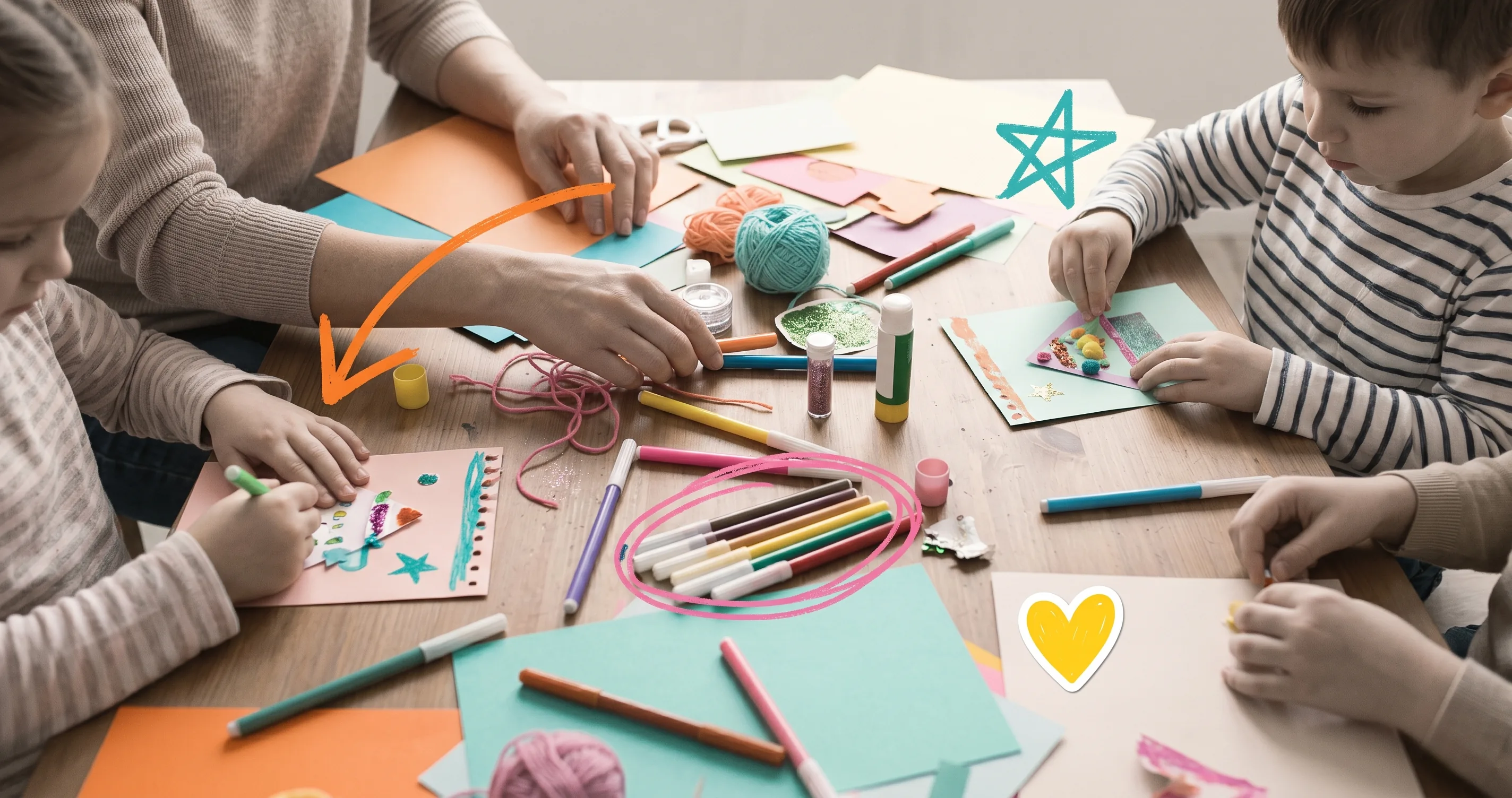
It is 3 p.m. on a rainy Saturday. The kids are circling the living room like bored satellites. One is reaching for the tablet. The other is already whining. You need family activities at home — but your brain is blank.
Sound familiar? Every parent has been there. The good news: you do not need a Pinterest board, a craft supply closet, or a plan. You need a list. This guide gives you 30 family activities at home that work on rainy days, weekdays, weekends, and every “I’m bored” moment in between — organized by energy level so you always have a match.
10 Active Indoor Activities
When the energy is high and the kids need to move, these indoor family activities burn it off without leaving the house. No equipment required for most of them.
1. Living-room dance party
Put on a playlist, push the couch back, and dance like nobody is watching. Take turns choosing songs. For extra fun, freeze when the music stops — last one moving picks the next song.
2. Indoor obstacle course
Use couch cushions, chairs, blankets, and pillows to build a course. Crawl under the table, hop across cushion “stepping stones,” and balance a book on your head for the final stretch. Time each family member and try to beat your own record.
3. Balloon volleyball
Stretch a string across the room as a net and use a balloon as the ball. No broken lamps, no bruised shins. Works even in small apartments and keeps younger kids engaged because the balloon moves slowly enough for them to track.
4. Hide and seek (with a twist)
Classic hide and seek never gets old, but try the sardines version: one person hides, everyone else seeks. When you find the hider, you squeeze in with them. The last seeker becomes the next hider. It always ends in giggles.
5. Yoga for kids
Search for a short kids’ yoga routine (or just make up animal poses). “Be a tree. Now be a frog. Now be a flamingo.” It burns energy quietly, improves balance, and gives everyone a chance to be silly together.
6. Indoor bowling
Line up empty water bottles or toilet paper rolls at the end of a hallway. Roll a soft ball toward them. Keep score on a whiteboard or piece of paper. Surprisingly competitive for something that takes 30 seconds to set up.
7. Scavenger hunt
Write a list of 10 to 15 items for kids to find around the house: “something blue,” “something that makes noise,” “something smaller than your thumb.” For older kids, use riddles instead of descriptions. This one buys you a solid 20 minutes.
8. Pillow fight tournament
Set ground rules first (soft pillows only, no hitting the face), then let the feathers fly. Round-robin bracket style makes it feel like an event. Losing is half the fun when everyone is laughing.
9. Simon Says marathon
Take turns being Simon. The physical version — “Simon says jump on one foot,” “Simon says spin three times” — tires kids out faster than you would expect. Add silly commands for bonus engagement.
10. Blanket fort relay
Split into teams and race to build the best blanket fort. Set a timer for 10 minutes. Judge on creativity, sturdiness, and whether an adult can actually fit inside. The winning team picks the movie for family movie night.
10 Calm Indoor Activities
Sometimes the energy is low — or you need it to be. These rainy day family activities are perfect for winding down, Sunday mornings, or the hour before bed.
1. Family puzzle
Pick a puzzle that matches your youngest child’s ability and work on it together over the course of a day or a week. Leave it on the dining table so anyone can add a piece whenever they walk by. The slow progress is part of the magic.
2. Read-aloud session
Take turns reading chapters of a book aloud. Even older kids enjoy being read to — especially if the reader does character voices. This works beautifully as a post-dinner wind-down ritual. For book ideas, see our screen-free activities guide.
3. Board game afternoon
Pull out a board game that works for everyone’s age. For mixed ages: Uno, Sorry, or Ticket to Ride. For younger kids: Candy Land or Hi Ho Cherry-O. For a challenge: Settlers of Catan or Codenames. Keep a running family scoreboard for extra motivation.
4. Baking together
Cookies, muffins, banana bread — pick something simple with few ingredients. Let kids measure, pour, and stir. Yes, the kitchen will get messy. But the smell of fresh cookies at 4 p.m. on a rainy day is worth every flour-dusted counter.
5. Indoor picnic
Spread a blanket on the living room floor, pack sandwiches and snacks, and pretend you are at the park. Add background nature sounds from a speaker if you want the full experience. Kids find this unreasonably delightful.
6. Family journaling
Give everyone a notebook and a prompt: “What was the best part of this week?” or “If you could have any superpower, what would it be and why?” Younger kids can draw their answers. Share afterward — the conversations that follow are often the best part.
7. Puzzle books and brain teasers
Crosswords, word searches, Sudoku for older kids, mazes for younger ones. Sit together at the table and work on your own puzzle books side by side. It is parallel play for families — together but not demanding constant interaction.
8. Indoor camping
Set up sleeping bags in the living room, turn off the lights, and use flashlights. Tell stories, eat trail mix, and play “what’s that shadow?” on the ceiling. This works as a full evening activity or even a sleepover alternative.
9. Listening to a podcast or audiobook together
Find a family-friendly podcast or audiobook and listen to an episode while doing a calm activity like coloring or building with LEGO. It gives everyone a shared experience without requiring a screen.
10. Card games
Go Fish, War, Crazy Eights, Slapjack — a single deck of cards holds dozens of games. Teach your kids a card game you loved as a child. It costs nothing, takes up no space, and creates the kind of low-key togetherness that kids remember.
10 Creative Indoor Activities
When the mood calls for making something, these screen free activities at home let kids create, build, and experiment. Most use supplies you already have.
1. Collaborative art wall
Tape a large piece of paper (or taped-together printer paper) to the wall. Everyone adds to it throughout the day — drawings, stickers, magazine cutouts, messages. By evening, you have a family mural.
2. Homemade playdough
Mix flour, salt, water, oil, and food coloring. The making is half the activity. Then let kids sculpt anything they want. This works for ages 2 through 10 — younger kids squish and roll, older kids build elaborate creations.
3. Write and perform a family play
Each person gets a role. Spend 20 minutes writing a short script (or just improvise). Use household items as props and a doorway as the stage. Record it on your phone for a keepsake you will watch for years.
4. Build something with recycling
Cardboard boxes, paper towel rolls, bottle caps, and tape. Challenge kids to build a robot, a castle, or a car. The constraint of using only recycled materials forces creative problem-solving that buying a kit never does.
5. Kitchen science experiments
Vinegar and baking soda volcanoes, growing crystals with sugar water, making slime, or testing which objects float. Simple experiments with household ingredients teach cause and effect while feeling like play.
6. Friendship bracelets or beading
A bag of beads and some string keeps hands busy for an hour. Kids can make bracelets for each other, for friends, or for stuffed animals. The repetitive motion is calming, and they end up with something to keep or give away.
7. Create a family newspaper
Each family member writes or draws a “story” — dad reviews the dinner menu, a child reports on the weather, someone interviews the pet. Staple the pages together. You now have a time capsule of an ordinary day.
8. Puppet show
Make simple puppets from socks, paper bags, or wooden spoons. Build a stage from a cardboard box. Younger kids will perform the same show five times in a row. Older kids will write increasingly elaborate plots. Both are wins.
9. Design a board game
Give kids a piece of cardboard, markers, and some dice. Challenge them to invent a game with rules, a board, and a way to win. Then play it together. The game will probably be unbalanced and chaotic — and that is exactly what makes it fun.
10. Photo challenge
Give each person a camera (or a phone with the camera app only) and a theme: “things that are round,” “something beautiful,” “the smallest thing you can find.” Set a timer for 15 minutes, then gather and vote on favorites. It teaches kids to notice their surroundings in a way that stepping away from screens naturally encourages.
The Boredom Jar: Never Hear “I’m Bored” Again
All 30 ideas above are only useful if you can remember them in the moment. You will not. When a child says “I’m bored,” your brain goes blank. That is why the boredom jar exists.
How to set it up
Take a jar, a bowl, or even a shoebox. Write each activity from this list on a separate slip of paper. Fold them up and drop them in. When boredom strikes, the child pulls a slip. Whatever comes out, that is the activity. No negotiating, no scrolling through options, no decision fatigue.
Why it works
The boredom jar solves the two biggest obstacles to things to do as a family at home: the blank-brain problem (you cannot think of anything) and the choice paralysis problem (too many options, so the child defaults to screens). By turning the decision into a random draw, you remove the argument. The jar decided. Not you.
Refilling the jar
Once a month, sit together and add new ideas. Remove any that consistently get groans. The jar evolves with your family. Some families color-code the slips — blue for active, green for calm, yellow for creative — so kids can match their energy to the category.
Quick Picks by Age
Not every activity works for every age. Here is a quick reference for family activities at home for kids by developmental stage.
| Age Group | Best Active | Best Calm | Best Creative |
|---|---|---|---|
| Ages 3–6 | Dance party, balloon volleyball, Simon Says | Baking, indoor picnic, read-aloud | Playdough, puppet show, collaborative art wall |
| Ages 7–10 | Obstacle course, scavenger hunt, indoor bowling | Board games, family puzzle, indoor camping | Kitchen science, design a board game, recycling builds |
| Ages 11+ | Blanket fort relay, pillow fight tournament, yoga | Card games, audiobook listening, family journaling | Photo challenge, family newspaper, write a play |
These are starting points. A motivated 5-year-old can do a scavenger hunt. A nostalgic 13-year-old will happily make playdough. Age ranges are guidelines, not walls. The real filter is whether the child is interested — which is why letting them choose from the boredom jar matters more than matching a chart.
Making Indoor Family Time a Habit
A single afternoon of family activities at home is great. A weekly habit is transformational. The difference between families who do this occasionally and families who do it consistently comes down to three things.
Schedule it like anything else
If family activity time is not on the calendar, it will not happen. Screens are always available. Screen-free activities require a small amount of activation energy. Block a recurring window — Saturday morning, Sunday after lunch, Wednesday evening — and protect it the way you would protect a doctor’s appointment. It does not need to be long. Thirty minutes is enough to build the habit.
Pair it with screen time
One of the most effective approaches is connecting family activities to screen time through an earn-based system. Completing a family activity together can earn screen time later. This reframes the activity as the gateway to screens, not the replacement for them. Kids stop resisting the activity because it leads to something they want.
Timily’s task system is designed exactly for this: complete a focus session or a family activity, earn screen time credits. The activity stops being “instead of screens” and becomes “the way to earn screens.” That shift changes everything.
Lower the bar
The biggest enemy of consistent family time is perfectionism. You do not need matching craft supplies. You do not need an Instagram-worthy setup. You need a balloon, a deck of cards, or a jar full of folded paper. The activities that stick are the ones that take less than two minutes to start. If setup takes longer than the attention span of your youngest child, it will not become a habit.
Let kids lead
When children choose the activity, they invest in it. When parents choose, it feels like an assignment. Give your kids ownership of family activity time as often as possible. The boredom jar does this automatically — the child draws the slip, the child leads the setup, the child is in charge. You are just there to participate.