
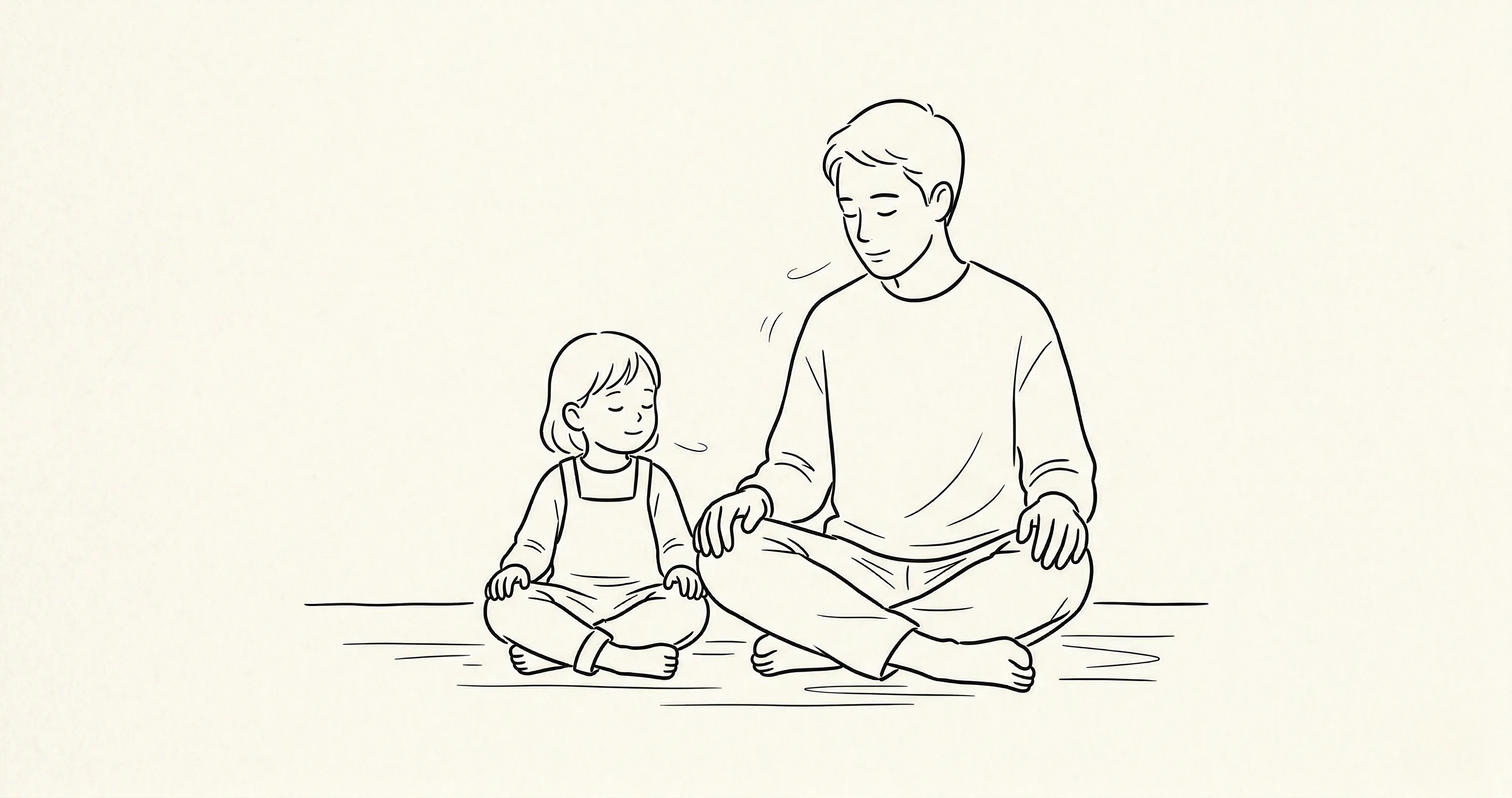
Your child is on the kitchen floor, screaming. The cereal is the wrong color. The socks feel weird. Something happened at school that they cannot articulate. You are standing there thinking: What am I supposed to do right now? If this sounds familiar, co-regulation parenting offers a clear, science-backed answer.
If you have ever searched for co-regulation parenting or “how to calm down an upset child,” you are already on the right track. The instinct to help your child through a big emotion — rather than punishing them for having it — is the foundation of co-regulation. This guide turns that instinct into a practical playbook you can use in the moment, even when the moment is loud.
What Is Co-Regulation in Parenting?
Co-regulation in parenting is the process of using your own regulated emotional state to help your child manage feelings they cannot yet handle on their own. Think of it as lending them your nervous system until theirs is mature enough to do the job solo.
When a toddler falls and looks at your face before deciding whether to cry, that is co-regulation at work. When a seven-year-old storms out of a board game and you sit nearby — quiet, steady, available — until they are ready to talk, that is co-regulation too. It is not a technique you perform. It is a way of being present during difficult moments.
Here is what co-regulation is not:
- It is not fixing the problem. You do not need to make the bad feeling go away. You need to be there while it runs its course.
- It is not talking them out of it. “There is nothing to cry about” is the opposite of co-regulation. Their nervous system disagrees with your logic.
- It is not coddling. You are not removing the challenge. You are helping them face it with a safety net.
The simplest way to understand co-regulation for parents is this: your child’s brain is still under construction. The part that manages impulses, plans ahead, and calms down after a setback — the prefrontal cortex — will not be fully developed until their mid-twenties. In the meantime, they borrow yours.
The Brain Science: Why Kids Borrow Your Calm
Co-regulation parenting is not a feel-good philosophy. It is rooted in neuroscience.
The nervous system connection
Humans are wired for social regulation from birth. When a baby hears a calm, rhythmic voice, their heart rate slows. When a toddler is held by a relaxed caregiver, their cortisol levels drop. This is not metaphor — it is measurable biology. Researchers call it neural co-regulation: the process by which one person’s regulated nervous system helps stabilize another’s.
The mechanism works through mirror neurons and the autonomic nervous system. When your child is in a state of emotional flooding — what some parents call a meltdown — their sympathetic nervous system (the fight-or-flight response) has taken over. Their thinking brain is essentially offline. In that state, words like “use your words” or “calm down” literally cannot be processed.
What can reach them is your regulated presence. Your slow breathing, steady posture, and calm tone activate their mirror neurons and begin to pull their nervous system back toward baseline. This is the science behind co-regulation parenting — and it is why sitting quietly next to a screaming child often works better than any script.
Why “calm down” backfires
Telling an activated child to calm down is like telling someone having a panic attack to relax. The instruction requires the exact brain function that is currently unavailable. Worse, it often escalates the situation because the child now feels misunderstood on top of feeling overwhelmed.
Co-regulation replaces the instruction with the experience. Instead of telling them to be calm, you show them what calm looks like. Their nervous system picks up the signal even when their ears cannot process the words.
The long game: building neural pathways
Every time you co-regulate with your child, you are not just solving the immediate crisis. You are helping them build the neural pathways they will eventually use to self-regulate. Each experience of “I was overwhelmed, someone stayed calm with me, and I came back to baseline” strengthens the circuitry. Over hundreds of repetitions across years, those pathways become strong enough for the child to travel them alone.
The Co-Regulation Playbook: What to Do in the Moment
This is the section you can bookmark for the next meltdown. At its core, co-regulation parenting comes down to a repeatable sequence. These co-regulation techniques for kids work across ages. Adjust the language for your child’s developmental level, but the steps stay the same.
Step 1: Regulate yourself first (even partially)
Before you do anything for your child, take one slow breath. Not five. Not a full meditation. One breath, in through the nose, out through the mouth, slightly longer on the exhale. This activates your parasympathetic nervous system and brings you at least one notch down from wherever you are. You do not need to reach zero. You just need to be calmer than they are.
Step 2: Get low and get close
Physical positioning matters more than most parents realize. Stand over a screaming child and you look like a threat, even if your words are gentle. Crouch down, sit on the floor, or kneel so you are at or below their eye level. Move closer, but do not force contact. Being within arm’s reach says “I am here” without requiring them to accept a hug they may not want yet.
Step 3: Validate before you redirect
Name what you see without judgment. “You are really frustrated right now.” “That felt unfair and you are angry.” “Your body is telling you something is wrong.” You are not agreeing that the cereal color is a legitimate crisis. You are acknowledging that their emotional experience is real to them. Validation is not permission. It is recognition.
Step 4: Offer sensory regulation
Once you are close and they know you see them, offer one sensory anchor. Not three options — one. A dysregulated child cannot process choices. Try:
- “Let’s breathe together. Watch my belly.” (Place your hand on your stomach so they can see the movement.)
- “Can I rub your back?” (Wait for a nod or lean-in before touching.)
- “Let’s squeeze this pillow together.” (Redirect physical energy.)
Step 5: Wait longer than you think you should
This is the hardest part. After you have positioned yourself, validated them, and offered a sensory anchor, the work is mostly waiting. The nervous system needs time to come down. It will not happen in 30 seconds. It might take five minutes. It might take fifteen. Your presence during this time is the co-regulation. Resist the urge to problem-solve, lecture, or move on before they are ready.
Step 6: Reconnect and (later) reflect
When the storm passes, reconnect physically — a hug, a gentle touch, a shared snack. Save the teaching for later. The immediate aftermath of a meltdown is not a learning window. Their brain is recovering. Hours later, or even the next day, you can reflect: “Remember when you were upset about the game? That was a big feeling. You came back from it. I was proud of you.”
But What If I Am Not Calm? (Imperfect Co-Regulation)
Here is the part no one writes about co-regulation parenting: sometimes you are the one who is dysregulated. Your child is screaming and your heart is pounding and your jaw is clenched and you want to yell back. That is normal. That is human. And it does not disqualify you from co-regulating.
You do not need to be at zero
The myth of the perfectly calm parent does real damage. It makes you feel like a failure when you are activated, which adds shame on top of stress, which makes regulation harder. The truth is that co-regulation strategies for parents work even when you are imperfect. You do not need to be at a 0 out of 10 on the stress scale. You need to be at a lower number than your child. If they are at a 9, you being at a 5 is enough.
The honest pause
If you are too activated to be helpful — if you are at an 8 or a 9 yourself — it is better to briefly step away than to co-regulate from a place of anger. Say exactly what is happening: “I am feeling really frustrated right now and I need a moment so I can help you. I am not leaving. I will be right back.” Then step into the hallway, take three breaths, and return. This is not abandonment. It is modeling.
Repair is part of the process
You will lose your temper sometimes. You will raise your voice. You will say something you regret. Every parent does. What matters is what happens after. Coming back and saying “I got really upset and I yelled. That was not okay. I am sorry” teaches your child something powerful: emotions happen to everyone, and relationships survive them. Repair after rupture is not a failure of co-regulation. It is co-regulation in its most honest form.
Children do not need a parent who never gets angry. They need a parent who shows them what to do after getting angry. Imperfect co-regulation parenting — the kind where you stumble, repair, and try again — is a lesson no amount of perfect calm can teach.
Co-Regulation Strategies for Parents by Age
The core principle of co-regulation — lend your calm — stays the same across ages. But the way you deliver it changes as your child’s brain develops. Here are practical co-regulation strategies for parents at every stage.
| Age | What They Need | What to Say | What to Do |
|---|---|---|---|
| 0–2 years | Physical comfort, rhythmic movement | Soft humming, gentle shushing, sing-song tone | Hold, rock, sway; match their breathing with yours |
| 3–5 years | Proximity, simple language, sensory tools | “I see you are upset. I am right here.” | Get on their level, offer a stuffed animal or blanket, breathe together |
| 6–9 years | Validation, patience, physical presence | “That was really frustrating. I get it.” | Sit nearby, offer a calm activity (drawing, squeezing a stress ball), wait |
| 10–12 years | Space with availability, respect for dignity | “I can see this is hard. I am here when you are ready.” | Stay in the room or nearby, do not force eye contact, let them come to you |
| Teens | Autonomy, non-judgmental presence | “I am not going to lecture. Just tell me what happened.” | Be available without hovering, respect closed doors but check in, drive in silence together |
Toddlers (0–2): It is all physical
Babies and toddlers cannot process language during distress. Co-regulation at this age is almost entirely physical: holding, rocking, skin-to-skin contact, rhythmic sounds. Your heartbeat against theirs is the most powerful co-regulation tool you have. If they are arching away, do not force the hold — stay close and keep your body relaxed until they are ready for contact.
Preschoolers (3–5): Simple words, big presence
Preschoolers are starting to understand language during distress, but their capacity is limited. Use short, concrete sentences. “You wanted the blue cup. The blue cup is in the dishwasher. That feels bad.” This is also the age where co-regulation connects to gentle discipline — the boundary stays firm, but the child is supported through their reaction to it.
School-age (6–9): Validation becomes the anchor
By this age, children can articulate some of what they feel, but they still need your help labeling and processing emotions. Frustration after losing a game, anger about a sibling conflict, disappointment about a canceled plan — these feelings are real and proportionate to their experience even when they seem small to you. Sit with them. Name what you see. Wait.
Tweens (10–12): Respect their space
Tweens start needing space to regulate, but they are not yet capable of doing it fully alone. The trick is being available without being intrusive. “I am in the kitchen if you want to talk” gives them agency. Forcing a conversation while they are activated pushes them further away. This is also the age where screen-related frustration often peaks — the transition from a device to real life can trigger intense reactions that benefit from co-regulation rather than punishment.
Teens: Co-regulation looks like driving in silence
Teenagers rarely want to sit on the floor and breathe with you. But they still need co-regulation. It just looks different. Driving together without forcing conversation. Watching a show side by side. Being in the same room doing separate things. The message is the same as when they were two: “I am here. You are not alone in this.”
Co-Regulation Activities for Kids
Effective co-regulation parenting is not only about crisis response. These co-regulation activities for kids are designed for calm times — practicing them when no one is upset builds the neural pathways your child will reach for during storms.
Breathing games
- Balloon breathing. Pretend your belly is a balloon. Breathe in to inflate it, breathe out to deflate. Do it together. Works well for ages 3 to 7.
- Square breathing. Trace a square in the air. Breathe in for one side, hold for the next, breathe out for the third, hold for the fourth. Good for ages 6 and up.
- Back-to-back breathing. Sit back-to-back with your child. Try to sync your breathing so you can feel each other’s inhales and exhales. Works for all ages.
Sensory anchoring
- Heavy work. Pushing against a wall, carrying a heavy book, doing wall push-ups together. Proprioceptive input calms the nervous system.
- Temperature reset. Hold an ice cube together. The cold sensation pulls attention into the body and out of the spiraling thought.
- Weighted lap pad. A heavy blanket or stuffed animal on the lap during homework or transition times provides calming pressure without requiring conscious effort.
Connection rituals
- Daily check-in. At dinner or bedtime, each person shares one “high” and one “hard” from the day. This normalizes talking about emotions when no one is in crisis.
- Calm-down corner (built together). Create a dedicated space with pillows, fidgets, and a feelings chart. When your child helps design it, they are more likely to use it.
- Transition routines. Use Timily’s Focus Timer to structure transitions between activities. A visual countdown replaces the abrupt “time’s up” that triggers meltdowns, giving your child a predictable bridge between one thing and the next.
From Co-Regulation to Self-Regulation: When Kids Are Ready
Every parent practicing co-regulation parenting wonders: when will my child be able to do this on their own? The answer is gradual, and it depends on the foundation you have built.
The developmental timeline
Self-regulation does not arrive on a specific birthday. It emerges in layers:
- Ages 3–4: First signs of self-soothing (thumb-sucking, retreating to a quiet space). These are early, imperfect attempts.
- Ages 5–7: Beginning to use language to manage feelings (“I need a break”). Still needs adult support most of the time.
- Ages 8–10: Can sometimes regulate independently for mild to moderate frustrations. Still needs co-regulation for big feelings.
- Ages 11–14: Growing capacity for self-regulation but with significant inconsistency. Hormonal changes add new challenges. Co-regulation remains important during high-stress moments.
- Ages 15+: More consistent self-regulation in most situations, but the prefrontal cortex is still maturing. Teens benefit from knowing a co-regulating adult is available even if they rarely need to use the support.
Signs your child is building self-regulation
You will notice the shift in small moments before big ones:
- They pause before reacting, even for a second
- They use a strategy you have practiced together without being prompted (“I need to take a breath”)
- They recover from frustration faster than they used to
- They can name what they are feeling (“I am not angry, I am disappointed”)
- They seek you out after a hard moment instead of shutting down completely
These moments are evidence that co-regulation parenting is working. Every one represents a neural pathway that is getting stronger.
Why “let them figure it out” delays the process
Some parenting advice suggests that children learn to self-regulate by being left alone with their emotions. The neuroscience says the opposite. A child who is repeatedly left to manage overwhelming feelings alone does not build self-regulation faster. They build coping mechanisms — which might look like self-regulation from the outside but often involve suppression, withdrawal, or people-pleasing rather than genuine emotional processing.
Self-regulation grows from co-regulation parenting. A child learns to calm themselves because they have experienced being calmed by someone else hundreds of times. You are not creating dependency. You are building the blueprint they will follow for the rest of their life.
As your child grows into managing tasks and responsibilities on their own, tools like Timily’s Task & Chore System can extend the co-regulation principle into daily life — providing structure and predictability that reduce the emotional friction of transitions and expectations, while building independence gradually.