
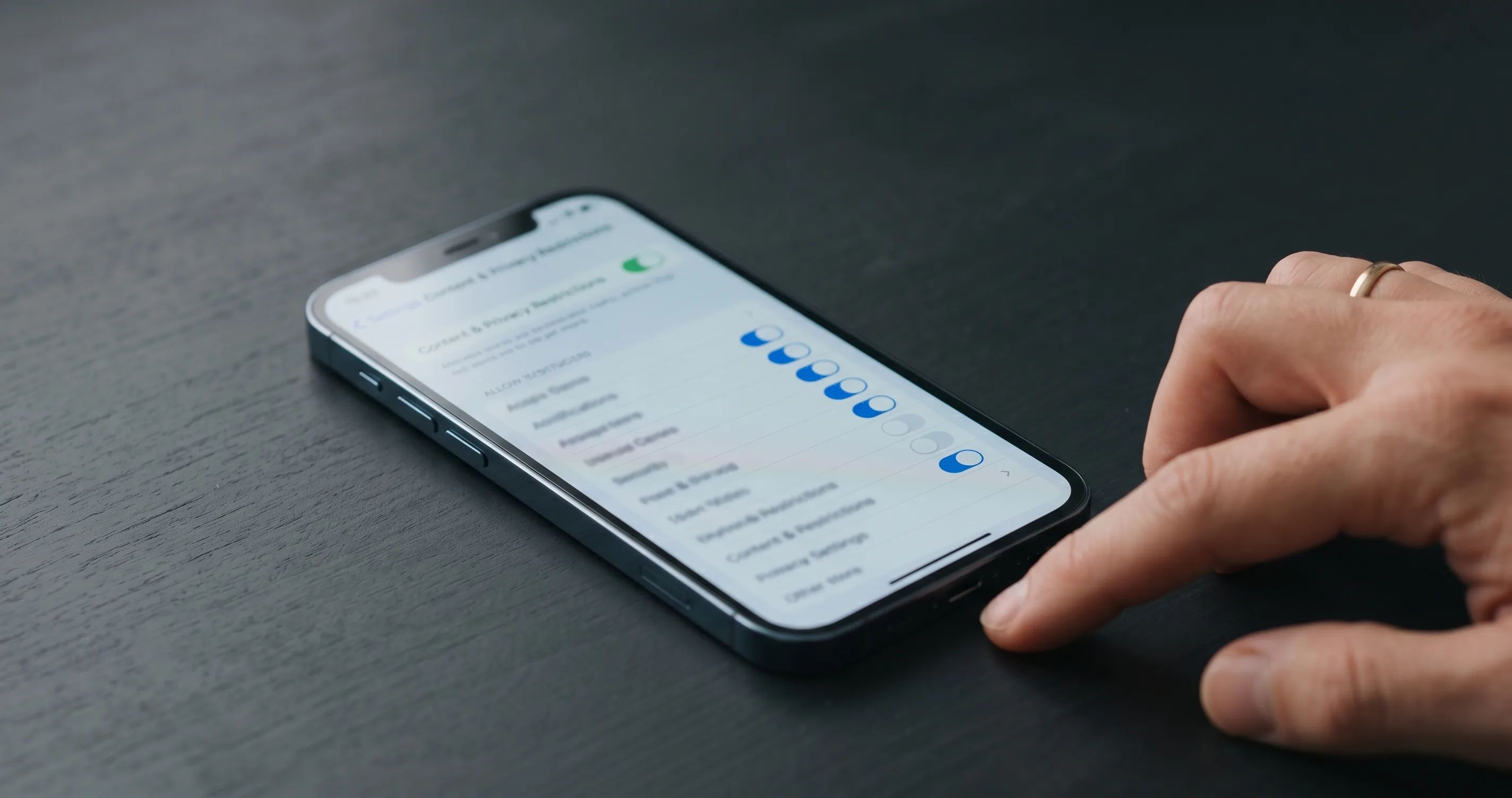
If you need to know how to block porn on iPhone for your child, the good news is you can block the vast majority of adult content in under 10 minutes using tools already built into iOS. At some point — through curiosity, a friend’s link, or an accidental search — your child will encounter it. The question is not if, but when.
This guide covers every method: how to block adult content on iPhone using Screen Time, how to block adult websites on iPhone with DNS filters, and how to block inappropriate websites across Chrome and Safari. Each layer covers a different gap. Used together, they give your child’s phone the strongest content filtering you can set up without third-party monitoring apps.
Method 1: Block Adult Content Using Screen Time
This is the fastest and most important step. Apple’s Screen Time includes a built-in web content filter that blocks known adult websites in Safari. It takes about two minutes to turn on, and it works immediately.
Step-by-step setup
- Open Settings on your child’s iPhone.
- Tap Screen Time. If Screen Time is not enabled yet, tap “Turn On Screen Time” and follow the prompts to set it up as a parent. For a complete walkthrough of the initial setup, see our iPhone parental controls guide.
- Tap Content & Privacy Restrictions.
- Toggle Content & Privacy Restrictions on (green).
- Tap Content Restrictions.
- Tap Web Content.
- Select Limit Adult Websites.
That is it. Safari will now block access to most known adult websites. When your child tries to visit a blocked site, they will see a restriction notice instead of the page content.
Adding specific sites to the blocklist
The “Limit Adult Websites” filter uses Apple’s database of known adult domains, but no database is complete. If you know of specific sites you want blocked, scroll down on the same Web Content screen and tap Add Website under the “Never Allow” section. Enter the full URL (e.g., example.com) and it will be permanently blocked.
The “Allowed Websites Only” option
For younger children (under 8), consider selecting Allowed Websites Only instead of “Limit Adult Websites.” This is a whitelist approach — only sites you explicitly approve will load. Apple pre-populates this list with child-friendly sites like Discovery Kids, PBS Kids, and Disney. You can add more as needed. This is the strictest option but can be frustrating for older children who need the web for homework.
Lock it with a passcode
None of these settings matter if your child can change them. Go to Settings > Screen Time > Lock Screen Time Settings and set a passcode that your child does not know. Use a different passcode than the phone’s unlock code. Without this step, a tech-savvy child can simply turn the restrictions off.
Method 2: Set Up a DNS Filter (CleanBrowsing / OpenDNS)
Screen Time blocks adult sites in Safari. A DNS filter blocks them everywhere — in every browser, in every app, and in every search engine on the device. It works at the network level, which means your child does not need to be using Safari for the protection to apply.
What is a DNS filter?
Every time your phone loads a website, it first asks a DNS server to translate the domain name (like example.com) into an IP address. A DNS filter intercepts that request and checks the domain against a blocklist. If the domain is flagged as adult content, the filter refuses to resolve it — and the site never loads.
Think of it as a bouncer at the door. The request to visit a site never even reaches the site’s server. The bouncer turns it away before it gets in.
How to set up CleanBrowsing on an iPhone
CleanBrowsing offers a free Family Filter that blocks adult content, mixed-content domains, and enforces SafeSearch. Here is how to configure it directly on your child’s iPhone:
- Open Settings > Wi-Fi.
- Tap the info icon (i) next to your connected network.
- Scroll down to DNS and tap Configure DNS.
- Select Manual.
- Remove existing DNS entries and add these two:
- 185.228.168.168
- 185.228.169.168
- Tap Save.
Repeat this for every Wi-Fi network your child connects to (home, school, grandparents’ house).
Covering cellular data
The Wi-Fi DNS settings above do not apply when your child is on cellular data. To cover cellular connections, you need to install a DNS profile. CleanBrowsing provides a free configuration profile you can download from their website. Once installed, it routes all DNS requests — Wi-Fi and cellular — through their family filter.
- On your child’s iPhone, open Safari and go to cleanbrowsing.org/guides/ios.
- Download the Family Filter profile.
- Go to Settings > General > VPN & Device Management.
- Tap the CleanBrowsing profile and tap Install.
- Enter the device passcode when prompted.
Router-level setup (protects every device at home)
If you want to protect every device on your home network — not just your child’s iPhone — change the DNS settings on your router instead of on individual devices. Log into your router’s admin panel (usually 192.168.1.1 or 192.168.0.1), find the DNS settings, and enter the CleanBrowsing or OpenDNS addresses there. This covers laptops, tablets, smart TVs, and game consoles in one step.
Method 3: Force SafeSearch on Google, YouTube, and Bing
Even with Screen Time and DNS filters in place, search engines can still surface explicit results if SafeSearch is not enabled. This method ensures that Google, YouTube, and Bing filter out adult content from search results and video recommendations.
Google SafeSearch
- Open Safari on your child’s iPhone and go to google.com/preferences.
- Check the box next to Turn on SafeSearch.
- Scroll down and tap Save.
If your child is signed into a Google account, go to myaccount.google.com > Data & Privacy > SafeSearch and select Filter. If the account is managed through Google Family Link, you can lock SafeSearch so your child cannot change it.
YouTube Restricted Mode
- Open the YouTube app on your child’s iPhone.
- Tap the profile icon in the top right.
- Tap Settings > General.
- Toggle Restricted Mode on.
Restricted Mode hides videos that have been flagged as containing mature content. It is not perfect — it relies on metadata, community flagging, and automated detection — but it significantly reduces the chances of explicit content appearing in search results or recommendations.
Bing SafeSearch
- Open Safari and go to bing.com/account/general.
- Under SafeSearch, select Strict.
- Tap Save.
If you are using CleanBrowsing as your DNS filter (Method 2), SafeSearch is enforced automatically for Google, Bing, and YouTube. This is one of the strongest reasons to use a DNS filter — it handles SafeSearch enforcement without you needing to configure each service individually.
Method 4: Block Adult Content on Chrome
This is the gap most parents miss. Apple’s Screen Time web content filter only applies to Safari. If your child has Google Chrome installed, they can open it and browse freely — completely bypassing the restrictions you set up in Method 1.
You have three options for how to block adult content on Chrome:
Option A: Remove Chrome entirely
The simplest solution. If your child does not specifically need Chrome, delete it. Go to Settings > Screen Time > Content & Privacy Restrictions > Allowed Apps & Features and disable the ability to install apps, or use the app blocking guide to restrict specific app installations. This forces all web browsing through Safari, where your Screen Time content filter is active.
Option B: Use Google Family Link
If your child has a supervised Google account through Family Link, you can manage Chrome’s content settings remotely:
- Open the Family Link app on your phone.
- Select your child’s profile.
- Tap Controls > Content Restrictions > Google Chrome.
- Select Try to block mature sites or Only allow approved sites.
This applies Google’s own content filter to Chrome, which works independently of Apple’s Screen Time.
Option C: Rely on the DNS filter
If you set up CleanBrowsing or OpenDNS in Method 2, adult content is already blocked in Chrome (and every other app). The DNS filter works at the network level, so it does not matter which browser your child uses. This is the strongest reason to use Methods 1 and 2 together — Screen Time handles Safari, DNS handles everything else.
How to Block Porn on Android (Quick Guide)
If your household has both iPhones and Android devices, or if your child uses an Android phone, the approach is similar but uses different tools. Here is the quick version:
- Google Family Link: Set up a supervised account. Go to Controls > Content Restrictions > Google Chrome and select “Try to block mature sites.” Family Link also lets you manage app installations, screen time limits, and SafeSearch enforcement.
- DNS filter: The same CleanBrowsing or OpenDNS setup works on Android. Go to Settings > Network & Internet > Private DNS and enter family-filter-dns.cleanbrowsing.org. This covers all apps and browsers.
- SafeSearch: Sign into your child’s Google account, go to SafeSearch settings, and select Filter. Lock it through Family Link so they cannot change it.
For a full walkthrough with screenshots, see our Android parental controls guide.
What These Methods Cannot Block
No content filter is 100% effective. Being honest about the limitations helps you set realistic expectations and plan accordingly.
Known gaps
- New and obscure domains. Blocklists rely on known adult domains. Newly created sites or less-trafficked domains may not be cataloged yet. Both Apple’s filter and DNS services update their lists regularly, but there is always a lag.
- Content inside apps. Screen Time’s web filter and DNS filters block website access, but they do not scan content within apps. Social media platforms, messaging apps, and even some gaming apps can contain user-generated adult content that these filters will not catch.
- VPNs and proxy workarounds. A tech-savvy teenager who installs a VPN app can route their traffic around the DNS filter. You can mitigate this by restricting app installations through Screen Time so they cannot install VPN apps without your approval.
- Text and image sharing. Content shared directly through iMessage, AirDrop, or other messaging platforms is not filtered by any of these methods. These are person-to-person transfers that bypass web-based filters entirely.
- Encrypted DNS (DoH/DoT). Some browsers and apps use encrypted DNS protocols that bypass your custom DNS settings. Apple’s configuration profiles (used in CleanBrowsing’s iOS setup) help prevent this, but it is worth being aware of the limitation.
The layered approach
Each method covers different gaps. Here is how they stack:
| Method | Covers | Does Not Cover |
|---|---|---|
| Screen Time (Safari) | Adult websites in Safari | Chrome, other browsers, in-app content |
| DNS Filter | All browsers, all apps (network-level) | VPN bypass, encrypted DNS, in-app DMs |
| SafeSearch | Google/YouTube/Bing search results | Direct URL access, social media, messaging |
| Chrome restrictions | Chrome browser specifically | Other browsers, apps, messaging |
No single layer is sufficient. All four together create strong protection for the vast majority of accidental and casual exposure. But they will not stop a determined teenager with technical knowledge — which is why the next section matters just as much as the technical setup.
Having the Conversation: Why Filters Aren’t Enough
Filters are the floor, not the ceiling. They catch accidental exposure, block curiosity-driven searches, and make it significantly harder for a child to stumble onto content they are not ready for. But they are not a replacement for talking to your child about what exists online and why you are taking steps to protect them.
When to have the conversation
The right time depends on your child’s age and maturity, but a general rule: if they have a phone, they are old enough for a version of this conversation. For children ages 7 to 10, keep it simple and focused on safety. For tweens and teens, be more direct about what adult content is and why it is not an accurate representation of real relationships.
What to say
You do not need a script, but these framing points help:
- “I set up some filters because there are things online that aren’t meant for kids.” This normalizes the filters without making your child feel spied on.
- “If you ever see something that makes you uncomfortable, you can always tell me. You won’t be in trouble.” This keeps the door open. Children who fear punishment hide things. Children who feel safe come to you.
- “The filters aren’t perfect. You might still see things that are confusing or upsetting. That’s why we talk about it.” This sets realistic expectations and positions you as a resource, not a police officer.
Building habits alongside filters
The technical setup protects your child today. Building healthy digital habits protects them for life. Timily’s focus timer helps children develop structured screen time habits — earning their time through tasks and focus sessions rather than having unlimited access that filters alone have to manage. When a child learns to use screens intentionally, the risk of stumbling into harmful content drops because they are not endlessly browsing or scrolling out of boredom.