
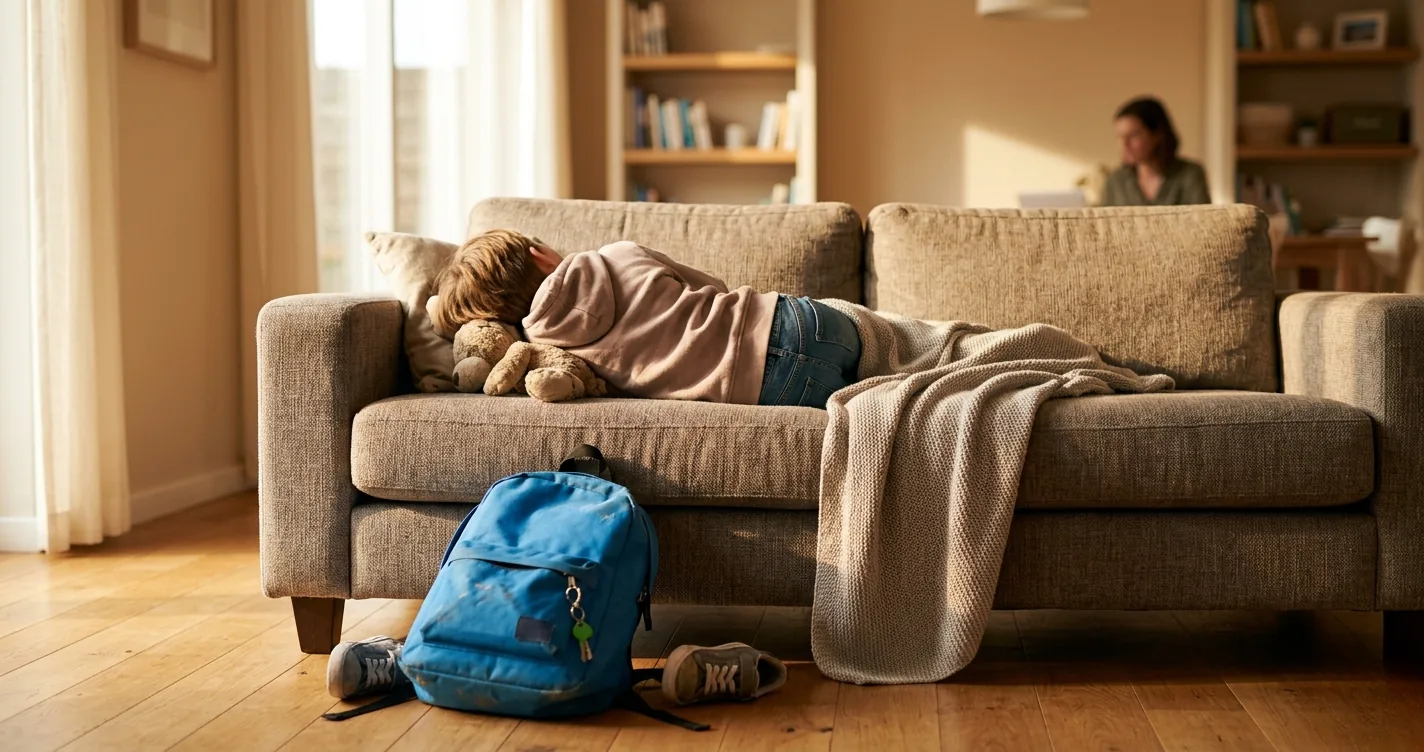
If you are searching for an after school routine ADHD guide, you already know the scene: your child walks through the door, the backpack hits the floor, someone is crying, and the homework battle has begun. You are not alone — and you are not doing anything wrong.
For kids with ADHD, the after-school window is the hardest part of the day. Their brain has been running on fumes since lunch, and you are asking it to keep going. This guide covers homework transitions ADHD families struggle with, how much downtime your child needs, and how to build an after school routine for focus that actually ends the daily meltdown. We also cover the after school transition routine kids with ADHD need before any homework can happen.
What Happens to ADHD Kids After School
To understand why your child falls apart at 3:30 PM, you need to understand what happened between 8:00 AM and 3:00 PM.
School is an executive function marathon. Sitting still, filtering background noise, switching between subjects, remembering multi-step instructions, managing social dynamics at recess, raising a hand instead of blurting out — every one of these tasks demands self-regulation. And for a child with ADHD, self-regulation costs significantly more cognitive energy than it does for neurotypical peers.
Restraint collapse explained
Clinicians and educators use the term restraint collapse to describe what happens when a child who has been holding themselves together in a structured environment finally reaches a safe space. The mask comes off. The effort stops. And everything they suppressed — frustration, sensory overload, emotional exhaustion — comes flooding out at once.
This is not a discipline problem. It is a neurological reality. Your child is not choosing to melt down. Their nervous system is releasing six hours of accumulated strain in the only place it feels safe enough to do so: home, with you.
The executive function battery
Think of your child’s executive function like a phone battery. A neurotypical child might come home at 40% battery — tired but functional. A child with ADHD comes home at 5%. They have been running more apps in the background all day: extra effort to focus, extra effort to sit still, extra effort to process instructions that do not click the first time. By the time they reach your front door, the battery is critical.
Asking a child at 5% battery to immediately start homework is like asking your phone to run a video call when it is about to die. It will not work. And getting frustrated about it will not charge the battery any faster.
The Decompression Window: What It Is and Why It Matters
Decompression is not a reward. It is not “getting away with doing nothing.” It is a biological necessity for a brain that has been running on overdrive.
The decompression window is the period between walking through the door and being ready to handle structured tasks. For most ADHD kids, this window is 30 to 60 minutes. Some children need the full hour, especially on days that were socially or sensorially demanding. Trying to shorten it almost always backfires — you end up spending more time managing the resulting meltdown than you would have spent waiting.
What decompression looks like
Effective decompression is low-demand activity that helps the nervous system downshift. This looks different for every child, but common examples include:
- Physical movement — jumping on a trampoline, riding a bike, shooting hoops, running around the backyard. Movement is one of the most effective ways to discharge built-up energy and regulate the nervous system.
- Sensory comfort — lying under a weighted blanket, petting the dog, squeezing playdough, listening to music with headphones. Sensory input helps the brain recalibrate.
- Quiet solitude — some kids need to be alone and unstimulated for a while. This is not avoidance; it is recovery.
- Creative play — drawing, building with LEGO, playing with figurines. Unstructured creative activity engages the brain without taxing executive function.
What decompression does not look like
Not everything that feels relaxing is actually decompressing. Some activities keep the brain in a heightened state even though the child appears calm:
- Video games — especially fast-paced or competitive ones. They demand rapid decision-making and sustained attention, which is exactly what your child’s brain needs a break from.
- YouTube or TikTok — the rapid-fire content and autoplay loops maintain high stimulation levels. The child looks relaxed but their brain is not downshifting.
- Social media — social comparison, notifications, and commenting add cognitive and emotional load rather than reducing it.
The distinction is important: decompression should lower arousal, not just shift it to a different kind of stimulation.
Reading the cues
How do you know when your child is decompressed enough to handle the next phase? Watch for these signs:
- They start seeking you out or initiating conversation
- Their body language softens — unclenched jaw, relaxed shoulders
- They move around the house more calmly instead of bouncing or flopping
- They can respond to a question without snapping or shutting down
When you see these signals, the battery has recharged enough to move on. Pushing before you see them is a gamble you will usually lose.
When Homework Should Start (And When It Should Not)
The single most common mistake in the after school routine for ADHD kids is starting homework too early. Parents think they are being responsible. Schools send worksheets home expecting them to be done that evening. And the child sits down at the table at 3:45 with their brain at 5% battery and everyone ends up in tears.
The homework window
For most ADHD children, the ideal homework start time is 4:30 to 5:00 PM — about 60 to 90 minutes after arriving home. This gives them time to decompress, eat a proper snack, and let their executive function come back online.
Some children do better with a later window, especially if they have after-school activities that serve as decompression. A child who goes from school to soccer practice and gets home at 5:30 may be ready for homework at 6:00 because the physical activity already did the regulating work.
How to structure the homework block
ADHD brains work best in short, focused bursts with built-in breaks. Instead of “sit down and finish everything,” try this structure:
- Review together (2–3 minutes) — look at what needs to be done, break it into small steps, and decide the order together. This reduces the overwhelm that causes avoidance.
- Work sprint (15–20 minutes) — set a visible timer and let them focus on one task. Knowing the endpoint makes it easier to start.
- Micro-break (5 minutes) — get water, stretch, walk around. The break must have a clear endpoint too.
- Repeat — another sprint, another break. Most elementary homework can be finished in 2–3 sprints.
This is where a structured routine like the one you use in the morning pays off. The child learns that routines have phases, and each phase ends. The predictability is what makes it tolerable. For structured activities between sprints, time management games can double as both a break and a skill-builder.
How Screens Fit Into an After-School ADHD Routine
This is where most families get stuck. Your child wants their tablet the moment they walk in. You know it will make the homework transition harder. But saying no triggers a meltdown, and you are already exhausted.
Why screens are tricky during decompression
Screens feel calming to the child because they provide instant dopamine — the exact neurotransmitter that ADHD brains are chronically short on. This is why your child gravitates toward them. But the calm is deceptive. Screens maintain a high level of neural stimulation, which means the brain never actually downshifts. When you finally take the screen away for homework, the transition is even harder because the child’s brain has to drop from high stimulation to high demand — with no regulation period in between.
A better placement for screens
Instead of using screens as the decompression activity, position them as the earned reward after homework. This accomplishes three things:
- It gives your child something to look forward to during homework — a light at the end of the tunnel.
- It avoids the screen-to-homework transition, which is the hardest transition of the day.
- It teaches the earn-before-play principle, which builds self-regulation over time.
If your child currently gets screens right after school and you want to shift the pattern, do it gradually. Move screens 15 minutes later each week rather than eliminating them cold turkey. Explain the reason clearly: “We are going to try putting screens after homework because I noticed it is really hard to stop and switch. Let us see if this works better for both of us.”
When screens during decompression can work
There is one exception worth noting. Some ADHD children use a very specific, calm screen activity as genuine self-regulation: watching a familiar show they have seen many times, listening to a podcast, or watching nature documentaries. The key difference is predictability and low stimulation. If the content is familiar, slow-paced, and the child transitions off it without a fight, it may be functioning as genuine decompression. If they resist stopping, it is not — it is stimulation masquerading as calm.
For more on managing screen rules around school devices, see our dedicated guide.
Sample After-School Routines (Elementary vs Middle School)
Here are two sample routines based on the four-phase framework: arrive → decompress → refuel → work. Adapt the times to your family’s schedule, but keep the phase order consistent.
Elementary school (ages 6–10)
| Time | Phase | Activity | Duration |
|---|---|---|---|
| 3:15 PM | Arrive | Backpack hook, shoes off, check folder together | 5–10 min |
| 3:25 PM | Decompress | Outdoor play, trampoline, drawing, LEGO, pet time | 30–45 min |
| 4:00 PM | Refuel | Protein-rich snack + water at the table (no screens) | 15 min |
| 4:15 PM | Work | Homework sprints (15 min work + 5 min break) | 30–45 min |
| 5:00 PM | Free time | Earned screen time, play, or family activity | Until dinner |
Middle school (ages 11–14)
| Time | Phase | Activity | Duration |
|---|---|---|---|
| 3:30 PM | Arrive | Unload bag, brief check-in (“How was today?”), review assignments | 10 min |
| 3:40 PM | Decompress | Physical activity, music, solo time, creative project | 45–60 min |
| 4:30 PM | Refuel | Substantial snack with protein and complex carbs | 15 min |
| 4:45 PM | Work | Homework sprints (20 min work + 5 min break), start with hardest subject | 45–75 min |
| 6:00 PM | Free time | Earned screen time, social time, hobbies | Until dinner / evening routine |
Why the phase order matters
The four-phase sequence is not arbitrary. It follows the natural rhythm of nervous system recovery:
- Arrive — a brief landing ritual that signals the transition from school mode to home mode. Keep it minimal: unload, check in, done.
- Decompress — the nervous system discharges accumulated stress through movement, sensory input, or quiet solitude.
- Refuel — blood sugar drops after a long school day. A protein-rich snack stabilizes energy and supports the executive function that homework demands. Common winning snacks: cheese and crackers, apple slices with peanut butter, yogurt with granola, or a turkey roll-up.
- Work — with a regulated body and a fueled brain, the child can now access their executive function for focused tasks.
Skipping or reordering phases — especially jumping from arrive straight to work — is where the daily fight begins.
When the Meltdown Happens Anyway
Even with the best routine, meltdowns will still happen. Bad days at school, sensory overload, social conflict, a change in the schedule, hunger, poor sleep the night before — any of these can override the routine. That is normal. The question is not how to eliminate meltdowns but how to handle them without making things worse.
What not to do
- Do not lecture. A child in the middle of restraint collapse cannot process verbal reasoning. Their prefrontal cortex — the part that handles logic and language comprehension — is temporarily offline. Talking more makes it worse, not better.
- Do not punish the meltdown. Taking away privileges because your child is dysregulated is like punishing someone for having a fever. The meltdown is a symptom, not a choice.
- Do not rush the recovery. “Are you done yet?” adds pressure to a system that is already overloaded. Give them time.
What to do instead
The research on co-regulation is clear: children cannot regulate themselves until they have been regulated by a calm adult first. During a meltdown, your job is not to fix it. Your job is to be the calm in the storm.
- Reduce sensory input. Lower your voice. Turn off background noise. Dim lights if possible. Fewer inputs mean less for the overloaded brain to process.
- Offer physical comfort if welcome. Some children want to be held. Others need space. Follow their lead. “I am right here when you are ready” works for children who pull away.
- Name what you see without judgment. “You had a really long day and your body is telling you it needs a break.” This validates their experience without labeling their behavior as bad.
- Wait, then reconnect. Once the storm passes, reconnect briefly: “That was a tough one. Want some water?” Do not rehash what happened. Move forward into the routine.
After the meltdown: adjust, do not abandon
A meltdown is data. It tells you something about the day, the load, or the routine that did not work. Maybe the decompression window was too short. Maybe they skipped snack. Maybe something happened at school that needs to be addressed. Use the information, but do not throw out the entire routine because of one bad afternoon. Consistency is what makes the routine work — and consistency means showing up with the same structure even on the hard days.
Making the Routine Stick Without Becoming the Enforcer
Here is the paradox: ADHD kids need routine more than most children, but they also resist it more than most children. The novelty-seeking brain that makes them creative and spontaneous is the same brain that fights predictable structure. So how do you hold the routine without becoming the bad guy?
Let the system enforce, not you
The single biggest shift you can make is removing yourself from the enforcement role. When you say “homework time,” it triggers a power struggle. When a timer signals “homework time,” the child’s frustration targets the system, not the parent. This distinction changes the entire emotional landscape of your afternoons.
Visual timers, structured task lists, and earn-based systems all serve this purpose. The routine becomes something the child follows rather than something the parent imposes. You shift from enforcer to coach.
Use visual anchors
ADHD brains process visual information more effectively than verbal instructions. A written or illustrated schedule on the wall — showing the four phases with approximate times — gives your child a reference point they can check themselves. “What comes next?” is a question they can answer by looking at the chart, rather than depending on you to announce each transition.
For younger children, picture-based schedules work well. For older kids, a simple checklist they can physically mark off gives them a sense of progress and control.
Build in choice
Rigidity kills compliance. Instead of dictating every minute, build choice points into the routine:
- “Do you want to decompress outside or in your room?”
- “Which homework subject do you want to start with?”
- “Apple with peanut butter or cheese and crackers for snack?”
These small choices give the child a sense of autonomy within the structure. They are following the routine, but they have agency over how they move through it. This dramatically reduces resistance.
Celebrate the routine, not the outcome
When your child follows the routine — even imperfectly — acknowledge it. “You took your break and then came back to homework without me reminding you. That was awesome.” Praising the process builds intrinsic motivation. Praising only results (“You got an A!”) teaches them that the outcome is all that matters, which increases anxiety and avoidance.
Expect the adjustment period
A new routine takes 2 to 4 weeks to become automatic — longer for ADHD kids whose brains resist habit formation. The first week will be messy. The second week will be slightly less messy. By week three, you will start to see moments where the child moves to the next phase without prompting. That is the routine taking hold.
Do not give up during week one. And do not change the routine every time it does not work perfectly. Consistency is the mechanism. Give it time to work.