
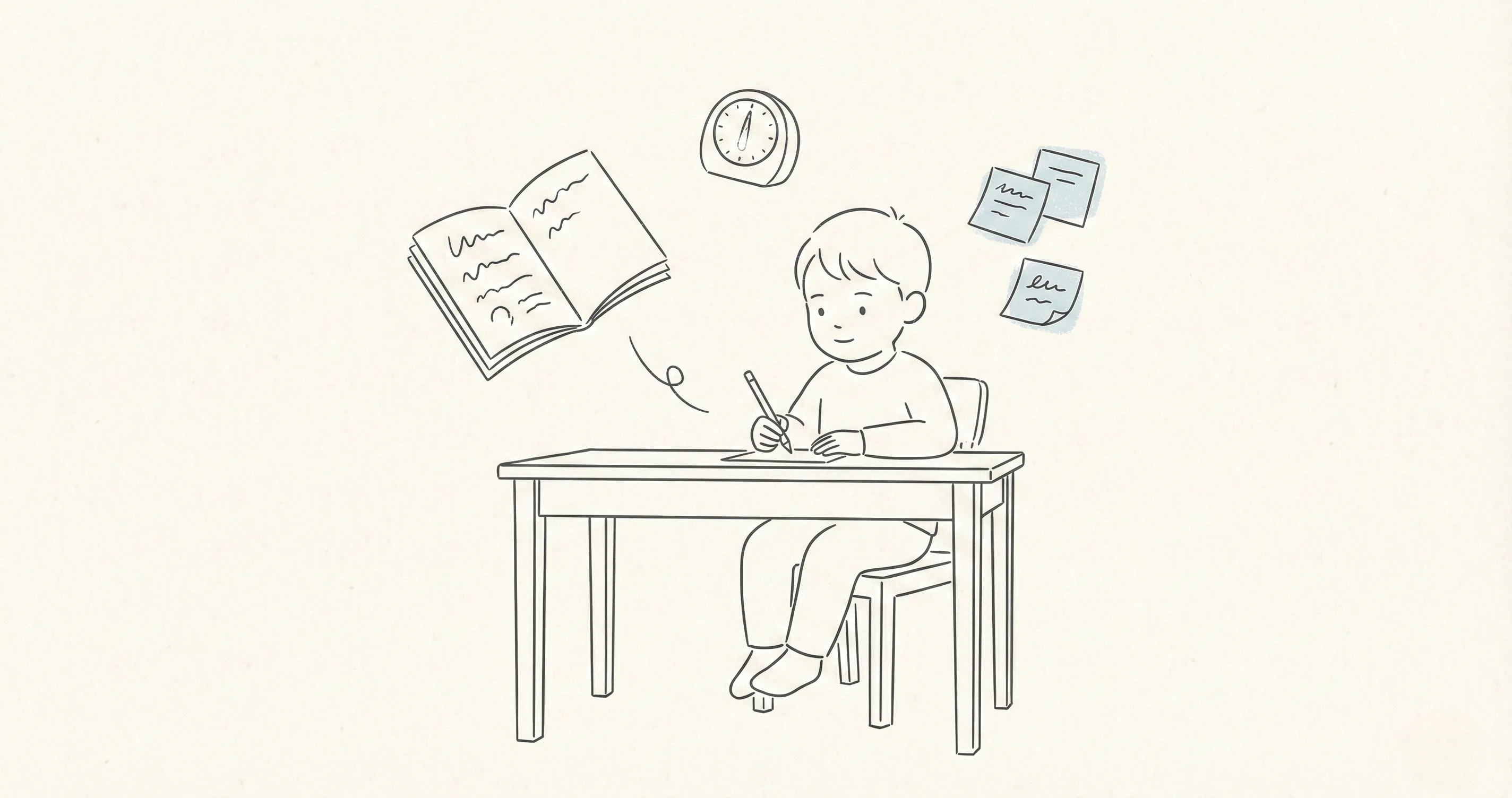
Most study advice assumes a brain that can sit down, plan an approach, sustain attention for 30 to 60 minutes, and self-correct when focus drifts. For a child with ADHD, every one of those steps is a neurological obstacle. Study techniques for ADHD need to account for differences in executive function, working memory, and dopamine regulation — otherwise they are just instructions the child cannot follow, no matter how hard they try.
The gap between what ADHD kids are told to do and what their brains can actually execute is not a motivation problem. A 2023 meta-analysis of over 130 studies confirmed that ADHD consistently impairs working memory, cognitive flexibility, and inhibitory control — the three pillars of executive function. These are the exact skills that traditional study methods demand but never teach.
This guide covers eight evidence-based study methods for ADHD, each designed to compensate for a specific executive function deficit. No technique works for every child, so the goal is to understand why each one works and match the right combination to your child.
Why Traditional Studying Fails for ADHD Brains
Traditional studying fails for ADHD brains because it demands sustained effort without providing the structure, external cues, or immediate feedback that ADHD brains need to stay engaged. Understanding why is the first step to choosing study strategies for adhd that actually produce results.
Executive function is the bottleneck
Executive function is the brain's project manager. It decides what to work on, in what order, for how long, and when to switch. In ADHD, the prefrontal cortex — where executive function lives — develops 2 to 3 years behind schedule. A 12-year-old with ADHD may have the executive function capacity of a 9 or 10-year-old. This means the study skills expected at their grade level are literally beyond what their brain can currently manage on its own.
The mismatch shows up in predictable patterns. The child stares at an assignment for 20 minutes without starting (initiation deficit). They start but jump between subjects without finishing any (cognitive flexibility impairment). They forget what they just read three paragraphs ago (working memory deficit). None of this is laziness. It is a brain that needs external scaffolding to do what neurotypical brains handle internally.
Working memory overload
Working memory is the mental scratchpad that holds information while you use it. ADHD reduces working memory capacity by roughly 20 to 30 percent compared to neurotypical peers. When a child with ADHD sits down to study, the instructions alone can fill their working memory — leaving little capacity for the actual content. "Read chapter 5, answer questions 1 through 10, then review your notes from last week" sounds like one assignment. For an ADHD brain, it is three competing demands on a system that barely handles one.
The dopamine mismatch
Studying is a low-dopamine activity. ADHD brains have lower baseline dopamine, meaning they need more stimulation to reach the engagement threshold that neurotypical brains reach naturally. This is why an ADHD child can focus on a video game for three hours but cannot sustain ten minutes of reading. The game provides rapid, variable rewards. The textbook provides none. Effective ADHD learning strategies must build reward, novelty, or urgency into the study process itself.
Chunking: Breaking Tasks Into Manageable Pieces
Chunking is the single most effective starting point for ADHD studying because it addresses the core problem: the task feels too big to start. By breaking an assignment into pieces small enough that each one takes 5 to 15 minutes, you lower the activation energy needed to begin — and beginning is usually the hardest part.
How chunking works for ADHD
Instead of "study for the science test," chunk the task into visible, concrete steps:
- Read section 1 (pages 42-45) and highlight key terms — 8 minutes
- Write one-sentence definitions for 5 highlighted terms — 6 minutes
- Take a 3-minute movement break
- Read section 2 (pages 46-49) and highlight key terms — 8 minutes
- Quiz yourself on all terms so far — 5 minutes
Each chunk has a clear start, a clear end, and a time estimate. This externalizes the planning that executive function would normally handle internally. The child no longer needs to figure out what to do next. They just follow the list.
Practical tips for parents
- Write it down. Do not give verbal instructions for chunked tasks. ADHD working memory will lose verbal instructions within seconds. Use a whiteboard, sticky notes, or a simple numbered list on paper.
- Include time estimates. ADHD causes time blindness — difficulty perceiving how long a task will take. Attaching a number of minutes makes each chunk feel achievable.
- Let the child check off completed chunks. The physical act of crossing something off a list provides a micro-dopamine reward that sustains motivation through the session.
- Keep chunks under 15 minutes for kids under 12. For teens, 15 to 20 minutes per chunk works better.
The Pomodoro Technique, Adapted for ADHD
The Pomodoro Technique uses timed focus intervals followed by short breaks. The standard version — 25 minutes on, 5 minutes off — was designed for neurotypical adults. For ADHD kids, it needs modification, but the underlying principle is powerful: a visible countdown creates urgency, and the guaranteed break makes the work feel finite.
Modified intervals for ADHD kids
- Ages 6-9: 8 to 12 minutes of focus, 3 to 5 minutes of break
- Ages 10-13: 12 to 18 minutes of focus, 4 to 5 minutes of break
- Ages 14+: 15 to 25 minutes of focus, 5 to 7 minutes of break
The timer itself matters. A visual timer that shows time draining (a shrinking colored wedge or a sand timer) works better for ADHD than a digital countdown, because it makes abstract time concrete. Timily's Focus Timer uses immersive scenes and calming music to support this kind of structured focus block, earning points for each completed session.
For a deeper look at how to adapt Pomodoro specifically for ADHD — including medication timing, hyperfocus management, and when standard intervals need to change — see our detailed guide on the Pomodoro technique for kids.
Body Doubling: The Power of Parallel Presence
Body doubling means having another person present — not helping, not tutoring, just being there — while the ADHD child works. It sounds too simple to work, but it is one of the most consistently reported effective study techniques for ADHD by both clinicians and parents.
Why body doubling works
The ADHD brain struggles with internal motivation and self-monitoring. When another person is present, the brain receives external activation signals that partially compensate for the missing internal ones. The presence of another person creates a low level of social accountability that helps the ADHD brain maintain the state of "working" without needing constant check-ins or reminders.
Research on ADHD and social facilitation suggests that the effect is neurological, not just behavioral. The presence of another focused person may increase norepinephrine levels, which supports sustained attention — one of the neurotransmitters that ADHD medication targets.
How to set up body doubling at home
- Parent body doubling: Sit at the same table working on your own task — paying bills, reading, answering emails. Do not supervise or comment on the child's work unless asked.
- Sibling body doubling: An older sibling doing their own homework nearby can serve the same function.
- Virtual body doubling: For teens, video study sessions with a classmate (cameras on, mics muted) replicate the effect when in-person options are not available.
- What not to do: Do not hover. Do not ask "are you staying focused?" every five minutes. The power of body doubling comes from presence without pressure.
Active Recall and Spaced Repetition for ADHD
Most ADHD students default to re-reading as their study method because it is passive and requires minimal executive function effort. Unfortunately, re-reading is also one of the least effective ways to learn. Active recall — testing yourself on material rather than passively reviewing it — produces significantly stronger memory formation.
Active recall for ADHD learners
Active recall works especially well for ADHD because it turns studying into a challenge. Instead of reading a page of notes, the child covers the page and tries to recall the key points. This creates a micro-game with immediate feedback (did I remember it or not?), which generates the novelty and reward that ADHD brains need to stay engaged.
Practical active recall methods for kids:
- Flashcards — physical cards are better than apps for younger kids because the tactile element adds a sensory channel
- The blank page test — after reading a section, close the book and write everything you remember on a blank page, then check what you missed
- Teach-back — the child explains the material to a parent or stuffed animal as if teaching a class. This forces organization and retrieval.
- Quiz-yourself checklists — write questions on one side of a sheet, answers on the back. The child quizzes themselves and tracks which questions they missed for the next round.
Spaced repetition: timing the review
Spaced repetition is the practice of reviewing material at increasing intervals — one day later, three days later, one week later. It exploits the brain's natural forgetting curve: each time you retrieve a memory right before you forget it, the memory becomes stronger.
For ADHD kids, spaced repetition requires external scaffolding because the child will not remember to review on their own (that requires planning and time awareness — both executive function skills). Parents can set up a simple system:
- Day 1: Learn new material
- Day 2: Quick 5-minute quiz on yesterday's material
- Day 4: Another quick quiz
- Day 7: Final review
Use a calendar or reminder app to schedule these reviews. The child should not be responsible for tracking the intervals — that defeats the purpose of externalizing executive function.
Environmental Design: Setting Up the Right Study Space
Environment has a disproportionate effect on ADHD studying. A neurotypical child might be mildly distracted by a cluttered desk or a TV in the next room. For an ADHD child, those same stimuli can make focused work nearly impossible. How to focus on homework with adhd often comes down to setting up the physical space correctly.
Noise and sound
Complete silence is not always ideal for ADHD brains. Many ADHD kids focus better with low-level background noise that occupies the part of the brain that would otherwise seek stimulation. Options include:
- White noise or brown noise machines
- Lo-fi music playlists (no lyrics — lyrics pull attention toward language processing)
- Noise-canceling headphones for environments where background noise is distracting rather than helpful
The key is consistency. Once you find the right sound environment, use it every study session. The brain begins to associate that specific sound with "focus mode," creating a Pavlovian cue that lowers the activation barrier over time.
Visual clutter and desk setup
An ADHD brain processes visual information differently. Every object in the visual field is a potential attention magnet. Before a study session:
- Clear the desk of everything except the current task materials
- Put the phone in another room (not just face-down — in another room)
- Close all browser tabs and apps except what is needed for the assignment
- Use a physical folder or tray for "finished" work so completed items leave the visual field
Movement-friendly seating
Requiring an ADHD child to sit perfectly still while studying forces their brain to spend energy on stillness that could go toward learning. Alternatives that allow micro-movement while working include wobble cushions, standing desks, exercise ball chairs, or simply allowing the child to stand and pace while reviewing flashcards.
Movement and Exercise as Study Tools
Exercise is the most underused study technique for ADHD. A 2022 meta-analysis found that a single 20-minute bout of moderate aerobic exercise improved attention, working memory, and inhibitory control in children with ADHD for up to 60 minutes afterward. The mechanism is straightforward: exercise increases dopamine and norepinephrine in the prefrontal cortex — the same neurotransmitters that ADHD medication targets.
Strategic exercise timing
Place exercise before the most demanding study block of the day. Twenty minutes of jumping jacks, a bike ride, a walk around the block, or a dance break before homework can be more effective than an extra 20 minutes of studying. This is not intuitive for most parents, who feel like play should come after work. But for ADHD brains, exercise is not a reward — it is a cognitive primer.
Movement between study chunks
Breaks between study chunks should involve physical movement, not screen time. Screen breaks replace one dopamine source with another, making it harder to re-engage with the lower-dopamine study task. Movement breaks, on the other hand, discharge physical restlessness and reset attention:
- 10 jumping jacks
- A lap around the house or yard
- Stretching or yoga poses
- Tossing a ball against a wall
- Dancing to one song
How to Combine Techniques by Age
No single technique is enough. The best way to study with adhd is to combine two or three methods that address different executive function deficits. Here is a starting framework based on age and developmental stage.
Elementary school (ages 6-9)
At this age, the parent is the external executive function. The child cannot yet self-manage any of these techniques independently.
- Lead with: Chunking (parent creates the task list) + visual timer (8-12 minute blocks)
- Add: Body doubling (parent sits nearby) + movement breaks between each chunk
- Study session length: 20 to 30 minutes total, including breaks
- Parent role: Set up the environment, create the plan, sit nearby, enforce break timing
Middle school (ages 10-13)
Gradually transfer ownership. The child begins co-creating the chunk list and choosing their own break activities.
- Lead with: Chunking (child helps create the list) + Pomodoro timer (12-18 minute intervals)
- Add: Active recall (flashcards or teach-back) + environmental design (child learns to clear own desk)
- Study session length: 35 to 50 minutes total, including breaks
- Parent role: Co-plan, body double when available, review the spaced repetition schedule
For screen time management alongside studying, an earn-based system can connect completed study chunks to screen time rewards. For example, using Timily's Focus Timer, each completed focus session earns points that the child can later redeem for app time — turning study effort into a tangible, immediate payoff that aligns with how the ADHD brain processes motivation.
High school (ages 14+)
The teen should drive the system, with the parent as a coach rather than a manager. Teens with ADHD can also begin using techniques independently if the system is set up well.
- Lead with: Chunking (self-created) + Pomodoro timer (15-25 minute intervals) + active recall and spaced repetition
- Add: Virtual body doubling (study sessions with peers) + exercise before the hardest block
- Study session length: 60 to 90 minutes total, including breaks
- Parent role: Check in on the system weekly, not daily. Help troubleshoot when it breaks down, not micromanage compliance.
When Study Struggles Signal Something More
These study techniques for ADHD address executive function challenges that respond to environmental and behavioral strategies. But some study struggles point to issues that techniques alone cannot fix.
Consider professional evaluation if:
- Multiple techniques produce no improvement after 4 to 6 weeks of consistent use. This may indicate a learning disability (dyslexia, dyscalculia) co-occurring with ADHD, which requires specialized intervention.
- Anxiety or avoidance is increasing despite a supportive study environment. ADHD and anxiety frequently co-occur, and anxiety-driven avoidance may need therapeutic support beyond study strategies.
- The child can focus during body doubling or with a timer but cannot sustain any focus alone. This may suggest medication should be discussed with the child's healthcare provider as a complement to behavioral strategies.
- Academic performance is declining despite genuine effort and multiple strategy changes. A psychoeducational assessment can identify specific processing weaknesses that current strategies are not addressing.
For broader guidance on managing ADHD and daily routines, including screen time, our guide on ADHD and screen time management covers how reward-based systems can work alongside these study strategies.