
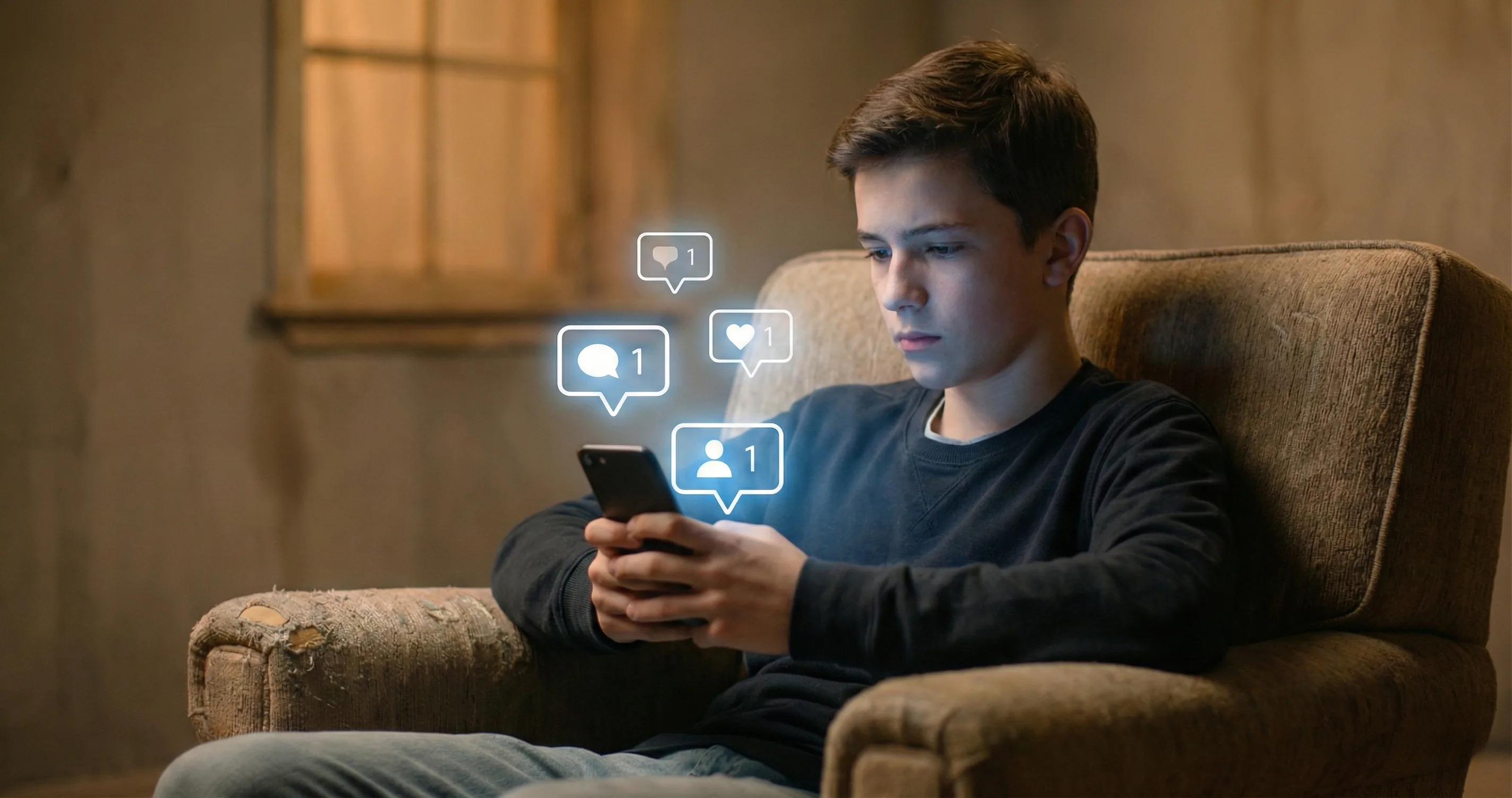
Your teenager used to be confident, sociable, and generally content. Then they got on Instagram, TikTok, or Snapchat — and something shifted. More time alone in their room. More comments about how they look. More irritability when the phone is taken away. If this pattern sounds familiar, you are not imagining things. Research increasingly confirms that the impact of social media on teens mental health is real, measurable, and worth taking seriously.
This is not another article telling you to panic or to confiscate your child’s phone. It is a clinical look at what the science actually says about how does social media affect teenagers mental health, which specific mechanisms cause the most harm, and — most importantly — what you can do about it without destroying your relationship with your teen in the process.
What the Surgeon General Says About Social Media and Kids
Understanding the impact of social media on teens mental health became a national priority in May 2023, when U.S. Surgeon General Dr. Vivek Murthy issued a landmark advisory on social media and youth mental health, warning that social media carries a “profound risk of harm” to young people. The advisory was not a recommendation to ban social media. It was a call to acknowledge that we cannot yet conclude social media is safe for children and adolescents.
The numbers behind the surgeon general social media kids advisory are striking. Up to 95% of teens aged 13–17 report using a social media platform. Nearly two-thirds use it daily, and one-third describe their usage as “almost constant.” The Surgeon General identified 3 hours per day as a critical threshold: teens who exceed this face double the risk of depression and anxiety symptoms.
In 2024, Dr. Murthy went further, calling for tobacco-style warning labels on social media platforms — a move that underscored just how seriously public health authorities now treat this issue. The American Psychological Association followed with its own health advisory on adolescent social media use, recommending age-appropriate monitoring and mandatory social media literacy training before teens are given unsupervised access.
How Does Social Media Affect Teenagers Mental Health?
The impact of social media on teens mental health does not flow through a single mechanism. It operates through several overlapping pathways, each reinforcing the others. Understanding these pathways is essential because the solution differs depending on which mechanism is most active in your child’s life.
The Five Core Pathways
- Social comparison: Teens constantly measure themselves against curated, filtered versions of their peers’ lives. This is the single strongest predictor of negative effects of social media on children, according to a 2023 systematic review published in the Journal of Adolescent Health.
- Cyberbullying: Approximately 46% of teens report experiencing some form of online harassment, according to Pew Research. Unlike schoolyard bullying, cyberbullying follows children home and into their bedrooms.
- Sleep disruption: Late-night scrolling suppresses melatonin, delays sleep onset, and reduces sleep quality. Poor sleep alone accounts for a significant portion of the mood and attention problems attributed to social media.
- FOMO (Fear of Missing Out): Social media creates a constant awareness of events, conversations, and gatherings happening without your teen. FOMO triggers anxiety even when nothing objectively bad is happening.
- Algorithmic amplification: Recommendation algorithms learn what holds attention — and for vulnerable teens, that often means increasingly extreme, distressing, or appearance-focused content.
A 2025 Pew Research report found that 48% of teens now say social media has a mostly negative effect on people their age, up from 32% in 2022. Teens themselves are increasingly aware of the toll — but awareness alone does not translate into changed behavior. The platforms are designed to keep them engaged.
For a deeper look at the neurological mechanisms behind compulsive social media use, see our guide on how screen time affects kids’ brains.
Social Media and Anxiety in Teens: The Comparison Trap
Social media and anxiety in teens are linked most strongly through the mechanism of social comparison. Unlike in-person interactions where your teen sees the full, messy reality of other people’s lives, social media presents a highlight reel. Every feed is a curated gallery of vacations, achievements, friend groups, and carefully posed photos.
The comparison trap works in two directions. Upward comparison — “their life is better than mine” — produces envy, inadequacy, and anxiety. Downward comparison — “at least I’m not like them” — can produce temporary relief but often leads to guilt and further scrolling. Both feed the cycle.
Why Teens Are Especially Vulnerable
Adolescence is already a period of heightened self-consciousness. The prefrontal cortex — responsible for rational perspective-taking and impulse control — is not fully developed until the mid-twenties. This means teens lack the neurological hardware to contextualize what they see online. When a peer’s post gets 200 likes and theirs gets 15, the emotional impact is genuinely different for a 14-year-old than for a 30-year-old.
Problematic social media use in adolescents rose from 7% in 2018 to 11% in 2022, according to a 2024 WHO Europe report. The increase tracks almost perfectly with the rise of algorithm-driven feeds that prioritize engagement over wellbeing.
What FOMO Actually Looks Like at Home
If your teen checks their phone compulsively, becomes visibly upset after scrolling, or frequently says things like “everyone else was invited” or “I’m the only one who doesn’t have...”, you are seeing FOMO in action. The anxiety is not about a specific event. It is about the persistent feeling that social life is happening without them, broadcast in real time through their feed.
Body Image, Self-Esteem, and Social Media
The relationship between social media body image teens experience and their self-esteem is one of the most well-documented effects in the research. Internal research from Instagram (leaked in 2021) showed that the company’s own data confirmed the platform made body image issues worse for one in three teen girls.
Beauty filters on TikTok, Snapchat, and Instagram create an unattainable standard. Teens see filtered versions of their own faces so often that their actual reflection begins to feel wrong. Dermatologists have documented a rise in teens seeking cosmetic procedures to match their filtered selfies — a phenomenon researchers call “Snapchat dysmorphia.”
Gender Differences in Body Image Impact
Girls face disproportionate harm from appearance-focused content. The constant exposure to edited photos, “what I eat in a day” videos, and beauty influencer culture drives dissatisfaction with their own bodies. Research published by the APA in 2023 found that reducing social media use by even 50% for a few weeks improved body image in young people.
Boys are not immune, though the pathway differs. For boys, social media increasingly promotes muscular ideals, fitness influencer culture, and supplements marketed toward unrealistic physiques. Boys also face higher exposure to aggressive and risk-glorifying content that shapes their sense of what masculinity should look like.
Social Media and Depression in Teens: What Research Shows
The link between social media and depression in teens has moved from theoretical concern to clinical evidence. A 2025 study from UT Southwestern Medical Center found that 40% of depressed and suicidal youth reported problematic social media use — defined as use that the teen themselves recognized as excessive but felt unable to control.
The causal direction matters, and researchers are increasingly clear on it. While teens who are already depressed may gravitate toward social media for comfort, the platforms themselves create conditions that worsen depression. Passive consumption — scrolling without posting, commenting, or interacting — is the usage pattern most strongly associated with depressive symptoms.
The Passive Scrolling Problem
Not all social media use is equal. Active use (messaging friends, creating content, participating in interest-based communities) carries different — and often lower — mental health risks. Passive use (scrolling through feeds, watching others’ stories, lurking without engaging) is where the strongest depression links appear.
The distinction matters because it changes the intervention. If your teen primarily messages friends on social media, the platform may be serving a genuine social function. If they primarily scroll through an algorithmically generated feed for hours, the risk profile is very different.
The Sleep Connection
Depression and sleep disruption form a feedback loop that social media accelerates. Blue light from screens suppresses melatonin production. Emotionally activating content — whether exciting, distressing, or anxiety-producing — keeps the nervous system in an alert state. Teens who use social media within an hour of bedtime consistently report worse sleep quality, and poor sleep is one of the strongest predictors of adolescent depression. For strategies on managing this, see our guide on digital detox for kids.
Signs Social Media Is Harming Your Child’s Mental Health
Recognizing the impact of social media on teens mental health early gives you the best chance of intervening before patterns harden. Look for changes that correlate with social media use — not just general teen moodiness, but shifts that track with when, how, and how much your teen is online.
Behavioral Warning Signs
- Mood changes after scrolling: Your teen picks up their phone in a neutral mood and puts it down visibly upset, anxious, or angry.
- Withdrawal from in-person activities: Declining invitations to events they used to enjoy, preferring online interaction to face-to-face time.
- Secrecy about phone use: Hiding screens when you walk by, creating secondary accounts you are not aware of, or becoming defensive when asked about their activity.
- Sleep disruption: Difficulty falling asleep, using the phone in bed after lights out, or appearing exhausted despite adequate time in bed.
- Negative self-talk: Increased comments about appearance, popularity, or social standing that reference what they see online.
Emotional Warning Signs
- Increased irritability: Particularly when asked to put the phone down or when unable to check notifications.
- Expressions of inadequacy: “Everyone else has a better life,” “Nobody likes my posts,” or comparing follower counts.
- Declining academic performance: Not because of distraction alone, but because emotional energy is being consumed by social dynamics playing out online.
- Loss of interest in hobbies: Activities that used to bring joy no longer compete with the dopamine feedback of social media.
A single sign is not cause for alarm. A cluster of three or more changes, sustained over several weeks, warrants a direct conversation. For a comprehensive framework on recognizing problematic screen behaviors, see our guide on screen addiction signs in kids.
How to Protect Your Teen Without Banning Social Media
Knowing the impact of social media on teens mental health is one thing. Knowing what to do about it is another. Outright bans rarely work with teenagers. They drive social media use underground, create secrecy, and remove your ability to guide their digital habits. The research and clinical consensus point toward a middle path: structured access with collaborative boundaries.
Start With a Conversation, Not a Confiscation
Before changing any rules, talk to your teen about what you have noticed — without accusation. Use specific observations: “I’ve noticed you seem upset after being on your phone. What’s going on?” Teens who feel heard are far more likely to cooperate with boundaries than teens who feel controlled.
Ask what they like about social media and what bothers them. You may be surprised: many teens will voluntarily acknowledge that certain platforms make them feel worse. This shared understanding becomes the foundation for rules that feel collaborative rather than imposed.
Set Clear, Specific Boundaries
Vague rules (“spend less time on your phone”) fail because they are unenforceable and open to interpretation. Effective boundaries are specific and tied to routines:
- Phone-free zones: No phones at the dinner table, in bedrooms after 9 PM, or during homework.
- Time limits: Agree on a daily social media cap. The Surgeon General’s 3-hour threshold is a useful starting point for discussion.
- Platform-specific rules: Not all platforms carry equal risk. You might allow messaging apps with fewer restrictions while placing tighter limits on algorithm-driven feeds like TikTok or Instagram Explore.
Use an Earn-Based Approach
Rather than positioning social media as something you take away when behavior is bad, frame access as something earned through positive actions. This shifts the dynamic from punishment to motivation. Timily’s Collaborative App Blocking lets you sit down with your teen and agree together on which apps are available by default and which require earned access — removing the daily negotiation that strains so many families.
Build Offline Alternatives
Teens do not stop using social media simply because a parent says so. They need compelling alternatives. Sports, creative projects, part-time jobs, volunteer work, and in-person social activities all provide the sense of belonging and accomplishment that social media mimics but rarely delivers.
The goal is not to fill every free minute — that breeds its own resentment. It is to ensure your teen has sources of identity and self-worth that do not depend on likes, followers, or algorithmic validation.
When to Consider a Social Media Break
If your teen shows multiple warning signs from the section above, a structured break — not an indefinite ban — can help reset the relationship with social media and protect teens mental health. Frame it as an experiment: “Let’s try two weeks without Instagram and see how you feel.” Research suggests that even short breaks can measurably improve mood and body image. If you need guidance on the process, our guide on when kids should get social media covers the graduated access approach in detail.
Know When to Get Professional Help
If your teen expresses thoughts of self-harm, shows signs of an eating disorder, or experiences anxiety or depression that interferes with daily functioning, a mental health professional should be part of the plan. Social media may be a contributing factor, but clinical depression and anxiety require clinical intervention. Your pediatrician can provide referrals to therapists who specialize in adolescent mental health and digital wellness.