
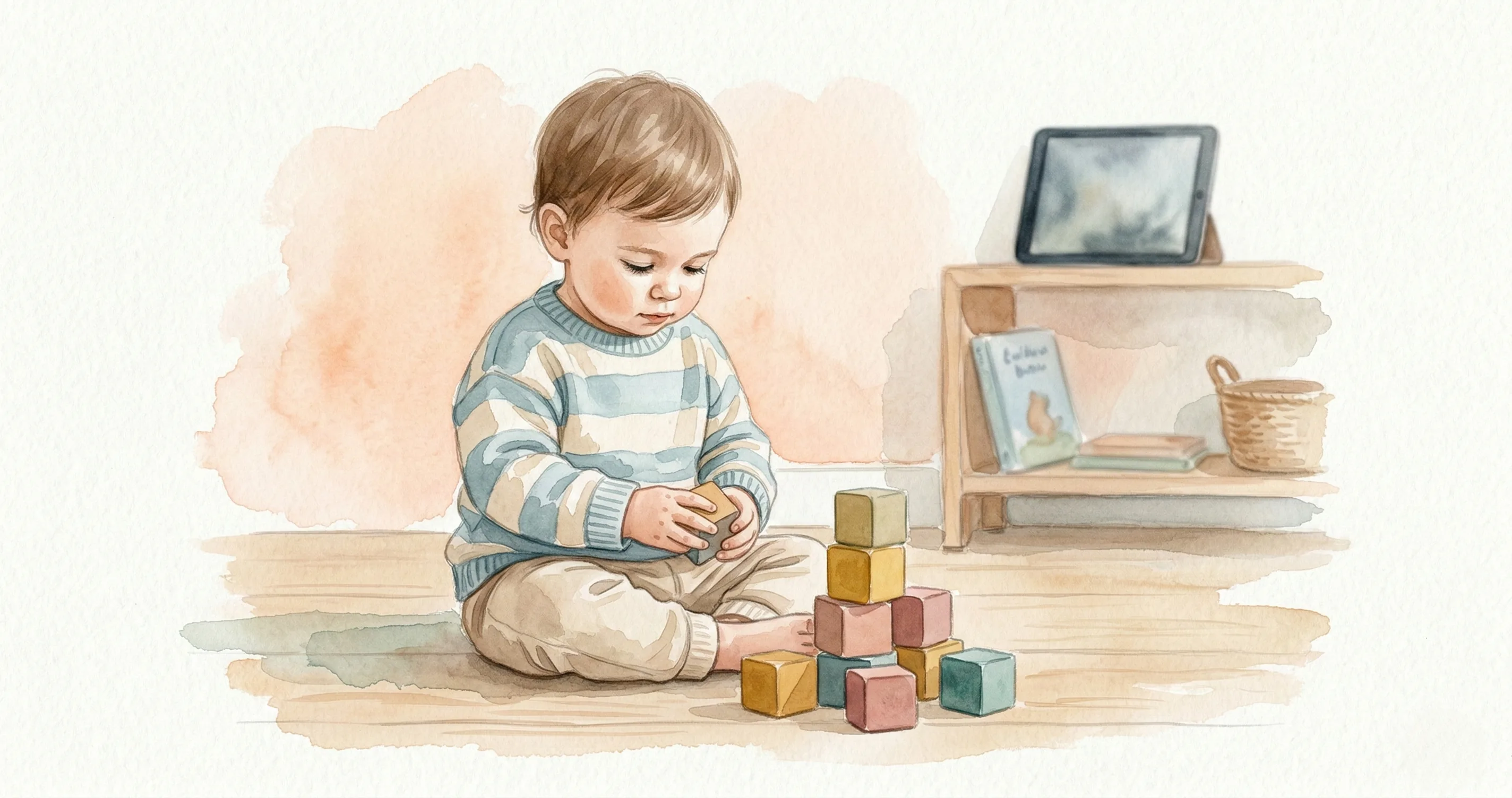
Questions about screen time for toddlers come up at every pediatrician visit and in every parenting group. How much screen time should a toddler have? Is screen time bad for toddlers at all? The answers you find online range from “zero minutes, ever” to “relax, it’s fine.”
The truth, as usual, sits somewhere in between. The research on screen time for toddlers has evolved significantly in recent years. Organizations like the World Health Organization (WHO) and the American Academy of Pediatrics (AAP) have updated their positions, and the conversation has shifted from rigid minute-counting to a more nuanced focus on content quality, parental involvement, and developmental context.
This guide covers what the evidence actually says about screen time for toddlers ages 2 through 5. You will find the latest guidelines, what the risks and benefits look like in practice, how different ages within the toddler range need different approaches, and specific strategies you can use starting today. For guidelines covering all ages from birth to teen, see our screen time rules by age overview.
What Do Experts Say About Screen Time for Toddlers?
Two organizations dominate the conversation around toddler screen time guidelines in 2026: the WHO and the AAP. Their recommendations are broadly aligned but differ in important ways.
WHO guidelines (2024 update)
The World Health Organization maintains some of the strictest guidance globally. Their physical activity and sedentary behavior recommendations for young children state:
- Under 12 months: No screen time at all.
- 12–24 months: No sedentary screen time. If parents introduce digital media, it should be high-quality programming watched together.
- 2–5 years: No more than one hour of sedentary screen time per day. Less is better.
The WHO framing is intentionally conservative. Their concern is primarily with sedentary behavior — time spent sitting passively in front of a screen displacing physical activity, social interaction, and sleep.
AAP guidelines (2024 shift)
The AAP has moved toward a quality-over-quantity approach. Their updated media guidelines acknowledge that not all screen time is equal:
- Under 18 months: Avoid screen media other than video chatting.
- 18–24 months: If parents want to introduce digital media, choose high-quality programming and watch it together. Avoid solo use.
- 2–5 years: Limit screen use to one hour per day of high-quality programs. Co-view whenever possible to help children understand what they are seeing.
The important shift in the AAP’s 2024 position is the emphasis on how screens are used rather than purely how long. They explicitly state that context — including whether a parent is watching alongside the child — matters as much as duration.
What the numbers actually look like
Despite these recommendations, the reality in most households looks very different. A 2023 Common Sense Media report found that children under 2 average 42 minutes of screen time per day. For children ages 2 to 4, the average is closer to 2.5 hours — well above the recommended one-hour maximum. These numbers are not meant to shame anyone. They simply reflect how difficult this is in practice, especially for families where both parents work or where screen time serves as a necessary tool for managing the day.
Is Screen Time Bad for Toddlers? What the Science Shows
The question “is screen time bad for toddlers?” does not have a simple yes-or-no answer. The research on the effects of screen time on toddlers consistently shows that outcomes depend on three variables: the type of content, the amount of exposure, and the context in which it happens.
The documented risks
Language development delays. A 2024 study published in JAMA Pediatrics found that toddlers who spent more than 1.5 hours per day on screens at age 2 were significantly more likely to score below average on language assessments at age 4.5. The mechanism appears to be displacement: time spent watching screens is time not spent in back-and-forth conversation, which is the primary driver of early language acquisition.
Sleep disruption. Screen exposure, particularly in the hour before bedtime, is consistently linked to shorter sleep duration and more nighttime wakings in toddlers. The blue light emitted by screens suppresses melatonin production, but the stimulating content itself also plays a role — an excited toddler brain does not wind down easily.
Reduced physical play. Every minute spent on a screen is a minute not spent crawling, climbing, running, or manipulating objects. For toddlers, who are in a critical period of gross and fine motor development, this trade-off matters. The WHO specifically frames their guidelines around the concern that sedentary screen time displaces active play.
The documented benefits (when done right)
Vocabulary gains through educational content. High-quality, age-appropriate programs can support vocabulary development — but only when a parent or caregiver is present to reinforce what the child sees. A child watching Sesame Street alone picks up far less than a child watching the same episode with a parent who pauses to ask questions and connect the content to real life.
Video calling supports social bonds. The AAP specifically exempts video calls from their screen time limits because research shows that toddlers can benefit from real-time social interaction via screens. A video call with a grandparent or distant relative is meaningfully different from passive consumption.
The key nuance: context matters more than minutes
The most important takeaway from the current body of research is this: not all screen time is equal. Thirty minutes of a parent and child watching a slow-paced educational show together, discussing what they see, is a fundamentally different experience from thirty minutes of a toddler alone with a tablet watching random YouTube videos. The minutes are the same. The developmental impact is not. When considering how much screen time is too much, the what and the how matter just as much as the number.
Worried You’ve Already Done Damage? What Research Says About Reversibility
If you have read the risks above and feel a wave of guilt, you are not alone. “Can you reverse the effects of too much screen time in toddlers?” is one of the most searched questions by parents of young children. The answer, according to current neuroscience, is encouraging.
The developing brain is remarkably plastic
Neuroplasticity — the brain’s ability to reorganize and form new connections — is at its peak during the toddler years. A 2023 review in Frontiers in Human Neuroscience found that children who reduced excessive screen time and increased interactive play showed measurable improvements in language development and attention within 6 to 12 months. The brain does not stay stuck in a pattern formed by screen exposure. It adapts when the environment changes.
What “reversing” actually looks like
Reversal is not about erasing what happened. It is about providing the experiences the brain needs going forward:
- Language recovery. Toddlers with screen-related language delays often catch up once screen time is reduced and replaced with conversation-rich interaction. Reading aloud, narrating daily activities, and asking open-ended questions rebuild the back-and-forth exchanges that screens displaced.
- Attention improvement. Studies on attention span show that children’s ability to sustain focus improves within weeks of reducing fast-paced screen content and replacing it with slower, child-directed activities like puzzles, block play, and outdoor exploration.
- Sleep normalization. Removing screens before bedtime typically improves toddler sleep patterns within 2 to 3 weeks, according to a JAMA Pediatrics randomized trial.
The bottom line for worried parents
Past screen time does not permanently define your toddler’s development. What matters most is what you do from today forward. If you are reading this article and thinking about making changes, your child’s brain is ready to respond. The research consistently shows that reducing screen time + increasing interactive play = measurable developmental gains, even after a period of excessive exposure.
Screen Time for 2 Year Olds vs 3–5 Year Olds: Age-Based Differences
Toddlers are not a monolithic group. The developmental difference between a 2 year old and a 5 year old is enormous, and their screen time needs should reflect that.
Screen time for 2 year olds
At age 2, children are in the earliest stages of language acquisition. They are learning to form two-word phrases, beginning to understand cause and effect, and building the foundational neural pathways for communication. At this age:
- Live interaction is irreplaceable. Two-year-olds learn language primarily through face-to-face interaction. They need to see a real person’s mouth move, hear the tone and rhythm of speech, and experience the back-and-forth of conversation. Screens cannot replicate this.
- Transfer deficit is real. Research shows that children under 2.5 have significant difficulty transferring what they learn from a screen to the real world. A toddler might watch a character stack blocks on a show but struggle to apply that concept with physical blocks. This “video deficit” diminishes with age but is strongest at 2.
- Keep it minimal and co-viewed. If you choose to introduce screens at 2, limit exposure to brief sessions (under 30 minutes) of high-quality content with a parent present. Programs should be slow-paced, repetitive, and directly address the viewer.
Screen time for 3 year olds
How much screen time for a 3 year old? At 3, children can begin to engage with narrative content. They understand simple storylines, can follow a character through a sequence of events, and are starting to grasp basic social concepts like sharing and taking turns. This opens up more options:
- Narrative shows become accessible. Programs like Daniel Tiger’s Neighborhood and Bluey use storytelling to teach social-emotional skills. Three-year-olds can follow these stories in ways that 2-year-olds cannot.
- Interactive apps can add value. At 3, some children can engage meaningfully with well-designed educational apps — especially those that require active participation rather than passive watching. Look for apps that ask the child to respond, choose, or create.
- The one-hour guideline applies. Both the WHO and AAP recommend a maximum of one hour of high-quality content per day for this age group. Co-viewing remains strongly recommended.
Screen time for 4–5 year olds (preschoolers)
Screen time for preschoolers can include a slightly broader range of content as cognitive abilities expand:
- Educational screen time becomes more effective. By age 4, children can learn new vocabulary, letters, numbers, and basic problem-solving from high-quality digital content — especially when reinforced by a caregiver.
- Social viewing becomes possible. Preschoolers can begin to watch content with siblings or peers, which adds a social dimension to the experience. Watching a show together and then playing out the scenes supports both social and imaginative development.
- This is the transition point. Ages 4–5 represent the bridge between the highly protected toddler years and the school-age years. This is when you can begin introducing simple concepts around screen time management — basic cause-and-effect structures that lay the groundwork for self-regulation.
Co-Viewing: The Strategy That Changes Everything
If there is one single strategy that transforms screen time for toddlers from a risk into an opportunity, it is co-viewing. The research on this is remarkably consistent: when a parent watches alongside a young child and actively engages with the content, the outcomes change dramatically.
What the research shows
Studies have found that co-viewed educational content produces 2 to 3 times greater vocabulary gains compared to the same content watched alone. The reason is straightforward: toddlers learn through interaction, not absorption. When a parent points to the screen and says “look, a red truck — just like the one we saw at the park,” the child’s brain makes a connection between the digital image and a real-world memory. That connection is where learning happens.
Conversely, when a toddler watches the same content alone, much of it washes over them. They may be entertained, but the educational value drops significantly. This is why the distinction between active and passive screen time is so critical during the toddler years.
How to co-view effectively
Co-viewing does not mean sitting on the couch staring at your phone while a show plays. It means actively participating in the media experience. Here is what effective co-viewing looks like in practice:
- Watch together and narrate. “Oh look, the puppy is sad. Why do you think the puppy is sad?” Simple narration and questions turn passive viewing into a conversation.
- Pause and discuss. Pause the show to talk about what just happened. “Daniel Tiger said he was frustrated. Have you ever felt frustrated?” This helps toddlers process emotions and build vocabulary around feelings.
- Connect screen content to real life. After watching a show about colors, point out the same colors around the house. After a show about animals, flip through a picture book about animals together. These bridges between screen and reality are where the deepest learning occurs.
- Sing along and move. Many toddler programs include songs and physical prompts. Join in. When you sing and clap alongside your child, you model engagement and make the experience social rather than solitary.
When co-viewing is not possible
Let us be realistic: you cannot co-view every minute of every screen session. Sometimes you need to start dinner. Sometimes you need ten minutes of quiet. That is okay. The goal is not perfection — it is making co-viewing the default rather than the exception. When solo viewing is necessary, choose content you have already watched together so the child has a framework for understanding it, and keep the session short.
Screen-Free Alternatives That Toddlers Actually Enjoy
One of the most practical ways to manage screen time for toddlers is to have compelling alternatives ready to go. The reason many parents default to screens is not laziness — it is that screens are easy and reliable. Having a short list of engaging screen-free activities reduces your dependence on screens and gives your toddler richer developmental experiences.
Morning routine alternatives
- Sensory bins. Fill a shallow container with rice, dried pasta, or water beads. Add scoops, cups, and small figurines. Most toddlers will engage with a sensory bin for 20 to 30 minutes — sometimes longer than they would watch a show.
- Simple cooking tasks. Toddlers love pouring, stirring, and tearing. Let them help with breakfast preparation: tearing lettuce for a salad, stirring pancake batter, or placing berries in a bowl. This builds motor skills and teaches sequencing.
- Music and movement. Put on music and dance. No screen required. Toddlers respond to rhythm instinctively, and physical movement in the morning helps regulate their energy for the rest of the day.
Rainy day alternatives
- Blanket forts and imaginative play. Drape blankets over chairs and create a fort. Add pillows, stuffed animals, and a flashlight. This kind of open-ended play develops creativity and spatial reasoning in ways no app can replicate.
- Sticker books and coloring. Simple, low-tech art supplies keep toddlers engaged. Large crayons and oversized coloring pages are ideal for ages 2 to 3. By 4, children can work with stickers, stamps, and child-safe scissors.
- Reading together. The single best alternative to screen time, at any age, is reading aloud. For toddlers, choose books with repetitive phrases, lift-the-flap mechanics, and bold illustrations. Let them turn the pages and point to pictures.
Restaurant and waiting room alternatives
- Small activity bag. Keep a ziplock bag with a few crayons, a small notepad, a couple of figurines, and a snack. This portable kit replaces the phone-in-the-restaurant habit and gives your toddler something to do with their hands.
- Observation games. “Can you find something red?” “How many dogs can you count?” Simple I-spy games keep toddlers engaged in their environment rather than withdrawn into a screen.
- Outdoor exploration. If waiting outdoors, let them explore. Toddlers are endlessly fascinated by leaves, rocks, ants, and puddles. These experiences are not just entertainment — they build scientific observation skills.
The key is preparation. Screen time often becomes the default not because parents prefer it, but because it requires zero advance planning. Having even two or three alternatives ready reduces your reliance on screens during the moments when toddler boredom strikes.
When and How to Set Your First Screen Time Rules
As toddlers approach preschool age (4–5 years old), they are developmentally ready for their first structured screen time rules. This is not about rigid enforcement — it is about planting seeds for the self-regulation skills they will need throughout childhood.
Why preschool is the right time to start
Between ages 4 and 5, children begin to understand basic cause-and-effect relationships. They grasp that actions have consequences and rewards. This is the cognitive foundation you need before introducing any kind of screen time structure. Attempting complex rules before this point is likely to create frustration for both parent and child.
Starting with simple earn-based concepts
The most effective first screen time rules are earn-based rather than restriction-based. Instead of “you can only watch for 30 minutes,” try “when you finish picking up your toys, you can watch one episode.” This frame teaches the connection between effort and reward — a principle that serves children well into adolescence.
Practical approaches for preschoolers:
- Sticker charts. Create a simple chart with three to four daily tasks (get dressed, brush teeth, tidy toys, help set the table). Each completed task earns a sticker. A full row of stickers earns a screen time session. The visual nature of a sticker chart is perfectly suited to how preschoolers process information.
- The “first-then” structure. “First we read a book together, then you can watch your show.” This phrasing is simple enough for a 4-year-old to understand and follow. It establishes the habit of completing a non-screen activity before accessing screens.
- Task-based earning. As children move toward age 5, you can introduce slightly more structured systems. Timily’s Task System is designed for exactly this transition — assigning age-appropriate offline tasks (tidying up, helping with a chore, completing a creative activity) that earn screen time in return. The visual structure makes it intuitive even for preschoolers.
Keeping it age-appropriate
Whatever system you choose, keep three principles in mind for the preschool age:
- Keep it simple. No more than three or four rules. If you cannot explain it in two sentences, simplify it.
- Keep it visual. Charts, stickers, and physical tokens work far better than verbal agreements at this age. Preschoolers think in pictures, not abstractions.
- Keep it positive. Frame rules around what children earn, not what they lose. “You earned your show!” feels fundamentally different from “No more TV until you behave.” The first builds motivation. The second builds resentment.
The transition to school age
The habits you establish during the preschool years create the foundation for everything that comes next. A child who learns at age 4 that screen time is something you earn through effort arrives at age 7 with an internal framework for self-regulation. They do not need to be told “no screens until homework is done” because they already understand the principle. The earlier you plant this seed, the easier the school-age years become.