
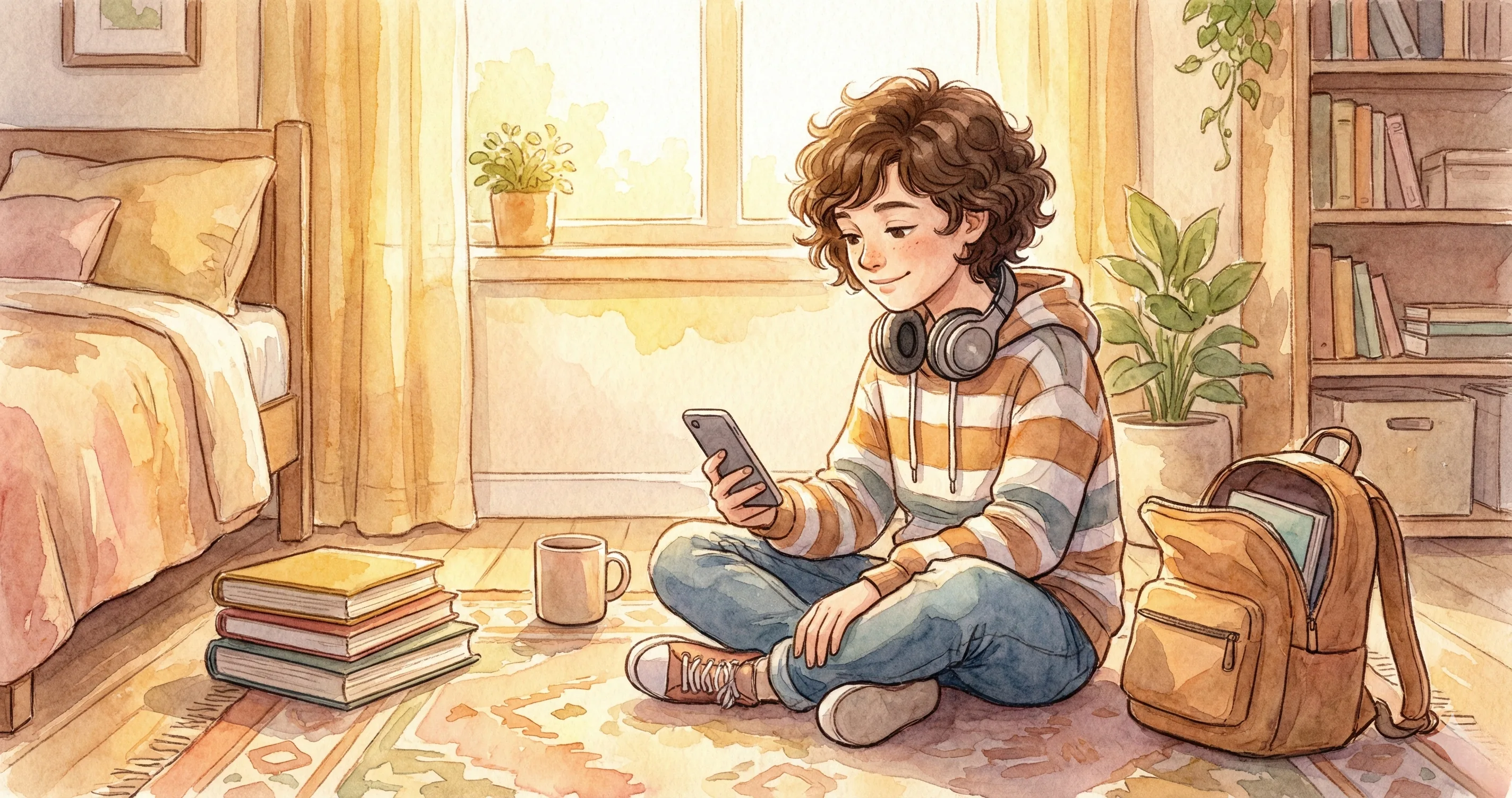
If you have a child between 10 and 13, you have probably noticed something shift. The rules that worked perfectly when they were eight suddenly feel like they belong to a different era. Your tween rolls their eyes at the family timer. They tell you that everyone else gets unlimited screen time. And the conversations about phones, games, and social media have a new intensity that catches you off guard.
You are not imagining it. Screen time rules for tweens really are a different challenge than they were even two years ago. The stakes are higher, the social dynamics are more complex, and your child is changing faster than your rules can keep up.
Here is the good news: this is a solvable problem. Not by clamping down harder, and not by giving up and letting them figure it out alone. The answer lives somewhere in between — in a space where your tween feels respected enough to cooperate and you feel confident enough to hold the boundaries that matter.
This guide is specifically for parents navigating the 10–13 age range. For a full age-by-age overview, see our screen time rules by age guide. What follows here is a deep dive into the unique pressures, strategies, and conversations that belong to the tween years.
Why Tween Screen Time Is Different From Everything Before
The tween years are not just “older kid” years. They represent a genuine developmental shift that changes everything about how your child relates to screens, rules, and you.
Identity formation is in full swing
Between ages 10 and 13, your child is actively figuring out who they are — separate from you. This is healthy and necessary, but it means that rules which once felt like safety now feel like control. When you set a screen time limit, your eight-year-old hears “that is the rule.” Your twelve-year-old hears “you do not trust me.” Same rule, completely different interpretation.
Social pressure reaches its peak
Social belonging becomes the dominant force in a tween’s life. Friendships form and fracture around shared digital experiences — group chats, gaming sessions, TikTok trends, YouTube references. When your tween says “I need my phone,” they are not being dramatic. In their world, being disconnected from the group chat genuinely feels like being left out of the social fabric.
New risks arrive all at once
The tween years bring simultaneous exposure to social media, online gaming communities, direct messaging, and peer-driven content consumption. Unlike younger children who use curated apps and watch parent-selected videos, tweens are beginning to navigate the open internet. They encounter advertising, influencer culture, comparison dynamics, and conversations that can escalate quickly beyond what they are emotionally equipped to handle.
The desire for privacy changes the dynamic
Your tween may start closing their bedroom door, angling their screen away from you, or reacting strongly when you check their device. This is not inherently suspicious. Privacy-seeking is a normal part of developing an independent identity. But it does mean that the “open screen in the living room” approach you relied on for younger children may need to evolve, carefully and gradually, into something that respects their growing need for space while maintaining appropriate oversight.
Understanding these shifts is the foundation for every strategy that follows. When you recognize that your tween’s resistance is developmental rather than defiant, you can respond with empathy instead of escalation — and that changes the entire conversation about managing screen time for preteens. Whether you think of it as screen time for middle schoolers or managing your preteen’s digital life, the underlying principle is the same: meet them where they are developmentally.
Screen Time Rules for 10–12 Year Olds That Actually Work
Here is the reality that most parents do not talk about: when it comes to how much screen time for tweens is appropriate, the exact number matters far less than how the rules are created. A two-hour limit imposed from above triggers rebellion. The same two-hour limit that a tween helped design feels like a reasonable agreement.
Start with the numbers, then make them human
Most pediatric guidelines suggest around two hours of recreational screen time per day for this age group. But according to Qustodio’s research, tweens currently average about 5.5 hours per day. That gap between recommendation and reality tells you something important: simply announcing a two-hour limit in a 5.5-hour household is going to feel catastrophic to your child.
Instead of jumping to the final number, work toward it together:
- Acknowledge where you are starting from. “I know you are used to about five hours a day. I am not going to cut that in half overnight.”
- Set a baseline together. Two hours of recreational screen time is a solid starting point. Make sure your tween understands that school-related screen use does not count against this limit.
- Build in earning opportunities. Once the baseline is established, let your tween earn additional time through specific actions — completing homework without reminders, helping with household tasks, or finishing a physical activity.
- Introduce self-monitoring. Give your tween a simple way to track their own usage. Self-monitoring is a skill they will need as a teenager, and introducing it now, with your support, builds that capacity gradually.
The written agreement approach
For screen time rules for 10–12 year olds, nothing works better than a written agreement. Sit down together and draft something that covers: how much time, what types of content, which devices, when screens go away at night, and what happens if the agreement is broken.
The power of putting it in writing is not about legalism. It is about removing ambiguity. When the rules are written down and signed by everyone, there is nothing to argue about in the moment. “But you said I could!” gets replaced with “Let us look at what we agreed.”
Handling FOMO and Peer Pressure Around Screens
“Everyone else has TikTok.” “I am the only one who does not have a phone.” “They are all in the group chat and I am not.”
If you are parenting a tween, you have heard some version of these statements. And here is the part that is hard to admit: they might be mostly right. The social dynamics of the tween years are genuinely mediated by technology in ways that did not exist a generation ago.
Validate first, hold boundaries second
The worst thing you can do when your tween expresses FOMO is dismiss it. “You do not need TikTok” or “real friends do not care about that” might be logically true, but to a twelve-year-old navigating a complex social landscape, those responses feel like you do not understand their world.
Try this instead:
- “That sounds really hard. Tell me more about what you feel like you are missing.” Often, the fear is not about the specific app — it is about belonging. When you dig into the specifics, you can sometimes address the underlying need without giving in on the boundary.
- “I hear you, and I take this seriously. Let me think about it.” This buys you time and shows respect. Tweens often respect a parent who genuinely considers their request more than one who says yes immediately.
- “What if we found a way for you to stay connected that I also feel good about?” This opens a negotiation rather than shutting one down.
Age-appropriate alternatives that actually satisfy
The goal is not to eliminate your tween’s digital social life. It is to shape it. Consider these middle-ground approaches:
- Messaging apps with parental visibility. Platforms like iMessage or WhatsApp family groups allow your tween to participate in group conversations while you maintain oversight.
- Supervised social media sessions. Rather than a blanket ban on social media, allow limited, supervised access during family time. This lets your tween understand the platforms while you are available to discuss what they encounter.
- Shared gaming time. If your tween’s friends are gaming together, consider joining occasionally. Understanding the social dynamics of their gaming world makes you a better guide.
The conversation, not the lecture
Tweens can detect a lecture from the first sentence. Instead, make these conversations genuinely two-directional. Ask questions: “What do you think the risks of that app are?” “If you were the parent, what rules would you set?” “What would you do if someone sent you something that made you uncomfortable?”
When tweens practice thinking through these scenarios out loud, they build the judgment muscles they will need when you are not there to guide them. That is far more valuable than any rule you could impose. For more on gauging whether your child is ready for their own device, see our guide on when to give kids a phone.
Gradually Handing Over Screen Time Control
The entire point of tween screen time guidelines is to prepare your child to manage their own screen habits as a teenager. If you are still setting all the rules at 15 the same way you did at 8, something has gone wrong. The tween years are when you begin the deliberate, staged handover of responsibility.
Stage 1 (ages 10–11): Parent-managed with input
At this stage, you still hold the primary responsibility for setting and enforcing screen time limits. But you actively involve your tween in the process. They have input into the rules. They know the reasoning behind the boundaries. They see the system as something you are running together, not something being done to them.
This is where an earn-based system like Timily can serve as a useful bridge — it gives your tween a tangible way to see their screen time as something they build through effort rather than something rationed from above, while keeping you in control of the overall structure.
Stage 2 (ages 11–12): Shared management with weekly check-ins
Introduce more autonomy, but with guardrails. Your tween begins making more of their own daily decisions about when and how to use their screen time, within the boundaries you have agreed upon together.
The critical addition at this stage is the weekly check-in. Sit down once a week — even just for ten minutes — and review how the week went. What worked? What did not? Did they run out of screen time too early? Did they stay up too late? These conversations are not interrogations. They are collaborative troubleshooting sessions that teach your tween to reflect on their own habits.
Stage 3 (ages 12–13): Self-managed with a safety net
By this stage, your tween should be doing most of the day-to-day management themselves. You are still present, still aware, and still available for guidance. But the daily enforcement has shifted from you to them.
The safety net looks like this: baseline rules that remain non-negotiable (no screens after bedtime, no social media accounts you do not know about, always tell you if something makes them uncomfortable) combined with the freedom to manage everything else independently.
This staged approach is also how you teach kids self-control with screen time — not through restriction alone, but through the progressive experience of managing responsibility and seeing the results.
Creating a Tween Screen Time Schedule That Fits Real Life
Theory is one thing. Real life — with homework, soccer practice, friends coming over, and the endless “just five more minutes” — is another. A screen time schedule for tweens has to account for the unpredictable rhythms of an actual tween’s week.
Sample school day schedule
- After school (3:30–4:00 PM): Decompression time. Allow 20–30 minutes of free screen time. Tweens need to unwind after a long school day, and a short screen session can serve that purpose.
- Homework block (4:00–5:30 PM): Screens away unless needed for schoolwork. If your tween uses a laptop for homework, keep recreational apps blocked during this window.
- Activity or free time (5:30–7:00 PM): Extracurriculars, outdoor time, or family time. No recreational screens.
- Evening screen time (7:00–8:00 PM): Earned recreational screen time. This is when they can game, watch videos, or chat with friends.
- Wind-down (8:00 PM): All screens to the family charging station. Reading, conversation, or quiet activity before bed.
Sample weekend schedule
- Morning: Screen-free until a family-agreed time (for example, 9:00 AM). This protects sleep-in time and encourages a slower start to the day.
- Midday block (flexible): Longer screen time block — up to 2–3 hours, which can be split across the day. Great for gaming sessions with friends, watching a movie, or creative projects.
- Outdoor or social time: At least one block of non-screen activity, whether that is a sport, time with friends in person, or a family outing.
- Evening: Same wind-down routine as school nights. Consistency at bedtime matters more than consistency during the day.
Building in the buffer
One of the biggest sources of conflict with tweens is the hard cutoff in the middle of something. “I just need to finish this level.” “We are in the middle of a game.” “I cannot just leave the group.”
These are not always stall tactics. Sometimes they are genuinely valid. Build a 10–15 minute buffer into the schedule for exactly this purpose. Your tween knows they have a small window to wrap up, and you know the end time is still firm. This tiny bit of flexibility within structure prevents a disproportionate number of arguments.
The key principle: flexibility within structure, not flexibility instead of structure. Your tween should know the schedule, agree to the schedule, and have a small amount of room to navigate within it. When screen time limits for tweens are clear and the flexibility is predictable, daily negotiations disappear.
When to Worry: Signs a Tween Needs More Structure
Most tweens push boundaries around screen time. That is normal. But there are signals that indicate screen use has crossed from typical tween behavior into territory that needs your attention.
Academic changes
A sudden drop in grades, incomplete homework, or teachers reporting that your tween seems distracted or tired in class. Screen time does not always cause academic problems, but when the two coincide, it is worth investigating the connection.
Sleep disruption
Difficulty falling asleep, waking during the night, or being noticeably harder to wake in the morning. If your tween has a device in their room after bedtime, this is the most common culprit. Blue light, stimulating content, and the social pull of late-night messaging all interfere with the sleep that a growing tween desperately needs.
Mood and behavioral changes
Increased irritability, especially when asked to put screens away. Withdrawal from family activities. Loss of interest in hobbies or activities they previously enjoyed. Anxiety or low mood that seems to correlate with online interactions. These changes do not always mean screen time is the problem, but they always warrant a closer look.
Social withdrawal
Paradoxically, excessive screen time can lead to both social FOMO and social withdrawal. If your tween is spending more time in online interactions and less time with friends face-to-face, or if they seem increasingly isolated despite being “connected” all the time, the balance has likely shifted in an unhealthy direction.
Sneaking screen time
Finding devices under pillows, discovering hidden apps, or catching your tween using screens outside of agreed-upon times. This is a sign that the current rules feel too restrictive to your tween — but it is also a sign that the rules are needed. The solution is not to eliminate the boundary. It is to have an honest conversation about why the sneaking is happening and whether the rules need adjusting.
When to tighten rules versus when to have a deeper conversation
If the signs above are mild and recent, start with a conversation. Ask open-ended questions: “I have noticed you seem more tired lately. What do you think is going on?” Often, tweens are aware of the problem but do not know how to fix it. Your role is to help them problem-solve, not to punish.
If the signs are severe or persistent — significant academic decline, serious sleep deprivation, signs of depression or anxiety — tighten the structure first and have the conversation second. Sometimes a tween needs you to hold a firmer boundary while they regain their footing, even if they resist it initially.
In either case, frame the change as care, not punishment: “I am adjusting the rules because I love you and something is not working right now. Let us figure this out together.”
Moving Forward Together
Setting screen time rules for tweens is not a problem you solve once. It is an ongoing conversation that evolves as your child grows. The strategies in this guide — co-creating rules, validating FOMO, gradually handing over control, building flexible schedules, and watching for warning signs — are not rigid prescriptions. They are a framework you adapt to your specific child and your specific family.
The tween years are messy, complicated, and often frustrating. But they are also the years when your child is building the habits and self-regulation skills they will carry into adolescence and beyond. Every collaborative conversation you have about screen time, every boundary you hold with empathy, and every bit of independence you extend with intention is an investment in the person they are becoming.
You do not have to get this perfect. You just have to stay in the conversation.