
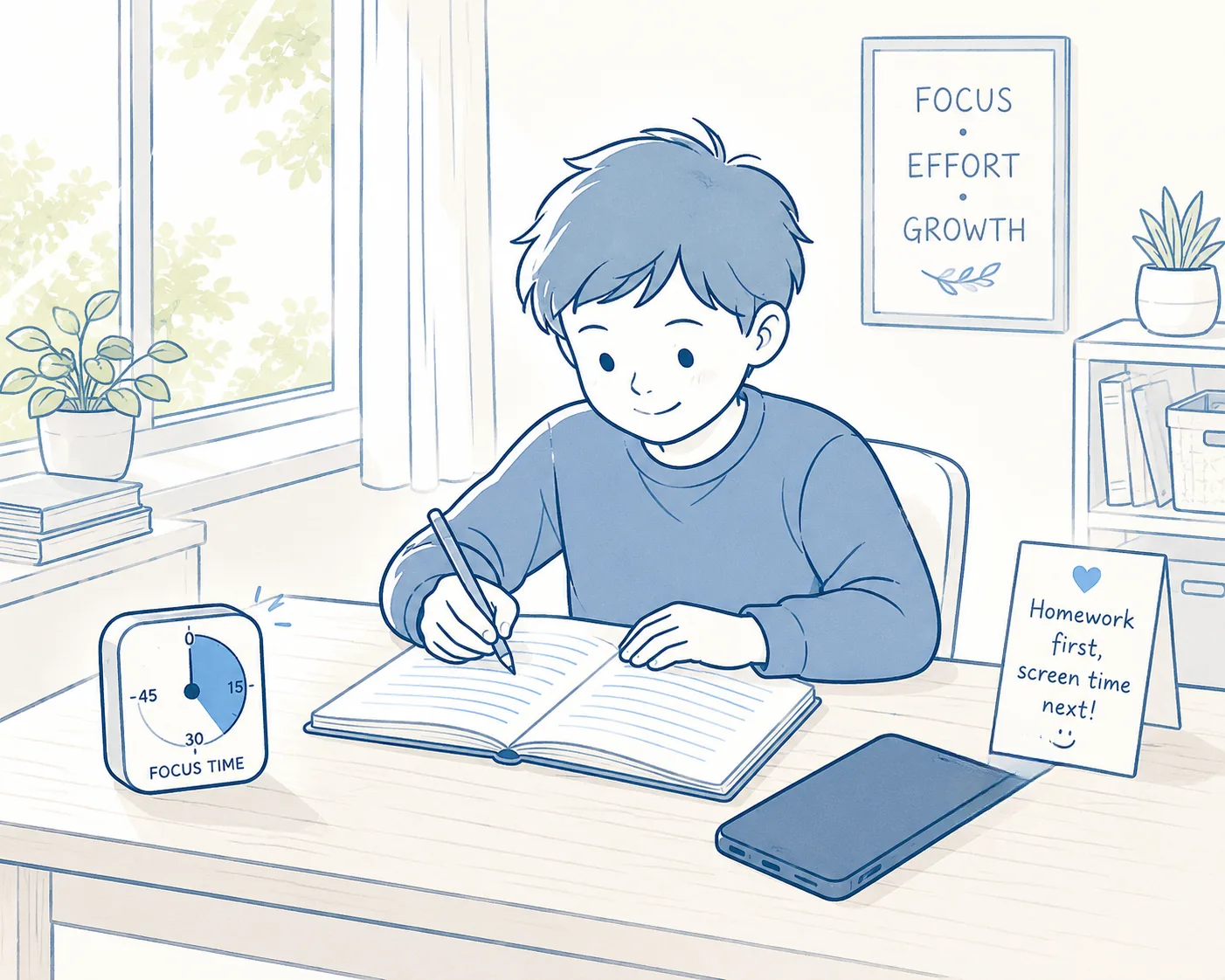
Why the Order Matters More Than the Amount
The daily fight usually starts the same way: your child walks in from school, drops the backpack, and reaches for a device. You say “homework first.” They say “just five minutes.” Thirty minutes later, the argument begins. The problem isn’t a lack of rules — it’s a lack of sequence. Homework before screen time works when it becomes a fixed routine, not a negotiation you repeat every afternoon.
Research on habit formation shows that behaviors become automatic when they follow a consistent cue-routine-reward pattern. The cue is arriving home. The routine is homework. The reward is screens. When this sequence is the same every day, children stop treating it as a rule to challenge and start treating it as “just what we do.”
Many parents focus on how much screen time to allow. That matters, but the order matters more. A child who does 30 minutes of focused homework and then gets 45 minutes of gaming is in a better position than one who plays for 20 minutes, resists the transition, half-focuses on homework while thinking about the game, and then fights for more screen time afterward. The sequence shapes the quality of both activities.
The After-School Routine That Makes It Automatic
The goal is a predictable after school screen time routine that runs without constant parental intervention. Here is a four-step framework most families can adopt within a week:
-
Step 1: Decompress (10–15 minutes) Let your child have a snack, chat about their day, or just sit quietly. Jumping straight from school to homework creates resistance. This buffer period is not wasted time — it’s a transition that makes the next step easier.
-
Step 2: Homework block (20–60 minutes depending on age) Devices are out of reach — ideally in another room or in a bag. The child works until the assignment is complete or the agreed time block ends, whichever comes first. If you have a child who struggles to start, see our guide on task initiation strategies.
-
Step 3: Movement break (10–15 minutes) A short physical break between homework and screens — a walk, shooting hoops, playing with a pet. This resets the brain and prevents the “homework fog” from carrying into screen time. It also builds a natural boundary between work and play.
-
Step 4: Screen access Now screens are available. The child earned them by completing the previous steps. There’s no argument because the sequence was known in advance. How long they get depends on your family’s own screen time rules.
Adapting the Rule by Age
The homework first then screen time principle stays the same across ages, but the execution shifts.
Ages 6–8
Homework is short — often 15–20 minutes. Sit nearby while they work (not doing it for them, just being present). At this age, the routine is more about building the habit than the homework itself. The reward should follow immediately: finish your worksheet, then you can watch your show.
Ages 9–11
Assignments grow longer and kids can work more independently. Introduce a timer — 25 minutes of focused work, then a break. If homework takes multiple sessions, each completed session earns a portion of screen access. This is where a homework timer method becomes especially useful.
Ages 12–14
Homework is substantial and kids want autonomy. The homework before screen time expectation still applies, but shift from “I check your work before you get screens” to “you manage your own block, and we review how it went at dinner.” The rule still exists, but the enforcement becomes collaborative rather than top-down. If your child struggles with self-regulation at this age, a structured earned screen time system can help bridge the gap.
What to Do When Kids Push Back
Expect resistance in the first week. Any new homework before screen time rule takes away something children previously had, and they will push back. Here is how to handle the most common objections:
“But I only have a little homework”
Great — then it will be done quickly and screens will come sooner. The rule is about sequence, not duration. Even a 10-minute assignment goes first.
“My friend doesn’t have to do this”
Acknowledge the feeling without debating: “That might be how their family works. In our family, homework comes first.” Keep it brief. Long explanations invite more negotiation.
“I’ll do it later, I promise”
This is the most dangerous one because it sounds reasonable. The answer is always the same: “The routine is snack, homework, break, then screens. Once homework is done, you’re free.” If you give in once, you’ve taught your child that persistence pays off — and the negotiation will get longer every day.
The silent refusal
Some children won’t argue — they’ll just sit at the desk doing nothing. Don’t turn this into a power struggle. Set a calm boundary: “Homework time runs until 4:30. If you choose not to work, that’s your call, but screens don’t start until the work is done.” Then walk away. Most kids start within a few minutes when the audience disappears.
The Rushing Problem (and How to Fix It)
Once the homework screen time rule is in place, some children discover a loophole: if they rush through homework, they get to screens faster. The result is sloppy work and missed learning.
Three fixes that work:
- Quality check, not perfection check. Glance at the work before approving screen access. You’re not grading it — you’re confirming real effort. “I can see you rushed through questions 3 and 4. Fix those two and you’re good.”
- Minimum focus time. Set a floor: “Even if you finish early, homework block is at least 20 minutes. Use extra time for reading or reviewing.” This removes the incentive to race.
- Bonus points for quality. If you use a reward system, offer extra points for work that’s done well on the first try — not just for finishing fast.
Weekends and Holidays: Keep It or Drop It?
The most effective families keep a lighter version of the homework before screen time routine on weekends rather than dropping it entirely. Total freedom on Saturday and Sunday makes Monday feel like a punishment.
A weekend version might look like:
- One responsibility first (a chore, 15 minutes of reading, or outdoor play)
- Then screens are available
During holidays, the same principle applies. The task changes — maybe it’s a creative project, a book chapter, or helping with a family activity — but the sequence stays: do something productive first, then enjoy screen time after homework or whatever the day’s obligation is.