
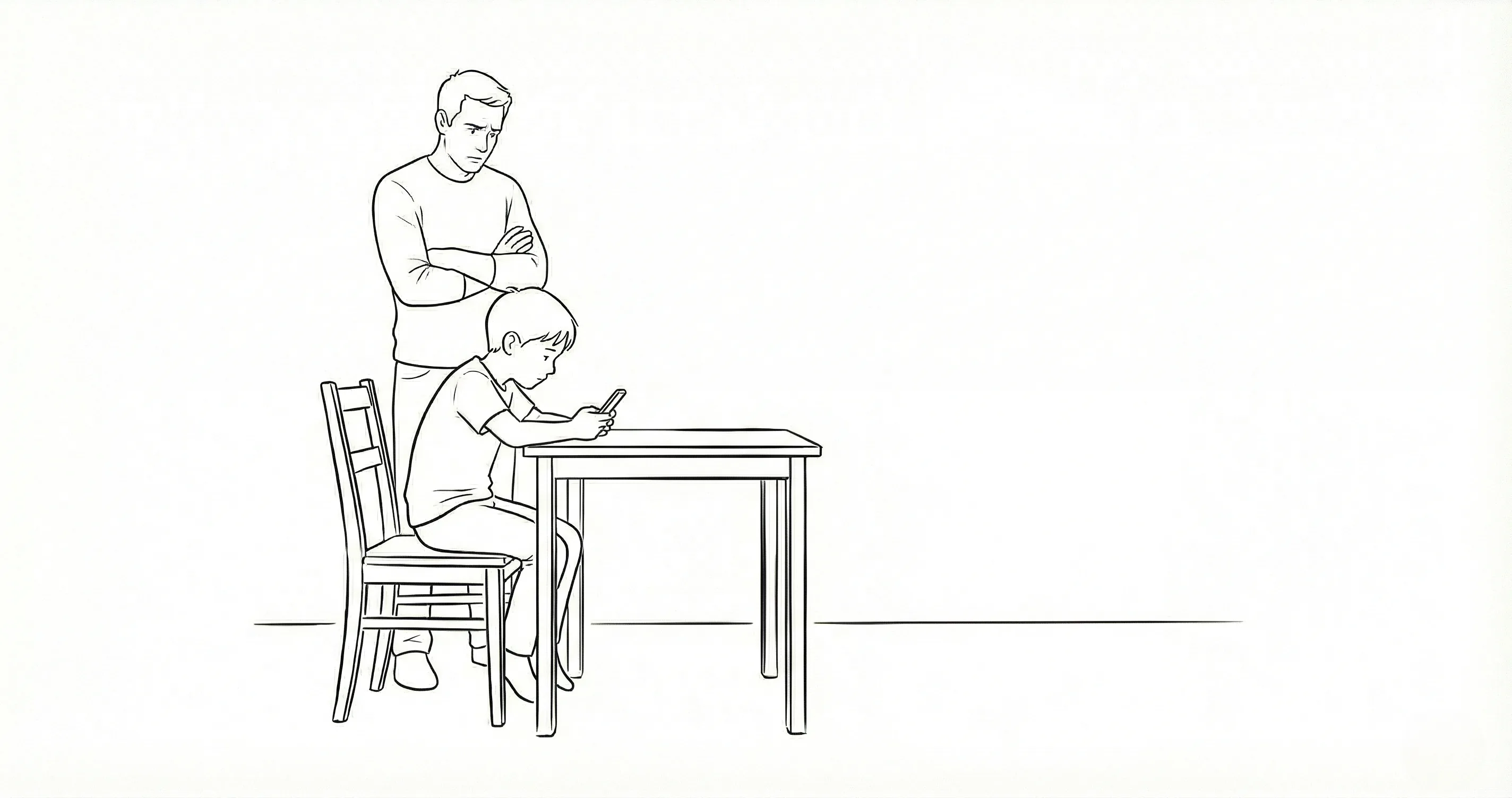
You installed the tracking app. You check the screen time reports three times a day. You read every group chat message before your kid wakes up. And yet something feels off — not safer, just more tense. If you have ever wondered whether your screen monitoring has crossed from protective to controlling, you are asking exactly the right question. These helicopter parenting examples in the digital age might look different from hovering over homework, but the pattern is the same: well-meaning parents taking so much control that their kids never learn to manage things themselves.
This guide walks through specific examples of digital helicopter parenting, explains why screens trigger our overprotective instincts, and offers a practical path from constant surveillance to collaborative management. No judgment here — just honest reflection and concrete steps forward.
What Is Helicopter Parenting (and What It Looks Like With Screens)
Helicopter parenting is a style of overinvolved parenting where adults hover over their children, making decisions for them, solving problems before they arise, and preventing any form of struggle or failure. The term was coined by Dr. Haim Ginott in 1969 when a teenager described their mother as hovering like a helicopter.
Traditional characteristics of helicopter parents include doing homework for their kids, fighting their social battles, calling coaches to demand more playing time, and refusing to let children experience natural consequences. These are the examples you find on every parenting blog.
But in the digital age, helicopter parenting has a new frontier: screens. And the examples look very different from hovering over a math worksheet. Digital helicopter parenting shows up as covert monitoring software, GPS tracking that pings every five minutes, reading every text message, requiring approval for every app, and blocking any website that has not been personally reviewed. The intent is safety. The impact is often the opposite.
10 Digital Helicopter Parenting Examples
Most articles about helicopter parenting examples list things like choosing your child's friends or calling their college professor. Those are real, but they miss the most common battlefield in modern parenting: screens. Here are ten helicopter parenting examples specific to the digital age.
1. Secretly Installing Monitoring Software
Installing an app that tracks every website visited, every search query, and every app opened — without telling your child it exists. When kids discover it (and they will), the trust damage is immediate and lasting.
2. Reading Every Text Message and DM
Scrolling through your child's messages before they wake up or while they are in the shower. For a younger child, some oversight makes sense. For a 14-year-old, reading every conversation sends a clear message: I do not trust you at all.
3. Requiring Approval for Every Single App
Not just filtering inappropriate content — but requiring personal approval for every download, including weather apps, school tools, and games their friends play. The bottleneck is not safety. It is control.
4. Checking Screen Time Reports Multiple Times a Day
Refreshing the screen time dashboard at lunch, after school, and before bed. If your child's daily minutes consume more of your mental energy than your own work tasks, the monitoring has become its own problem.
5. GPS Tracking That Goes Beyond Safety
Location sharing for a young child walking home from school is reasonable. Tracking your 16-year-old's movements every 10 minutes and texting them when they deviate from their expected route is surveillance, not safety.
6. Banning All Social Media Regardless of Age
A blanket ban on social media for a 7-year-old is age-appropriate. The same ban for a 15-year-old, with no plan for gradual introduction, forces them into social isolation or secret accounts — neither of which you can guide.
7. Hovering During Every Screen Session
Standing behind your child every time they use a tablet or laptop, watching what they click, commenting on their choices. This prevents the independent decision-making that builds self-control around screen time.
8. Locking Down Devices Without Any Discussion
Setting rigid app blocks, time limits, and website filters without explaining why or involving your child in any part of the process. Kids who have no voice in the rules have no investment in following them.
9. Immediately Confiscating Devices at the First Sign of Trouble
Your child watches one video you disapprove of, and the tablet disappears for a week. The punishment is disproportionate and teaches avoidance rather than judgment. For more on why this approach fails, see our guide on whether parental controls actually work.
10. Creating Fake Accounts to Monitor Your Teen
Making a fake social media profile to follow your teenager and watch their posts. When discovered — and it always is — this is not just a trust violation. It teaches your child that deception is an acceptable tool in relationships.
Signs You Might Be a Digital Helicopter Parent
The tricky part about digital helicopter parenting is that it often feels like responsible parenting. The signs of helicopter parenting around screens are subtle because the fear driving them is real. Here is a self-check.
You might be over-monitoring screens if:
- You feel anxious when you cannot see what your child is doing on their device — even when they are in the next room doing homework.
- You check their screen time data more than once a day. The data exists to inform weekly conversations, not to fuel hourly worry.
- Your child has never independently chosen an app, a video, or a game — because every choice requires your explicit approval.
- You have caught yourself reading messages meant for their friends — not because of a specific safety concern, but out of habit.
- Your monitoring creates more conflict than it prevents. If every evening ends in an argument about screen time, the system is not working.
- Your child hides their screen use from you — turning the phone face-down, switching tabs when you walk in, or finding ways to bypass your controls.
- You apply the same restrictions to your 14-year-old that you used for your 8-year-old. If the rules have not loosened as your child has matured, that is a sign.
Recognizing these patterns does not make you a bad parent. It makes you a parent who cares deeply and wants to get this right. The fact that you are reading this article is evidence enough of that.
Why Screen Time Makes Parents Extra Overprotective
Parents who happily let their kids ride bikes around the neighborhood will lock down every app on their tablet. There are real reasons why screens trigger our helicopter instincts more than almost anything else.
The Threats Feel Invisible and Unpredictable
When your child climbs a tree, you can see the risk. When they are on a device, the dangers — cyberbullying, predators, inappropriate content — are invisible to you. This invisibility makes the threat feel bigger and more constant than it usually is.
Parenting Guilt and Social Pressure
Every week brings another headline about screen time damaging children's brains or social media causing depression. The message parents absorb is: if something goes wrong online, it is your fault for not monitoring enough. This guilt-driven narrative pushes parents toward more control, not less.
Technology Gives You the Ability to Monitor Everything
Previous generations of parents could not read their child's diary without physically picking it up. Today, parental control software can track every keystroke, every search, every location — all from your own phone. Just because you can monitor everything does not mean you should.
We Did Not Grow Up With This
Most parents raising kids today did not have smartphones until adulthood. There is no personal experience to draw on, no childhood memory of how your own parents handled this. That uncertainty defaults to overcontrol.
How Over-Monitoring Backfires on Kids
The research on helicopter parenting effects is consistent and sobering. A 2018 study published by the American Psychological Association followed 422 children over eight years and found that helicopter parenting was associated with more behavioral and emotional difficulties. Children with overcontrolling parents showed less ability to regulate their emotions and behavior — the exact skills parents were trying to protect them from needing.
A 2022 systematic review in Frontiers in Psychology examined 38 studies and found a direct relationship between helicopter parenting and symptoms of anxiety and depression. The mechanism is straightforward: when parents handle every challenge, children never build confidence in their own problem-solving abilities.
Here is how these effects play out specifically with screens:
Kids Learn to Hide Instead of Self-Regulate
When monitoring is oppressive, children do not use screens less. They use screens more carefully — meaning they create secret accounts, use friends' devices, clear browsing history, and develop sophisticated methods to bypass controls. The behavior goes underground, not away.
Conflict Replaces Connection
Families with heavy-handed screen monitoring report more daily arguments, not fewer. The screen becomes a constant source of tension rather than something the family manages together. Mealtimes become interrogations about screen activity. Bedtimes become device inspections.
Anxiety Transfers from Parent to Child
Children internalize their parents' anxiety about screens. If you treat every online interaction as a potential threat, your child learns that the digital world is fundamentally dangerous — which ironically makes them less equipped to navigate it safely when they eventually have unsupervised access.
Self-Regulation Never Develops
This is the most significant long-term effect. A child who has never chosen to put down a device — because a parent or app always made that choice for them — arrives at college with zero practice managing their own screen time. The Gottman Institute notes that helicopter parenting is connected to lower self-regulation, which is deeply ironic given that the entire goal was to impose control.
Helicopter Parenting Pros and Cons: An Honest Look
Most articles about helicopter parenting pros and cons pretend there are no pros. That is not honest. Understanding what helicopter parenting gets right helps explain why so many thoughtful parents fall into it.
What Helicopter Parenting Gets Right
- Safety awareness: Helicopter parents are paying attention. They know the risks of unsupervised internet access, and that awareness is genuinely valuable.
- Involvement: Being engaged in your child's digital life — knowing what apps they use, who they talk to online — is a protective factor when done transparently.
- Structure: Having rules, limits, and expectations around screen use is better than having none at all.
Where Helicopter Parenting Goes Wrong
- No room to practice: Kids who never experience minor digital mistakes (a wasted afternoon on YouTube, an embarrassing post) never learn judgment.
- Trust erosion: Covert monitoring destroys the parent-child trust that is actually the strongest protective factor online.
- Dependence: Children who rely entirely on parental controls cannot protect themselves when those controls are removed.
- Relationship damage: The daily battles over screens can overshadow every other positive interaction in the family.
The goal is not to stop caring about your child's screen use. It is to channel that care into strategies that build your child's capacity rather than your control.
From Helicopter to Lighthouse: How to Stop Helicopter Parenting
The alternative to helicopter parenting is not permissive parenting. It is what some researchers call "lighthouse parenting" — standing firm as a beacon while letting your child navigate the waters. Here is how to stop helicopter parenting around screens without abandoning oversight entirely.
Step 1: Audit Your Current Monitoring
List every monitoring tool, app, and habit you currently use. For each one, ask: Is this age-appropriate? Would I be comfortable if my child knew about it? Is this solving a real problem or managing my own anxiety? Be ruthlessly honest. Most parents discover at least two or three monitoring behaviors they would not want their child to know about.
Step 2: Replace Covert Monitoring With Open Agreements
Sit down with your child and create a screen use agreement together. This is not about giving them unlimited access. It is about making the rules visible and shared. Include what apps and sites are allowed, how much daily or weekly screen time is reasonable, what the expectations are around messaging and social media, and what happens when the agreement is broken. When kids help create the rules, they are far more likely to follow them. Our guide on screen time rules that work walks through this process in detail.
Step 3: Loosen One Thing at a Time
You do not have to dismantle your entire monitoring setup overnight. Pick one area where you can give your child more autonomy this week. Maybe they choose their own apps from an approved category. Maybe they manage their own screen time on weekends. Watch what happens. Most parents are surprised by how responsibly kids behave when they have genuine ownership.
Step 4: Use Collaborative Tools Instead of Surveillance Tools
There is a fundamental difference between a parental control app that secretly tracks everything and one that works with your child's awareness and input. Timily's Collaborative App Blocking takes this approach: parents and kids sit down together to identify which apps are distracting, and the child earns screen time through focus sessions and real-world tasks. The child knows exactly what is blocked and why, and they have a clear path to earning access. That is structure without surveillance.
Step 5: Have Weekly Check-Ins, Not Daily Inspections
Replace daily screen time report checking with a single weekly conversation. Review the week together: What went well? What was hard? Does anything in the agreement need adjusting? This shifts the dynamic from policing to coaching.
Step 6: Accept That Some Mistakes Are Educational
Your child will occasionally make poor screen choices. They will watch something you would not have approved. They will spend too long on a game. These minor mistakes are not failures of your parenting. They are the raw material for learning judgment. The question is not whether your child will make digital mistakes, but whether they feel safe telling you about them afterward.
Helicopter parenting comes from love. Every parent who has secretly checked their child's phone or locked down every app did it because the alternative — not knowing, not controlling — felt terrifying. But the research is clear: the tighter the grip, the less prepared the child. The path forward is not less involvement. It is different involvement — visible, collaborative, and designed to build the self-regulation your child will need long after your monitoring tools are gone.