
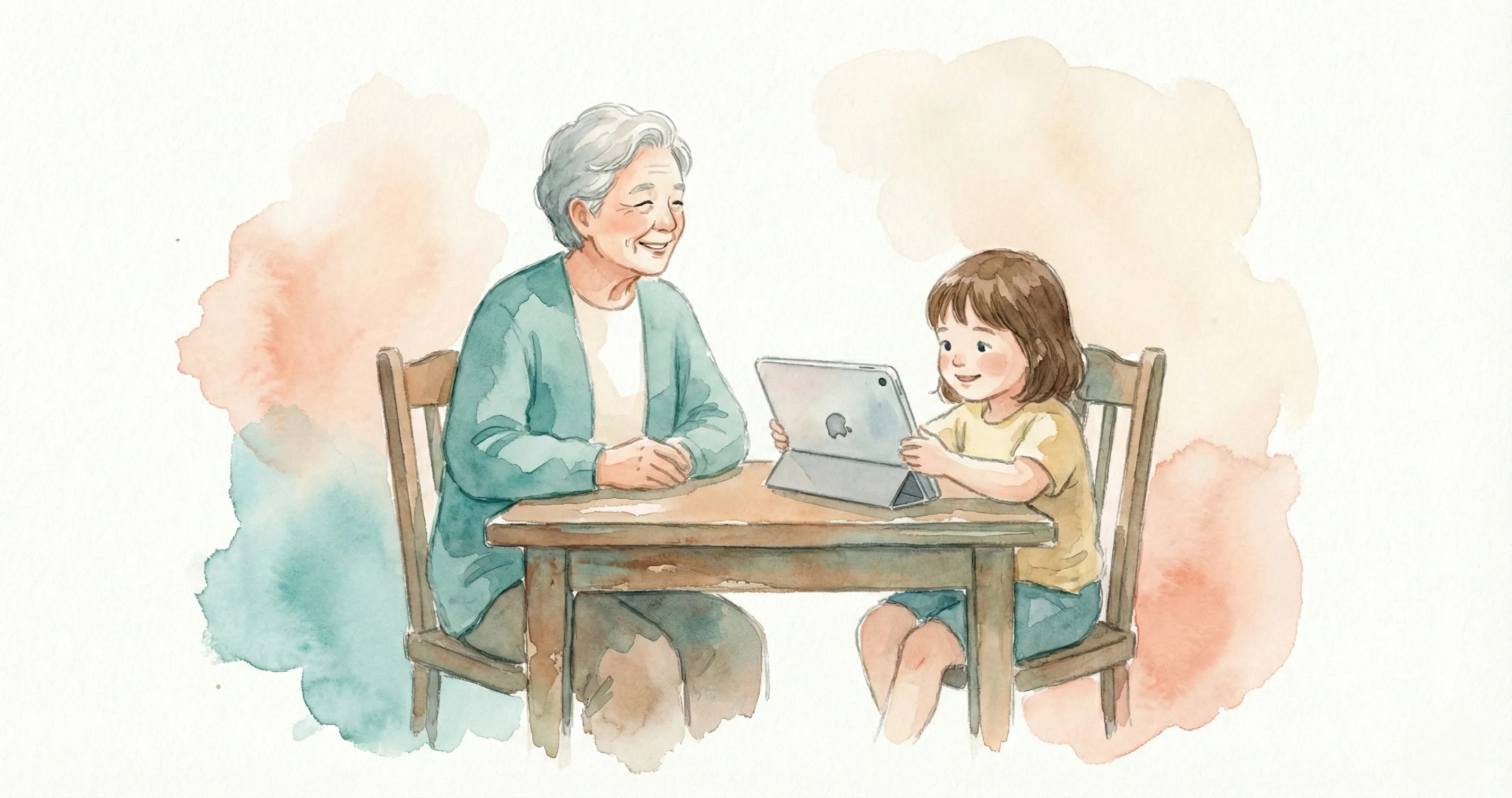
Your kids come home from Grandma’s house wired. They watched three movies, played on the iPad for two hours, and now they are melting down because you said no to one more episode. You love your parents. You appreciate their help. But the grandparents screen time rules conversation feels impossible — like you are criticizing the people who raised you.
You are not alone in this. A University of Arizona study published in the Journal of Children and Media found that nearly half of the time children spend with grandparents involves screen media. That is not a small gap — it is a pattern that can quietly undo the habits you are building at home.
This guide will give you the actual words to say, a simplified plan grandparents can realistically follow, and a framework for deciding when to push back and when to let it go. No guilt trips, no family drama — just strategies that work.
Why Grandparents Let Kids Have More Screen Time (It Is Not Defiance)
Before you have the conversation, it helps to understand why grandparents too much screen time is such a common complaint. The answer is almost never “they do not respect you.” It is more nuanced than that.
They did not grow up with this problem
Your parents raised you in a world where “screen time” meant a TV in the living room with four channels. The idea that a device in a child’s hand could affect brain development, sleep quality, and emotional regulation is genuinely foreign to many grandparents. They are not dismissing your concerns — they literally do not have the same frame of reference you do.
When your mother says “You watched TV and you turned out fine,” she is not being dismissive. She is drawing from her own experience — which did not include autoplay algorithms, infinite scroll, or YouTube rabbit holes that lead from Peppa Pig to conspiracy content in six clicks.
Spoiling is their love language
Grandparents are wired to indulge. They already did the hard work of rule-setting with their own kids. Now they get to be the fun ones. Handing over the iPad is easy, keeps the child happy, and avoids the tantrums that come with saying no. For a grandparent who sees your kids once a week or once a month, being the enforcer feels like a waste of their limited time together.
They genuinely do not see the harm
If a child seems happy, quiet, and occupied, many grandparents interpret that as “everything is fine.” They may not connect the post-visit meltdown to the three hours of unstructured screen time that preceded it. Without understanding the delayed effects — disrupted sleep, increased irritability, difficulty transitioning — there is no reason for them to change what appears to be working.
Are You Overreacting? How to Know When It Is a Real Problem
Not every extra hour of screen time at Grandma’s house is a crisis. Kids can handle occasional flexibility. The question is whether the screen time at grandparents house is consistently undermining the habits you are building at home.
Signs it is just a treat
- Your child bounces back to their normal routine within a day
- The extra screen time happens occasionally, not every visit
- Your child does not use it as leverage (“Grandma lets me”)
- Grandparents are generally respectful of your biggest concerns
If this describes your situation, you may be able to let it go. Grandparents who occasionally bend the rules are not a threat to your child’s development. They are grandparents.
Signs it is undermining your rules
- Your child has increased tantrums and arguments about screens after every grandparent visit
- Sleep is disrupted for multiple nights after they come home
- Your child regularly weaponizes grandparent rules: “That is not fair, Grandpa always lets me”
- The grandparent actively dismisses or mocks your screen time limits
- You are starting to avoid visits because of the aftermath
If you recognize three or more of these, the issue is real and worth addressing. A C.S. Mott Children’s Hospital survey found that 32% of parents have limited grandparent visits because of rule violations. You do not want to reach that point — and you do not have to.
The Conversation Script: How to Talk to Grandparents About Screen Time
This is the part most parents dread. How to talk to grandparents about screen time without it turning into “You think I was a bad parent” or “You are being too controlling.” The key is framing, timing, and having actual words ready — not just good intentions.
Before the conversation: get on the same page with your partner
If you have a partner, align first. Nothing derails the grandparent conversation faster than one parent saying “We need to talk about screen time” while the other shrugs and says “It is fine, Mom.” Decide together which rules are non-negotiable and which ones you are willing to flex on. Present a united front.
Script for grandparents who are receptive
If your parents or in-laws are generally open to feedback, a warm, direct conversation works best. Try something like:
Why this works: It leads with gratitude. It cites an authority (the pediatrician) rather than your personal opinion. It asks rather than demands. And it offers a concrete, written plan instead of leaving them to guess what you want.
Script for grandparents who are defensive
If past conversations have gone sideways, take a different approach. Avoid the word “you” entirely. Focus on the child’s behavior, not the grandparent’s choices:
Why this works: It positions the grandparent as part of the solution team, not the source of the problem. The “few weeks” trial period feels low-stakes. And the written plan removes ambiguity — they do not have to remember a verbal list of rules.
What to do if they push back
Some grandparents will resist no matter how gently you approach it. If you hear “You turned out fine” or “You are too strict,” resist the urge to debate. Instead:
- Acknowledge their perspective: “I know it seems like a lot. The world we grew up in was really different from what kids face now.”
- Restate the boundary calmly: “I am not asking you to agree with me on everything. Just these two things. They make a big difference for [child].”
- Name the consequence honestly: “If the visits keep leading to meltdowns, I am going to have to shorten them, and I really do not want to do that.”
This is not a threat. It is an honest statement about what is sustainable for your family. Most grandparents, when they understand the alternative is less time with their grandchild, are willing to make adjustments.
Grandparent House Rules: A Simplified Plan That Works
The biggest mistake parents make is trying to export their entire screen time system to Grandma’s house. You have spent months building routines, earning systems, and boundaries. Expecting grandparents to replicate all of that is unrealistic — and unnecessary.
Instead, create a grandparents not following screen time rules-proof plan: a stripped-down version with just the essentials. Think of it as the “grandparent edition” of your family’s approach.
The 3-rule maximum
Grandparents are more likely to follow a plan they can remember without checking their phone. Limit your grandparent house rules to three items:
- No screens in the hour before bedtime. This is the single most impactful rule you can ask a grandparent to follow. Sleep disruption from late-night screen use carries over into the next day regardless of which house the child wakes up in.
- No screens during meals. Mealtimes are connection time. This rule is easy to follow, requires no monitoring, and reinforces the idea that people are more interesting than devices.
- Content boundaries. Share your child’s approved apps or shows. A short list of “these are fine” options is easier to follow than a long list of restrictions. Consider printing it or texting a screenshot so it is always available.
That is it. Three rules. If the grandparents follow these three, you can let the smaller stuff slide — and your child’s sleep, behavior, and transition back to home rules will be significantly smoother.
What to let go
The total number of minutes is probably the least important thing to enforce at Grandma’s house. If your child watches an extra 30 minutes of an age-appropriate show on a Saturday afternoon, that is not going to undo your progress. The AAP’s Family Media Plan emphasizes content quality and context over strict minute counts — and the same principle applies at grandparents’ homes.
The screen time rules that actually stick are the ones everyone can remember and follow without a manual. For the full framework behind building age-appropriate limits, share our screen time recommendations by age guide with grandparents — it gives them the expert context they need to understand why these rules matter.
When to Compromise vs. When to Hold Firm
Every family has to draw their own line. But after hearing from hundreds of parents navigating grandparents ignoring screen time limits, a clear pattern emerges around what is worth fighting for and what creates unnecessary conflict.
Worth compromising on
- Extra screen time on special occasions. Movie night at Grandma’s, a rainy day with nowhere to go, a long car ride. These are not habits — they are exceptions, and your child can handle them.
- Different app or show preferences. If Grandpa prefers National Geographic documentaries while you allow Bluey, that is fine. Different content within your approved age range is not a problem.
- Different earning methods. Maybe at your house, kids earn screen time through chores. At grandparents’ house, it might be more informal. The concept of not having unlimited passive screen access matters more than the exact mechanism.
Non-negotiable boundaries
- Screens at bedtime. This is the hill to stand on. Blue light before sleep disrupts melatonin production in children regardless of whose house they are in.
- Age-inappropriate content. If grandparents are letting a 6-year-old play Fortnite or watch PG-13 movies, this is a safety issue, not a preference.
- Using screens to avoid interaction. If every visit consists of grandparents parking kids in front of a TV while they do something else, the relationship itself is suffering. Gently point out that this limited time together is not being spent together.
How a Screen Time App Can Be the Neutral Peacekeeper
One of the hardest parts of enforcing grandparents screen time rules is the verbal confrontation. Every visit, you repeat the same requests. Every visit, the same awkward tension. A screen time app can quietly remove that friction by making the rules visible, consistent, and impersonal.
Timily’s Task & Chore System lets parents set up simple offline tasks — “Read for 20 minutes,” “Play outside,” “Help with lunch” — that grandparents can check off during visits. Kids earn points for completing tasks, and those points unlock screen time through the Reward & Redemption System. The grandparent does not have to be the enforcer. The app handles the structure, and the child sees the same system no matter whose house they are in.
This approach works because it depersonalizes the rules. Grandma is not saying “No more iPad.” The app is showing “You have not earned enough points yet.” The conflict shifts away from the relationship and onto a neutral system — which is easier for everyone.
What Research Says About Screen Time at Grandparents House
If you need data to back up the conversation — or just to confirm that you are not the only parent dealing with this — the research is clear: screen time at grandparents house is significantly higher than at home, and the gap is worth paying attention to.
- Nearly half of children’s time with grandparents involves screen media. The University of Arizona study surveyed 350 grandparents and found that out of an average seven-hour visit, children spent roughly half that time watching TV, playing video games, or using devices.
- Children aged 6–7 averaged 143 minutes of device time per grandparent visit. A Rutgers University study found that younger kids (ages 4–5) averaged 106 minutes, and older kids averaged even more — well above most pediatric recommendations for a single sitting.
- 32% of parents have limited grandparent visits because of rule violations. Data from C.S. Mott Children’s Hospital shows that screen time disagreements are a leading cause of reduced grandparent access — a consequence that neither generation wants.
- Grandparent digital confidence predicts mediation style. The Arizona study also found that grandparents who felt more comfortable with technology were more likely to use active mediation strategies (watching together, discussing content) rather than passive ones (leaving the child alone with a device).
None of this research says grandparents are bad. It says there is a real gap between what happens at home and what happens during grandparent care — and that gap has measurable effects on children’s sleep, behavior, and screen habits. The good news is that the same research shows active grandparent involvement (watching together, setting some limits, discussing content) produces much better outcomes than passive screen use.
The grandparent screen time conversation is awkward. There is no getting around that. You are asking the people who raised you to follow rules they did not have to follow with their own kids. That takes courage and humility on both sides.
But you are not doing this to control your parents. You are doing it because you have seen the difference that consistent screen time rules make in your child’s behavior, sleep, and mood — and you want that consistency to extend beyond your own front door.
Start small. Pick the 2–3 rules that matter most. Have the conversation once, with kindness and a written plan. And remember that most grandparents, when they understand the why, are willing to meet you more than halfway. They love your kids too. That is the whole reason this conversation is worth having.