
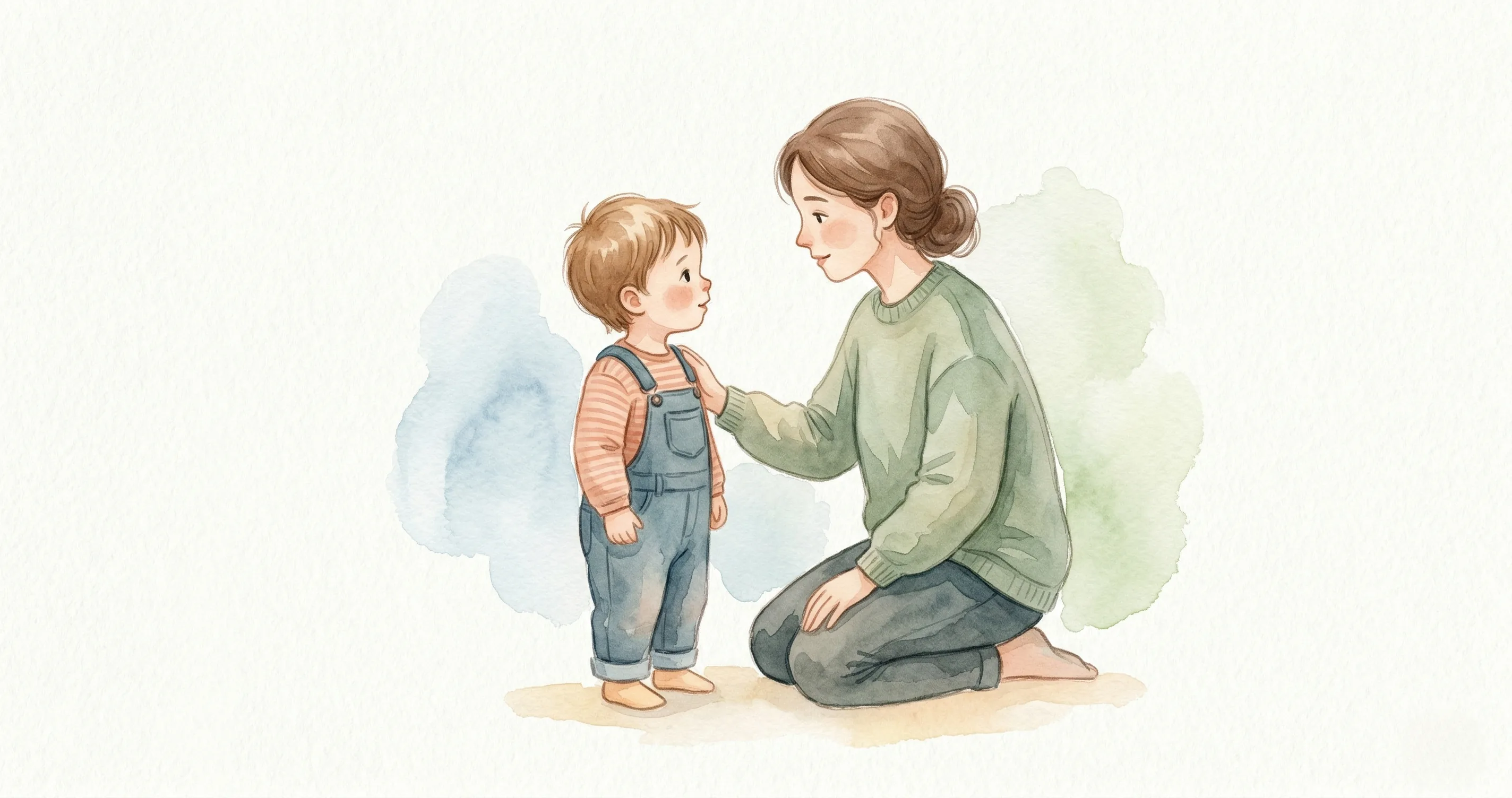
Your three-year-old just hit her brother. You believe in gentle parenting discipline — but right now, you need to stop the hitting. Not in five minutes. Not after a deep breath exercise. Now.
This is where most gentle parenting advice falls apart. It tells you to be empathetic. It tells you not to yell. But it rarely tells you exactly what to say in the three seconds between the hit and the next one.
This guide fills that gap. You will get a concrete 3-step framework, exact scripts for the most common aggressive behaviors, and age-specific language — all grounded in the principle that gentle parenting boundaries are real boundaries, not suggestions.
What Is Gentle Parenting Discipline?
Gentle parenting discipline is an approach where you hold firm boundaries while treating your child with empathy and respect. It is not the absence of rules. It is correction without shame, fear, or physical punishment.
The core distinction is simple: all feelings are welcome, but not all behaviors are. Your child is allowed to feel furious. They are not allowed to hit. Your job is to validate the fury and stop the fist — at the same time.
Research from the American Academy of Pediatrics shows that punitive discipline — yelling, spanking, shaming — increases aggression in children rather than reducing it. Children who experience harsh punishment are twice as likely to show aggressive behavior in subsequent years. Gentle parenting discipline works the other direction: children who feel emotionally validated show fewer behavioral incidents over time.
The 3-Step Response: Validate, Hold the Boundary, Redirect
Every discipline moment in this approach follows the same structure, regardless of the behavior or the child’s age. The framework has three steps, delivered in order, in under ten seconds:
- Validate the feeling. Name what your child is experiencing. “You’re angry.” “That was frustrating.” “You wanted that toy.” This does not excuse the behavior — it tells the child that their inner experience is understood.
- Hold the boundary. State the limit clearly and physically enforce it if necessary. “I won’t let you hit.” “Pushing is not OK.” Use your body — gently hold a hand, move between two children, pick up a toddler — to stop the unsafe behavior.
- Redirect to an alternative. Give your child something they can do with the energy. “You can stomp your feet.” “Use your words: I want a turn.” “Squeeze this pillow.” The alternative must be specific and immediately actionable.
That’s it. Three steps, three sentences. The magic is in the consistency, not the complexity.
Why this order matters
If you skip validation and go straight to the boundary (“Stop hitting!”), the child’s emotional brain hears a threat, not a correction. Their stress response escalates rather than de-escalates. Validation first lowers the emotional temperature enough for the boundary to land.
If you validate but skip the boundary (“I know you’re angry, sweetie” — and then the hitting continues), you have accidentally taught the child that empathy means permission. This is where the “permissive” accusation sticks, and it’s a valid critique when the boundary step is missing.
Gentle Parenting Discipline for Hitting
Hitting is the behavior that tests gentle parents the most. It is urgent, physical, and often directed at a sibling or another child. Here is what positive discipline hitting looks like when you follow the 3-step framework.
Immediate response (0–3 seconds)
Physically intervene first. Get at the child’s eye level. Gently hold the hitting hand or move your body between the children. Then deliver the 3 steps:
- Validate: “You’re really angry right now.”
- Boundary: “I won’t let you hit. Hitting hurts.”
- Redirect: “You can stomp your feet or squeeze this cushion.”
If the hitting continues
Some children hit repeatedly after the initial redirect. This does not mean gentle discipline has failed. It means the child’s emotional state has overwhelmed their ability to process your words. In this case:
- Remove the child from the situation calmly. “I’m going to help you move to a safe spot.”
- Stay with them. Do not isolate them as punishment.
- Wait for the emotional wave to pass. Once they are calmer, re-state the boundary: “Hitting hurts people. Next time you’re angry, you can stomp or ask for help.”
For more on why children can’t process logic during emotional peaks, see our guide on screen time meltdowns and the brain science behind them.
After the storm: repair
Once everyone is calm (this might take 10 minutes or an hour), circle back. “Earlier, you hit your brother because you wanted the truck. Next time, what could you do instead?” Let them answer. If they say “ask for a turn,” you have just witnessed discipline working — not because you punished, but because you taught.
Scripts for Pushing, Grabbing, and Screaming
Hitting gets the most attention, but positive discipline hitting scripts need companions. Here are the 3-step scripts for three other common aggressive behaviors.
Pushing
- Validate: “You wanted more space.”
- Boundary: “Pushing is not safe. Bodies are not for pushing.”
- Redirect: “Say: Please move. Or come stand over here.”
Grabbing toys from another child
- Validate: “You really want that toy.”
- Boundary: “I can’t let you grab it from her hands.” (Gently return the toy.)
- Redirect: “Ask: Can I have a turn when you’re done?”
Screaming or shrieking
- Validate: “I hear you. You’re really upset.”
- Boundary: “Screaming hurts our ears. I need you to use a talking voice.”
- Redirect: “Tell me what happened with your regular voice and I will listen.”
Notice the pattern: every script names the feeling, states a clear limit, and offers a specific replacement behavior. The words change; the structure does not.
Gentle Parenting Discipline Examples by Age
The 3-step framework stays the same at every age. What changes is the language, the level of physical intervention, and how much autonomy you give the child in choosing alternatives.
| Age Group | Validate | Boundary | Redirect |
|---|---|---|---|
| Toddler (1–3) | “You’re mad.” | “No hitting.” + physically stop | “Stomp feet.” / “Squeeze pillow.” |
| Preschool (3–5) | “You’re frustrated because she took your crayon.” | “Hitting is not OK, even when you’re angry.” | “Use your words: I was using that.” |
| School-age (6–10) | “I can see this feels really unfair to you.” | “Even when it’s unfair, we don’t hit.” | “What could you do instead? Walk away? Ask me for help?” |
For toddlers, use two-to-three-word phrases. Their brains cannot process full sentences during emotional overload. For school-age children, start asking them what they could do differently — this builds the internal decision-making that is the whole point of discipline.
When Gentle Parenting Discipline Feels Like It Isn’t Working
You have been validating and redirecting for three weeks and your child is still hitting. It is natural to wonder whether this approach actually works — or whether you need to bring back consequences.
Three common reasons gentle discipline stalls:
- Intervening too late. If you only respond after the hit lands, you have missed the window. Watch for pre-hit signals — a tense body, a raised hand, a clenched jaw — and intervene before contact. “I see your hand is up. You’re angry. Let’s find another way.”
- Too many words. During emotional peaks, children cannot process long sentences. If your validation speech takes 30 seconds, cut it to 5. “You’re mad. No hitting. Stomp instead.” You can have the longer conversation later, when everyone is calm.
- Inconsistency across caregivers. If one parent uses the 3-step framework and the other yells, the child receives conflicting signals. The framework works best when all adults — including grandparents and caregivers — follow the same pattern.
This approach is not about getting immediate compliance. It is about building a child’s internal regulation over months and years. The metric is not “zero meltdowns” — it is “fewer meltdowns, and faster recovery when they happen.”
Gentle Parenting Boundaries: Where Empathy Meets Firmness
The word “gentle” trips people up. It sounds soft. Optional. But gentle parenting boundaries are the opposite of soft — they are unwavering limits delivered without hostility.
Here is the distinction that matters:
- Punitive discipline: “Go to your room! You never listen!” (The child learns: I am bad.)
- Permissive parenting: “Oh, sweetie, I know you’re upset.” (The hitting continues.) (The child learns: feelings override rules.)
- Gentle discipline: “You’re angry. I won’t let you hit. Stomp your feet instead.” (The child learns: my feelings are OK, and there are rules about what I do with them.)
The boundary is the backbone. Without it, you are not doing gentle parenting — you are doing no parenting. The empathy makes the boundary teachable rather than terrifying.
When boundaries feel especially hard — like during screen time transitions — tools that give children a sense of agency can help. Timily’s Task and Chore System lets kids earn screen time through agreed-upon responsibilities, turning “you can’t have it” into “you can earn it.” That shift from restriction to reward is gentle parenting discipline applied to digital life.
Practicing positive reinforcement alongside these scripts makes the whole system stronger. When you catch your child using words instead of fists — “I noticed you asked for a turn instead of grabbing. That was brave.” — you are reinforcing the exact behavior the 3-step framework teaches.