
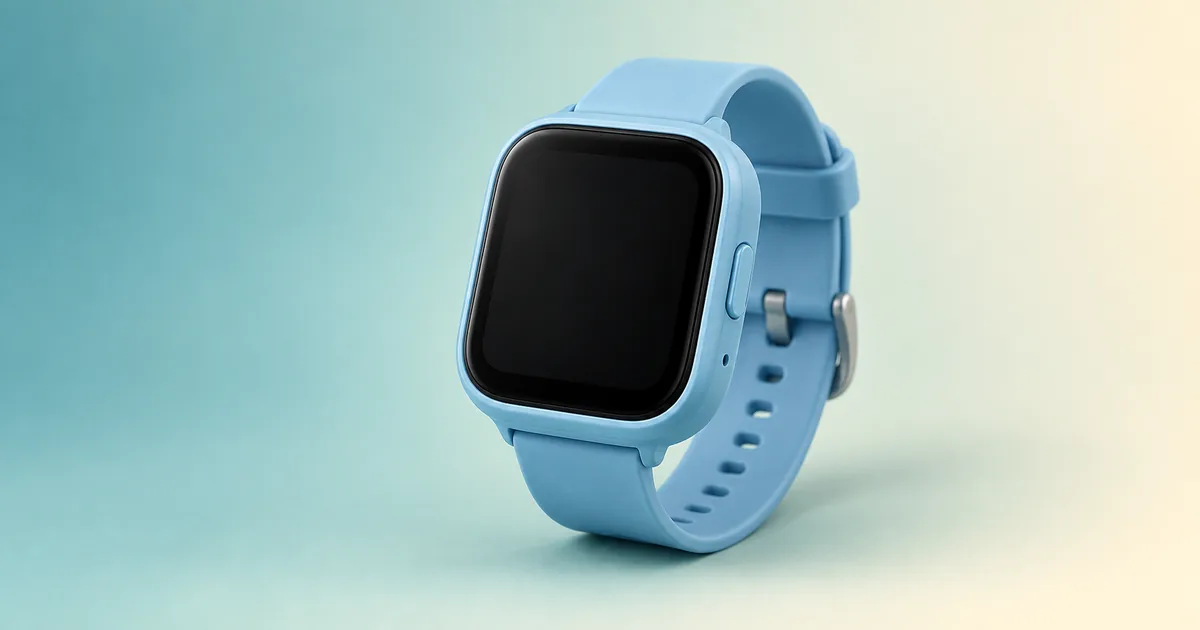
A gabb watch review written like a phone review misses the point. The watch is not a smaller Gabb Phone — it answers a different question, for a younger child, and the features that matter are almost the opposite ones.
A phone is bought when a child needs to communicate independently. A watch is bought when a parent needs to reach a child who is not ready to carry a phone at all. That distinction should drive the whole evaluation.
A Watch Is Not a Small Phone
On a kid phone, the questions are which apps are allowed, how much screen time it produces, and what happens when the child wants more. On a watch, there are no apps to argue about and no feed to fall into. The screen is too small to be a destination.
That changes the evaluation entirely. The things worth judging are how fast an SOS call connects, how many contacts it holds, whether safe zones fire reliably, how long the battery lasts on a school day, and whether it survives a playground. Feature counts are close to irrelevant.
What the Gabb Watch Does
Note that gabb wireless watch reviews and Gabb Watch reviews describe the same product — Gabb Wireless is the company and its own carrier, so the watch and its service are bought together rather than added to an existing family plan.
The Gabb Watch handles calls and texts to a parent-approved contact list, GPS location with safe-zone alerts when a child arrives or leaves a defined area, and a quiet-time schedule that silences it during class. There are no games, no internet, and no social apps.
Contacts are capped at a small number — around ten — which sounds restrictive and is the correct design. An unbounded contact list on a device for a seven-year-old is a liability, not a feature.
Gabb Watch 3 vs 3e
The current generation improved the things that matter for this category rather than adding capability. The 3e places an SOS call in roughly four seconds, which is the single most consequential specification on a safety wearable and the one least likely to appear in a comparison table.
Build quality follows the same logic: a 1.41-inch colour touchscreen behind Gorilla Glass 3, with IP68 water and dust resistance. Reviews of the gabb watch 3e reviews variety consistently rate durability well, which for a device worn by a six-year-old outdoors is worth more than any software feature.
Gabb vs Bark Watch
Both are locked-down kid wearables with calling and location. The split mirrors the one between their phones: Gabb restricts by design, Bark leans on monitoring and alerting.
On a watch, that difference compresses almost to nothing. There is very little content to monitor when the device cannot browse, install, or receive media from strangers. So gabb vs bark watch tends to come down to ecosystem — whichever company you will also buy the phone from later, since staying in one dashboard is genuinely simpler than running two. Our Gabb phone review covers that next step.
Gabb Watch vs Gizmo
Verizon’s Gizmo Watch is the other name that comes up, and the comparison is mostly practical rather than philosophical. Gizmo requires a Verizon line, which decides the question immediately if you are on another carrier. Gabb operates its own service, so it works regardless of your family plan.
Searches for gabb watch vs gizmo and gizmo watch vs gabb watch both resolve on that carrier point before any feature gets compared. If you are already on Verizon, price both; if you are not, the comparison is largely academic.
What Age Is It Actually For?
Roughly four to ten, with the sweet spot around six to nine. Below four, most children cannot reliably operate even a simple interface under stress, which is when it matters. Above ten, the watch starts to feel limiting — peers are texting in groups, and a ten-contact wrist device does not participate.
The upgrade question tends to arrive sooner than parents expect. If your child is already nine, you may be buying eighteen months of use rather than three years, and the phone conversation is closer than the purchase implies.
Who Should Buy One
The watch is the right purchase when a child walks to school, goes to practice, or spends time at other houses, and you want reachability without handing over a screen. It is also the right purchase when you want to delay a phone by two or three years and need something to fill the gap credibly — our guide to phones by age covers what comes next.
It is the wrong purchase if what you actually want is to see what your child is doing online — there is no online. And it is the wrong purchase for a child whose friends are already coordinating over group chats, because the watch cannot join that and the gap will be felt.
What Comes After the Watch
A watch buys time, and that is its real value. It delays the phone by two or three years without leaving a parent unable to reach their child.
But it delays a decision rather than preparing anyone for it. Nothing about wearing a calling device builds judgement about apps, hours, or attention, because none of those things exist on it. The day the phone arrives, that learning starts from zero — the same upgrade cliff that every restriction-based device creates.
The window between the watch and the first phone is when that practice can happen, usually on a shared tablet or a family iPad. Timily is built for that stage: its Focus Timer and points system make screen time something a child earns through focus sessions and completed tasks, so the habit is already in place before a phone makes it consequential.
Before you buy
- Check the age window honestly — at nine, you may get eighteen months, not three years.
- Test SOS and call quality in week one, not month three.
- Pick the ecosystem you will stay in, since the phone decision follows within a few years.
- On Verizon already? Price Gizmo too. Otherwise the comparison does not apply.