
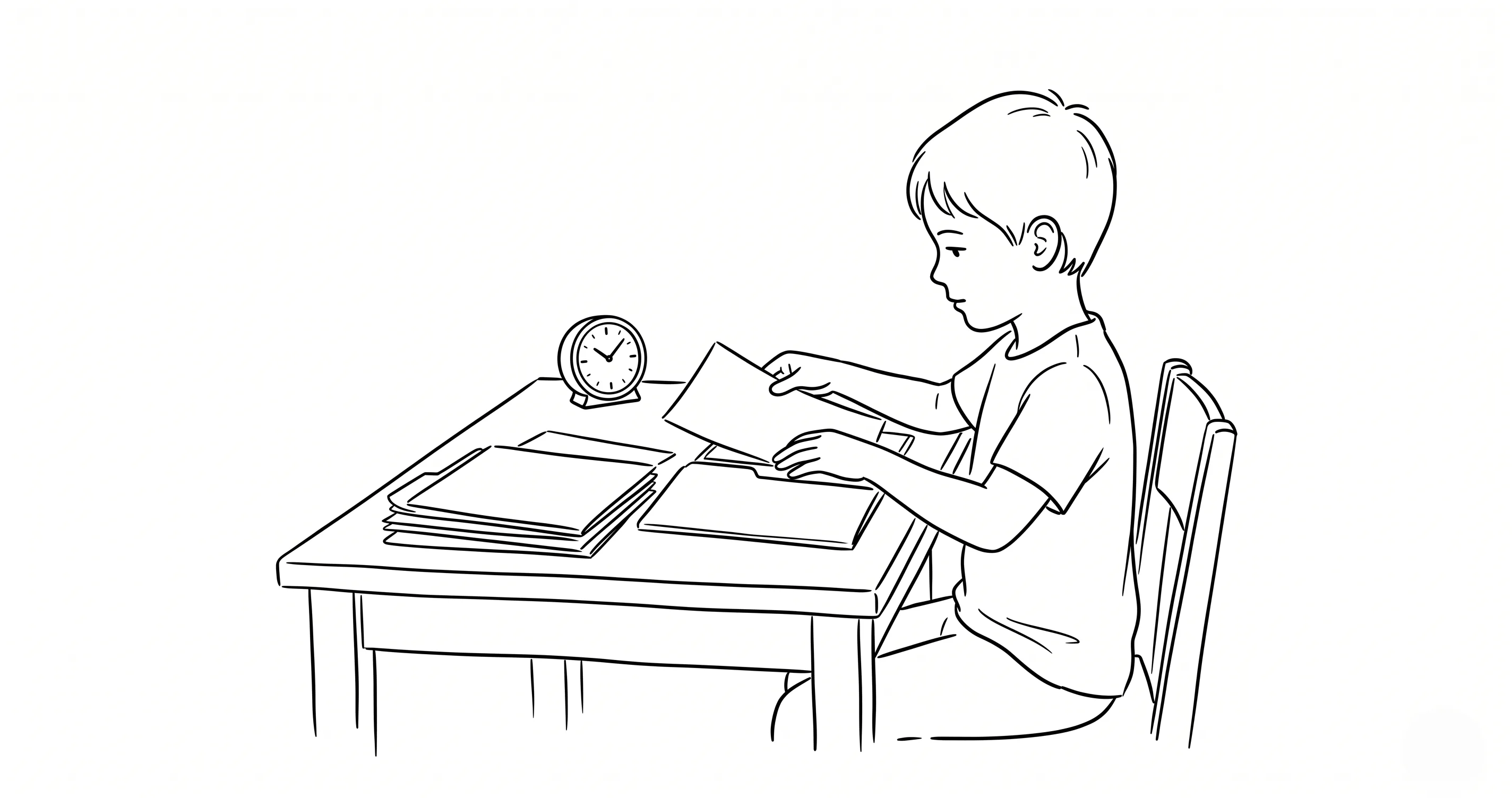
Your child forgets their lunch box every morning. They start homework and then wander off to find a snack, forgetting what they were doing. They melt down when plans change. You have explained the routine a hundred times. You have made charts. You have tried consequences. And still, the same patterns repeat — because the real issue is executive function skills for kids, not willpower.
If this sounds familiar, the issue probably is not motivation, attitude, or willfulness. It is likely executive function — a set of brain-based skills that children develop gradually, at different rates, and that no amount of lecturing can accelerate. This guide explains what executive function skills for kids actually are, how they show up in daily family life, and what parents can do to help — practically, at home, without waiting for a diagnosis.
What Executive Function Means in Real Family Life
Executive function is not a single ability. It is an umbrella term for the mental processes that allow a person to plan, focus, remember instructions, and manage multiple tasks at once. Researchers at Harvard’s Center on the Developing Child describe it as the brain’s “air traffic control system” — the mechanism that manages the flow of information, prioritizes what matters, and prevents collisions.
For adults, these skills operate mostly in the background. You make a grocery list, drive to the store, remember what you need, resist buying things that are not on the list, and adjust your plan when an item is out of stock. You do not think about the dozens of micro-decisions involved. But for children, every one of those steps requires conscious effort. Their air traffic control system is still under construction.
This is why a child can understand a rule perfectly and still fail to follow it. Knowing what to do and being able to execute it in the moment are two completely different cognitive demands. Executive functioning skills for kids are not about intelligence or obedience. They are about brain development — and the prefrontal cortex, where these skills live, is one of the last brain regions to fully mature.
The Core Executive Function Skills Parents Notice First
Researchers typically break executive function into three foundational components. Understanding each one helps parents identify exactly where their child struggles — which is the first step toward meaningful support.
Working memory
Working memory is the ability to hold information in mind while using it. It is what allows a child to remember the three things you asked them to do, follow a multi-step math problem, or keep track of where they are in a story while reading aloud.
When working memory is weak, children appear forgetful. They walk into a room and forget why. They lose the thread of a conversation. They need instructions repeated — not because they were not listening, but because the information did not stay in active memory long enough to act on it. If your child frequently seems to “lose” information moments after hearing it, working memory is likely the bottleneck.
Cognitive flexibility
Cognitive flexibility — sometimes called “flexible thinking” — is the ability to shift between tasks, adjust to new information, and tolerate changes in plans. It is what allows a child to switch from reading to math without a meltdown, accept that the playground is closed and suggest an alternative, or try a new strategy when their first approach to a problem does not work.
Children with weak cognitive flexibility get “stuck.” They insist on doing things one way. They fall apart when the schedule changes. They cannot let go of an idea, even when it is no longer working. This rigidity is not stubbornness — it is the brain struggling to release one mental set and activate another.
Inhibitory control
Inhibitory control is the ability to resist impulses, think before acting, and filter out distractions. It is the skill that lets a child raise their hand instead of blurting out, stay seated during a lesson, or resist grabbing a toy from a sibling. It is also what allows a child to stop a behavior once they have started it — which is significantly harder than not starting it in the first place.
Weak inhibitory control shows up as impulsivity: interrupting, acting without thinking, difficulty waiting, and trouble disengaging from something rewarding (like a screen) to do something less immediately satisfying (like homework). Parents often describe these children as “acting before they think,” which is neurologically accurate — the braking system in their prefrontal cortex is not yet strong enough to override the accelerator.
| Skill | What It Does | What Weakness Looks Like |
|---|---|---|
| Working Memory | Holds and uses information in real time | Forgets instructions, loses belongings, needs constant reminders |
| Cognitive Flexibility | Adapts to changes and shifts between tasks | Meltdowns with schedule changes, rigidity, gets “stuck” on one approach |
| Inhibitory Control | Resists impulses and filters distractions | Blurts out, acts before thinking, cannot stop a rewarding activity |
Executive Function by Age: What Is Realistic
One of the most common sources of parent frustration is expecting executive function skills that are not yet developmentally available. Knowing what is realistic at each age prevents you from interpreting normal immaturity as a problem — and helps you spot genuine delays early.
Ages 3–5: the foundation
Preschoolers are just beginning to develop executive function. At this stage, children can follow simple two-step directions (“Put on your shoes and then go to the door”), wait for a short period with adult support, and begin to understand basic rules. They cannot plan ahead, manage time, or organize materials independently. Expecting a 4-year-old to “get ready for school” without step-by-step guidance is asking for a skill that does not exist yet.
Ages 6–8: rapid growth
This is the period of fastest executive function development. Children begin to hold two or three steps in mind simultaneously, follow routines with decreasing prompts, and show early signs of self-monitoring (“I think I forgot something”). However, they still need external structure — visual schedules, checklists, and consistent routines — to stay on track. Independent planning and time management are not yet reliable.
Ages 9–12: building independence
By late elementary school, children can plan simple projects, manage basic homework routines with minimal oversight, and begin to estimate how long tasks will take. They can start to manage their own time with appropriate scaffolding, and hands-on time management games for students can make that practice engaging. This is when parents can begin gradually stepping back — but stepping back does not mean disappearing. The scaffold should thin, not vanish.
Ages 13 and beyond: slow refinement
Adolescent executive function is better than a child’s but still far from adult-level. Teens can handle more complex planning and longer-term projects, but they remain vulnerable to impulsive decision-making, especially under emotional stress or peer pressure. The prefrontal cortex does not fully mature until approximately age 25 — which means even a responsible 16-year-old is operating with hardware that is still being installed.
How Executive Function Challenges Show Up in Homework, Chores, and Screen Time
Executive function is invisible. You cannot see it the way you can see a child read or ride a bike. But you can see its absence — in the patterns that repeat daily, despite your best efforts.
Homework
A child with executive function challenges may sit down to do homework and immediately get distracted. They might spend 20 minutes sharpening pencils, looking for the right notebook, or staring at the first problem without starting. Once they begin, they may lose track of the steps, skip problems without noticing, or rush through to finish without checking their work. The issue is not that they do not understand the material. It is that organizing the process of doing the work overwhelms the same brain resources needed for the work itself.
Chores
A parent says, “Clean your room.” To an adult, this is a single instruction. To a child with weak executive function, it is an unsorted pile of sub-tasks: pick up clothes, make the bed, put books away, organize the desk, find a place for loose toys. Without the ability to break a large task into ordered steps, the child stands in the middle of the room, overwhelmed, and does nothing — which the parent interprets as defiance.
Screen time
Screens are the ultimate executive function stress test. They provide constant, high-dopamine stimulation that requires almost no executive function to engage with — and then demand the highest levels of inhibitory control to disengage from. This is why children who seem perfectly functional during screen time fall apart when it ends. The screen was doing the executive function work for them (choosing what to focus on, maintaining engagement, filtering distractions). The moment it stops, those demands transfer back to the child’s own brain — which may not be ready for them. Tools that externalize this transition, like structured timers and visual countdowns, reduce the executive function load of stopping.
Executive Function Activities That Work at Home
The good news: executive function is trainable. Like a muscle, it strengthens with practice — but only the right kind of practice. Here are executive function activities for kids that target each core skill, organized by what they actually build.
Activities that build working memory
- Cooking together. Following a recipe requires holding steps in mind, tracking ingredients, and sequencing actions. Start with two- or three-step recipes for younger children and increase complexity as they grow.
- Story retelling. After reading a book or watching a show, ask your child to retell the story in order. This forces them to hold the full narrative in working memory and organize it sequentially.
- Card and board games. Games like Memory (matching pairs), Uno (tracking what has been played), and chess (planning several moves ahead) are natural working memory workouts.
- Graduated instructions. Start with one-step requests and build to two, then three. “Put your plate in the sink, wipe the table, and then get your backpack.” The goal is stretching the number of items they can hold and act on.
Activities that build cognitive flexibility
- Plan changes on purpose. Occasionally change a familiar routine in a small, low-stakes way — take a different route to school, eat breakfast in a different room, swap the order of two bedtime steps. Practice noticing and adapting.
- “What else could we do?” When your child gets stuck on one solution, ask them to brainstorm two alternatives. The goal is not finding the “right” answer but practicing the skill of generating options.
- Role reversal games. Let your child play the parent or teacher for 10 minutes. Switching roles requires perspective-taking and cognitive shifting simultaneously.
- Open-ended building. LEGO without instructions, art without a template, or building forts from furniture all require adjusting plans as materials and ideas change.
Activities that build inhibitory control
- Red Light, Green Light and Simon Says. These classic games are pure inhibitory control practice — requiring children to stop an action, override an impulse, or wait before responding.
- Turn-taking games. Any game where the child must wait their turn (board games, catch, conversation practice) builds the ability to inhibit the impulse to act immediately.
- Focus timers with a visual end point. Using a timer to practice staying with one task — even for just five minutes — builds the muscle of resisting distraction. Start with short intervals and extend them gradually as your child’s capacity grows.
- Mindful pausing. Before answering a question or making a request, practice counting to three. This creates a habit of inserting a pause between impulse and action — which is the foundation of self-regulation.
What Helps at Home Before You Think About Diagnosis
Many parents jump to “Does my child have ADHD?” before exploring what executive function support looks like at home. While a professional evaluation is warranted in some cases, there is a wide range of how to improve executive function in kids that does not require a diagnosis, a therapist, or a label.
When it is probably developmental
If your child’s executive function challenges are roughly in line with their age group (see the age chart above), they are likely on a normal developmental timeline. Not every 7-year-old who forgets their homework needs an evaluation. Most just need better scaffolding.
When to consider professional input
Consider seeking an evaluation if your child’s executive function challenges are:
- Significantly behind same-age peers — not just “a little forgetful” but unable to function in age-appropriate settings without constant adult intervention
- Impacting multiple domains — struggles showing up at school, at home, and in social situations, not just one context
- Getting worse rather than better — most children improve gradually; if your child’s executive function seems to be declining or stalling, that warrants attention
- Causing significant distress — to the child themselves, not just to you. A child who is frustrated, anxious, or losing confidence because they “can’t do anything right” deserves professional support
Even when a diagnosis is appropriate, the home strategies in this guide remain the foundation. ADHD medication, for example, can improve attention and impulse control — but it does not teach organizational skills. Those still need to be built through practice, scaffolding, and patient repetition. Resources like Understood.org provide additional guidance for families navigating this process.
The skill-gap reframe
The single most helpful shift a parent can make is moving from “My child won’t” to “My child can’t — yet.” This is not about lowering expectations. It is about matching expectations to current ability and building from there. A child who “won’t” clean their room is a discipline problem. A child who “can’t yet” break a large task into steps is a child who needs scaffolding — a completely different parental response.
Building Executive Function Support Into Daily Routines
The most effective executive function support is not a special program or a weekly therapy session. It is what happens in the ordinary structure of daily life. Routines are where executive function is practiced, strengthened, and eventually internalized.
Morning routines as training ground
A consistent morning routine is one of the most powerful executive function tools available to parents. When the steps are the same every day — wake up, get dressed, eat breakfast, brush teeth, pack backpack, shoes on — the sequence eventually becomes automatic. This frees up working memory for other demands. For younger children or those with significant executive function challenges, pair the routine with a visual checklist posted at eye level. Let your child check off each step themselves. The physical act of marking completion reinforces the sequence and builds ownership.
Homework routines that reduce friction
The single biggest executive function challenge in homework is getting started. Once a child is engaged, they can often sustain effort — but the initiation step requires planning, organization, and impulse suppression all at once. Reduce this demand by making the start point as concrete as possible: same time, same place, materials already out, first task clearly identified. A focus timer can lower the barrier further by reframing the task from “do all your homework” to “work for 15 minutes.”
Chore systems that teach planning
Instead of giving a child one large instruction (“clean your room”), break it into a sequenced list: 1) Pick up clothes and put them in the hamper. 2) Put books on the shelf. 3) Make the bed. 4) Put toys in the bin. This is not coddling — it is teaching the skill of task decomposition, which is one of the most important executive function skills for adult life. Over time, you can ask the child to create the list themselves: “What steps do you need to do to get your room clean?” The scaffolding shifts from your structure to their own.
Screen time transitions as practice
Every time your child stops using a screen, they practice inhibitory control. Every time they follow a timer instead of arguing, they strengthen the connection between rules and behavior. This is why structured screen time systems — where the transition is predictable, the end point is visible, and the next activity is clear — are not just about managing screen time. They are executive function training sessions that happen every single day.
The graduated independence model
The long-term goal of executive function support is not to do the thinking for your child forever. It is to gradually transfer the cognitive load from you to them. This follows a predictable pattern:
- Do it for them — model the skill while narrating your thinking aloud (“First I’m going to sort these by color, then I’ll put each group away”)
- Do it with them — work alongside them, providing prompts and guidance as needed
- Watch them do it — step back but stay present, offering help only when asked or when they get stuck
- Check after they do it — review the result together and discuss what went well and what they could adjust
- Trust them to do it — the skill is internalized and the scaffold is no longer needed
This progression takes months or years, not days. But each step represents genuine neurological growth. The child is not just following a routine — they are building the brain architecture that will eventually let them plan, prioritize, and self-regulate on their own.