
If you have searched “body doubling ADHD” you probably already know the frustration: your child sits down to do homework, the pencil is out, the worksheet is open — and then nothing. They stare, fidget, get up for water, and twenty minutes later have not written a single word. You have tried timers and rewards. Nothing sticks.
Body doubling is one of the simplest, most effective focus strategies for ADHD kids, and it requires almost no effort on your part. You just have to be there. It also works as body doubling for studying — not just homework but any task that requires sustained focus.
This guide explains what body doubling is, why it works neurologically, how to do it at home and virtually, and how to adapt it for body doubling ADHD kids at every age.
What Is Body Doubling?
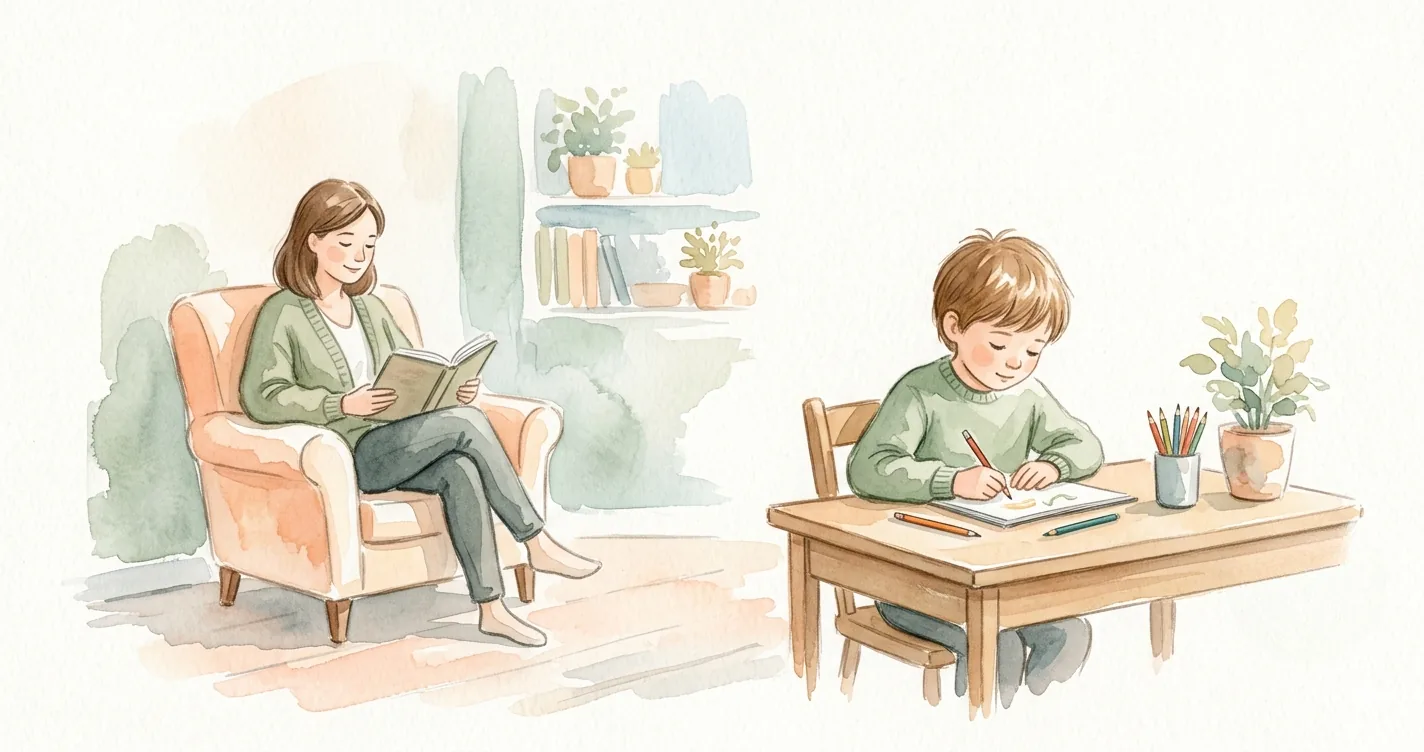
Body doubling is the practice of having another person present — not helping, not instructing, not watching — while you work on a task. The other person simply exists in the same space. They might be reading a book, folding laundry, working on their own laptop, or sitting quietly. Their presence alone provides enough external structure to help an ADHD brain get started and stay on task.
The term originated in the ADHD coaching community and has been used clinically for decades, though it has only recently gained wider recognition. CHADD (Children and Adults with Attention-Deficit/Hyperactivity Disorder) describes body doubling as a practical accommodation that leverages the ADHD brain’s responsiveness to external cues.
What body doubling is not
Body doubling is not tutoring. It is not supervision. It is not hovering over your child’s shoulder and pointing out mistakes. The body double does not need to understand the task, engage with it, or even look at what the other person is doing. The moment you start helping, correcting, or directing, you have shifted from body doubling into something else entirely — and for many children with ADHD, that shift actually makes focus harder, not easier.
Why parents often do it without knowing
Many parents have already experienced body doubling without having a name for it. Your child refuses to clean their room alone but happily does it when you are sitting on their bed scrolling your phone. They cannot start homework at their desk but will work through the entire assignment at the kitchen table while you cook dinner. That is body doubling. The difference is doing it intentionally, consistently, and understanding why it works — so you can replicate it when you need it most.
Why Body Doubling Works for ADHD Brains
To understand why body doubling is so effective, you need to understand the core challenge of ADHD: it is not a deficit of attention. It is a deficit of regulating attention. Children with ADHD can hyperfocus on a video game for hours but cannot sustain focus on a worksheet for ten minutes. The difference is not willpower. It is dopamine.
The dopamine connection
ADHD brains have lower baseline levels of dopamine — the neurotransmitter that drives motivation, reward anticipation, and sustained effort. When a task is inherently interesting (video games, building with LEGO), the brain generates enough dopamine to maintain focus. When a task is not inherently stimulating (math homework, brushing teeth, tidying up), the ADHD brain struggles to produce the chemical motivation needed to start and persist.
Body doubling provides a gentle external source of stimulation. Another person’s presence activates the brain’s social awareness circuits, adding just enough arousal to bridge the dopamine gap. It is not exciting. It is not distracting. It is a subtle, steady signal that says: someone is here, and things are happening.
Co-regulation and the social brain
Humans are deeply social creatures. Our nervous systems are wired to regulate in response to other people’s states. When a calm, focused person is nearby, your child’s nervous system picks up on that energy and begins to mirror it. Developmental psychologists call this co-regulation — the process by which one person’s calm state helps stabilize another’s.
For children with ADHD, whose internal regulation systems are less reliable, this external anchor is especially powerful. The body double does not need to say a word. Their regulated presence does the work.
Accountability without pressure
There is a third mechanism at play: social accountability. When someone else is in the room, there is an implicit sense of being observed — even when the other person is not watching. This is enough to reduce the likelihood of task avoidance behaviors (getting up to wander, switching to something more stimulating) without creating the anxiety that comes from direct monitoring.
This is a crucial distinction. Direct supervision (“I’m watching you do your homework”) often increases stress and decreases performance for children with ADHD. Body doubling provides accountability through presence, not surveillance.
In-Person Body Doubling: How to Do It at Home
The good news about body doubling is that it requires no special training, no equipment, and no curriculum. Here is how to set it up effectively at home.
Choose the right space
Body doubling works best in a shared space where your child can see or sense your presence without being directly across from you. The kitchen table while you prep dinner. The living room while you read. Their bedroom doorway while you fold laundry in the hall. The goal is proximity without confrontation — side-by-side is usually better than face-to-face.
Do your own thing
The most effective body doubles are busy with their own tasks. When you are genuinely engaged in your own activity — reading, working, organizing — your calm focus radiates outward. If you sit down with nothing to do and just stare at your child, you have become a supervisor, not a body double. Bring something to do.
Minimize interaction
Once the work session starts, keep conversation to a minimum. A brief “I’m here if you need me” at the beginning is fine. Occasional encouragement (“nice work”) is fine. But avoid asking how it is going, checking their progress, or offering help unless they ask. Every interruption resets the focus clock for an ADHD brain.
Pair it with a timer
Body doubling becomes even more powerful when combined with a structured time block. A Pomodoro session — 25 minutes of focused work followed by a 5-minute break — gives the work period a clear beginning and end. Your child knows they do not have to focus forever. They just have to focus until the timer sounds. And you will be there the whole time.
What to do if your child resists
Some children, especially older ones, may feel self-conscious about needing someone nearby. Frame it casually: “I’m going to sit in here and read while you work — I like the light in this room.” Do not label it as a strategy or make it clinical. The less attention you draw to it, the more naturally it works.
Virtual Body Doubling: Apps, Videos, and Online Options
You cannot always be in the room. Work schedules, multiple children, and simple exhaustion make in-person body doubling impractical as a daily solution. That is where virtual body doubling comes in.
Video calls with a study partner
The simplest form of virtual body doubling is a video call with a friend, classmate, or family member. Both people turn on their cameras, briefly share what they plan to work on, mute their microphones, and work in parallel. The visual presence of another person on screen provides the same social accountability as being in the same room. Many college students with ADHD use this technique daily — and it works just as well for younger children with a parent or grandparent on the other end.
Study-with-me livestreams
YouTube and other platforms host thousands of “study with me” videos — long, quiet recordings of someone studying at a desk, often with a timer on screen. These videos create a sense of shared presence without requiring another real person’s time. For children who are struggling to start homework, putting on a study-with-me stream can provide just enough external structure to bridge the initiation gap.
Dedicated body doubling apps
Several apps have been designed specifically for virtual body doubling:
- Focusmate — pairs you with an accountability partner via video call for a timed work session (25 or 50 minutes)
- Flow Club — group co-working rooms where multiple people work together on camera with structured check-ins
- Flown — facilitated deep work sessions with a host who guides the group through focus blocks
These are primarily designed for adults, but the concept translates directly to children. A parent can set up a video call with a grandparent, aunt, or family friend who simply stays on camera while the child works. The child gets the presence. The adult gets to go about their own tasks.
Digital body doubling with focus tools
Focus timer apps can serve as a form of digital body doubling by providing a persistent, calming external presence. When your child starts a focus session with a visual timer — especially one with ambient scenes, gentle countdowns, and a sense of structure — the app functions as a quiet companion. It is not a person, but it fills the same role: an external anchor that says this is focus time, and you are not alone in it.
Body Doubling for Kids: Age-Appropriate Approaches
Body doubling looks different at every age. What works for a six-year-old will not work for a thirteen-year-old. Here is how to adapt the strategy as your child grows.
Ages 5–7: The natural body double
Young children are naturally inclined toward body doubling. They want you nearby for everything. At this age, lean into it rather than pushing independence too early. Sit with them during homework. Be in the room during cleanup. Your presence is their primary regulation tool, and that is developmentally appropriate.
Practical approach: set up a “work together” station at the kitchen table. You do your tasks (bills, emails, meal planning). They do theirs (homework, coloring, reading). The shared space creates a natural body doubling dynamic without any formal structure.
Ages 8–10: Structured parallel work
By this age, children are developing more independence but still benefit significantly from external structure. Introduce the concept of “parallel work time” — a set period where everyone in the family works on their own tasks in the same space. This normalizes the practice and removes any stigma.
Pair body doubling with ADHD-friendly study techniques at this age: break homework into small chunks, use a visual timer, and allow movement breaks between blocks. Your presence during the work blocks and your availability during breaks creates a rhythm that ADHD brains respond well to.
Ages 11–13: The subtle shift
Preteens may resist the idea of needing a parent nearby. This is normal and healthy — they are developing autonomy. Instead of sitting in the room, try being in an adjacent space with the door open. Work in the kitchen while they work in the dining room. Be on the same floor of the house. The proximity still provides a co-regulation effect, even if your child would not describe it that way.
This is also the age to introduce virtual body doubling. A video call with a friend during homework normalizes the practice and shifts the social anchor from parent to peer — which is where adolescent motivation naturally wants to go.
Ages 14+: Peer and virtual options
Teenagers are unlikely to want a parent sitting with them during homework, and that is fine. Virtual body doubling — study-with-me videos, video calls with classmates, or apps like Focusmate — provides the same benefit through a medium that feels age-appropriate. The focus shifts from parental presence to self-selected accountability partnerships.
For teens with ADHD, learning to recognize their own need for body doubling and set it up independently is a valuable self-advocacy skill. Help them identify when they struggle most (starting homework, studying for tests, completing long-term projects) and experiment with different body doubling methods until they find what works.
| Age Group | Body Double | Setting | Key Principle |
|---|---|---|---|
| 5–7 | Parent (in-person) | Same table or room | Natural proximity; do not push independence too early |
| 8–10 | Parent or sibling | Shared workspace | Structured parallel work time; pair with timers |
| 11–13 | Parent (adjacent) or peer (virtual) | Nearby rooms; video call | Subtle presence; introduce virtual options |
| 14+ | Peers, apps, study streams | Virtual or library | Self-selected accountability; self-advocacy skill |
When Body Doubling Doesn’t Work (And What to Try Instead)
Body doubling is not a universal solution. There are situations where it does not help — or can actually make things worse. Recognizing these situations is important so you do not blame the strategy (or your child) when the issue is something else entirely.
When the task itself is the problem
If your child is avoiding a task not because they cannot focus but because they genuinely do not understand it, body doubling will not help. Sitting next to a confused child while they stare at a math problem they do not know how to solve is not body doubling — it is shared frustration. Before setting up a body doubling session, confirm that your child understands the task. If they do not, address the knowledge gap first.
When sensory needs are unmet
Some children with ADHD are also sensory-sensitive. For these children, another person’s presence can actually increase distraction — the sound of typing, the rustling of pages, or even the feeling of being watched can push them further from focus rather than pulling them toward it. If your child consistently performs worse with someone nearby, they may need a sensory-first approach (noise-canceling headphones, a private workspace, or environmental modifications) before body doubling can work.
When emotional regulation is the barrier
Body doubling assumes a baseline level of emotional readiness. If your child is in a state of heightened distress — angry about a fight with a friend, anxious about a test, overwhelmed by a long to-do list — the issue is not task initiation. It is emotional regulation. In these moments, co-regulation through conversation, validation, and calming techniques needs to come before any focus strategy.
Complementary strategies
When body doubling alone is not enough, combine it with other ADHD-friendly approaches:
- Task decomposition — break large tasks into the smallest possible steps so the initiation barrier is lower
- Environmental design — remove competing stimuli from the workspace (phone in another room, browser tabs closed, desk cleared)
- Movement breaks — intersperse focus blocks with physical activity to release built-up energy
- Timers and structure — Pomodoro technique or similar time-boxing methods provide a clear endpoint that makes sustained focus feel manageable
Making Body Doubling Part of Your Family’s Routine
The real power of body doubling emerges when it becomes a habit rather than an intervention. Here is how to integrate it into your family’s daily and weekly rhythms.
Designate a daily parallel work block
Pick a consistent time each day — right after school, after dinner, or on weekend mornings — when everyone in the family works on their own tasks in a shared space. Parents catch up on emails or reading. Children do homework or practice an instrument. Siblings work on their own projects. The structure normalizes body doubling as something the whole family does, not something imposed on the child with ADHD.
Create a homework ritual
Rituals reduce the cognitive load of starting. The routine might look like this: arrive home, have a snack, set up at the kitchen table, start the focus timer, and work until the timer sounds. You are nearby the entire time, doing your own thing. The predictability of the sequence makes task initiation easier because the brain does not have to decide what comes next — it just follows the pattern.
Rotate body doubles
You do not have to be the body double every time. Siblings, the other parent, a grandparent on a video call, or even a family pet (seriously — some children with ADHD find that a dog sleeping nearby provides a similar anchoring effect) can fill the role. The more people who participate, the more sustainable the practice becomes.
Combine with digital tools
On days when in-person body doubling is not possible, have a backup plan ready. A study-with-me video queued up, a focus timer app set to a calming scene, or a standing video call with a family member. The transition from “no one is available” to “I have a digital body double ready” should be seamless.
Track what works
Not every body doubling setup will work equally well for your child. Keep a mental note (or a brief log) of which configurations lead to the best focus: Which room? Which body double? What time of day? With or without background music? Over a few weeks, patterns will emerge. Use those patterns to optimize the routine rather than defaulting to the same setup every time.