
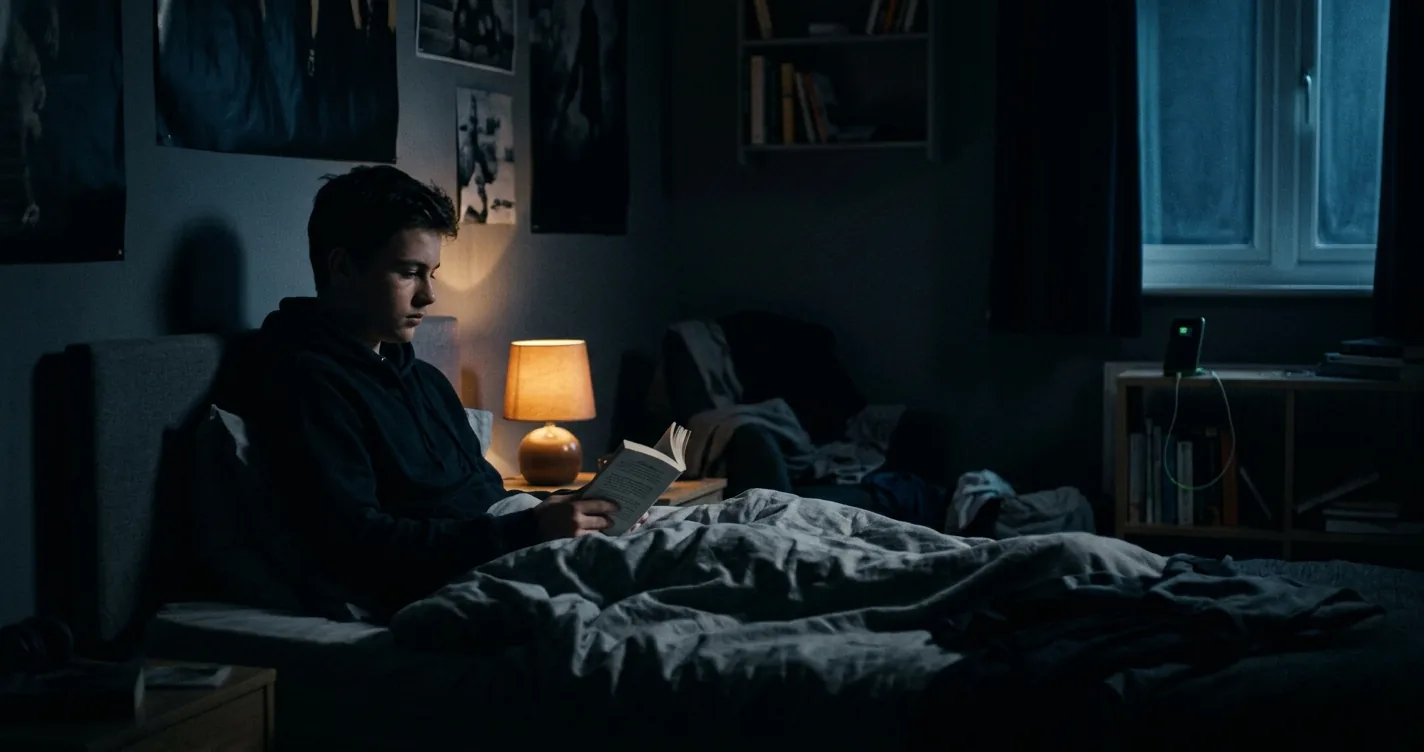
It is 11:30 PM on a school night. You walk past your teenager’s door and see the glow of a phone screen under the covers. You have had this conversation before. “Put the phone away.” They mumble something. Twenty minutes later, the glow is back. You know they need a bedtime routine for teenager that actually works — and yet here you are, stuck in the same cycle again.
If this scene feels familiar, you are dealing with one of the most common conflicts in families with teens. The good news: a bedtime routine for teenager that actually works is not about stricter rules or taking the phone away. It is about understanding why teens stay up late, removing the biggest sleep obstacle, and building a wind-down routine they helped create. This guide walks through all three.
Why Teenagers Stay Up Late (Biology, Not Laziness)
Before you can fix your teen’s teenager sleep habits, you need to understand why they are the way they are. The short answer: puberty rewires the sleep clock.
The circadian shift
During puberty, the brain delays the release of melatonin — the hormone that triggers sleepiness — by approximately two hours compared to younger children and adults. This is not a choice. It is not laziness. It is a well-documented biological shift that the Sleep Foundation and the American Academy of Pediatrics have both confirmed.
A 10-year-old who felt sleepy at 8:30 PM may not feel genuinely tired until 10:30 or even 11 PM at age 14. Telling a teenager to go to sleep at 9 PM is like telling an adult to fall asleep at 7 PM — biologically, their brain is not ready.
The second wind effect
Teens who push past their initial drowsiness window (usually around 10–10:30 PM) often experience a “second wind” that keeps them alert until well past midnight. This is the cortisol rebound — the body’s stress response kicking in when it senses the person is fighting sleep. Once this second wind hits, falling asleep becomes genuinely difficult, not just a matter of willpower.
Social and emotional factors
Biology is the foundation, but it is not the whole story. Nighttime is often the only time teenagers feel truly alone and unwatched. For many teens, the late-night hours are when they process the social dynamics of the day, message friends, journal, or simply decompress from a schedule they had no control over. Understanding this does not mean accepting 1 AM bedtimes — but it does mean that a teen bedtime routine needs to account for the need for autonomy and private time, not just sleep hygiene.
How Much Sleep Teens Actually Need
The numbers are straightforward. The teen sleep schedule research is consistent across every major health organization.
| Age | Recommended Sleep | Realistic Bedtime (for 6:30 AM wake) |
|---|---|---|
| 13–14 years | 9–10 hours | 8:30–9:30 PM |
| 15–16 years | 8–10 hours | 8:30–10:30 PM |
| 17–18 years | 8–10 hours | 8:30–10:30 PM |
The gap between what teens need and what they get is staggering. The CDC reports that over 70% of high school students get fewer than 8 hours of sleep on school nights. That is not a minor shortfall — it is a public health problem that affects academic performance, emotional regulation, driving safety, and mental health.
Why “catch-up sleep” on weekends does not work
Many families accept the weeknight deficit and assume teens will catch up on weekends. The research on this is clear: weekend recovery sleep does not fully compensate for chronic weeknight deprivation. Worse, sleeping until noon on Saturday shifts the circadian clock even further, making Sunday and Monday nights harder. It creates a cycle that repeats every week — what researchers call “social jet lag.”
The most effective approach is consistency. A sleep routine for teenager that keeps the wake time within 60 minutes of the school-day schedule — even on weekends — produces measurably better sleep quality than one that allows large weekend shifts.
The Phone Problem: Why Screens Wreck Teen Sleep
You already suspect the phone is the issue. The data confirms it. A 2024 Common Sense Media study found that 68% of teens use a screen within 30 minutes of bedtime, and teens who keep their phone in the bedroom sleep an average of 28 minutes less per night than those who do not.
The three ways screens destroy sleep
Blue light suppression. Screens emit blue-wavelength light that directly suppresses melatonin production. Even with “night mode” filters, the suppression is significant enough to delay sleep onset by 20 to 30 minutes. This compounds the circadian delay that puberty already creates.
Dopamine engagement. Social media, games, and short-form video are engineered to trigger dopamine release. Each notification, each new video, each message creates a micro-reward that keeps the brain in an alert, seeking state — the opposite of what is needed for sleep onset. This is not a willpower issue. These products are designed by teams of engineers to be difficult to put down.
Emotional activation. A single text message at 11 PM can trigger anxiety, excitement, or social comparison that keeps a teen’s mind racing for an hour. Screens before bed do not just delay sleep through light and stimulation — they create emotional states that are incompatible with falling asleep.
The 80% solution
If you do nothing else from this article, do this: get the phone out of the bedroom at night. A charging station in the hallway or kitchen — for every family member, not just the teen — eliminates the biggest single barrier to healthy teenager sleep habits. It removes the temptation, the notifications, and the blue light in one move. Families who implement this consistently report that their teen falls asleep 20 to 40 minutes earlier within the first week.
Negotiating a Screen Curfew With Your Teen
You cannot enforce a bedtime for a teenager. Anyone who has tried knows this. What you can do is negotiate a phone curfew — a specific time when devices go to the charging station and the wind-down period begins. Some families call it a screen curfew; the idea is the same.
Why negotiation matters more than dictation
Teens who help set the rules are significantly more likely to follow them. This is one of the most consistent findings in adolescent psychology. A curfew imposed by a parent feels like control. A curfew agreed upon in a conversation feels like a contract. Same outcome — very different compliance rate.
The negotiation framework
Work backward from wake-up time together. “You need to be up at 6:30. That means you need to be asleep by 10:30 at the latest. If it takes 30 minutes to fall asleep, the wind-down starts at 10:00. That means screens off by 9:30. Does that feel doable?”
Give them a 30-minute range. “Screens off somewhere between 9:00 and 9:30 — you pick.” When they choose 9:30, they own it. When you impose 9:00, they resent it. The 30-minute difference in sleep is less important than the difference in buy-in.
Be specific. Does the laptop stay in the room for music? Is a Kindle allowed because it is not backlit? Can they listen to a podcast? Ambiguity creates loopholes and conflict. Define the boundaries clearly so there is no nightly renegotiation.
What happens if they break the curfew? What happens on Friday nights? Build in flexibility so the system does not feel rigid. A teen who knows Friday is more relaxed is more willing to respect Tuesday.
Using tools to remove yourself from enforcement
The most common reason phone curfews fail is that the parent has to be the one who says “time’s up.” Every night, the same interaction: “It’s 9:30.” “Just one more minute.” “Now.” This wears both sides down.
Automated tools change this dynamic. When apps lock at 9:30 PM because that is what the system does — not because Mom said so — the nightly argument disappears. The teen’s frustration targets the system, not the parent. You stay the coach instead of becoming the enforcer. Setting up screen time boundaries for teens through an app makes the curfew feel like a fact of life rather than a power struggle.
A Wind-Down Routine Teens Won’t Hate
Once the phone goes to the charging station, the next 30 to 60 minutes matter. A bedtime routine for teens that works has three qualities: it is short, it is low-stimulation, and the teen chose it.
The non-negotiable elements
- Consistent timing. The routine starts at the same time every school night. The brain learns to associate this time with winding down. Inconsistency resets the conditioning every time.
- Low light. Dim the overhead lights or switch to a warm lamp. Bright overhead lighting suppresses melatonin just like a phone screen does.
- No screens. This is the point of the curfew. The wind-down period is phone-free, laptop-free, and TV-free.
Activities that actually work for teens
The biggest mistake parents make is suggesting activities that feel childish. A 15-year-old does not want a bedtime story. Here is what teens consistently report as helpful:
- Reading — physical books or a non-backlit e-reader. Fiction works better than nonfiction because it allows the brain to disengage from real-world concerns.
- Music or podcasts — calm music or a low-key podcast (comedy, storytelling, not news) through a speaker, not headphones. Headphones keep the brain in an active-listening mode.
- Stretching or light yoga — five to ten minutes of gentle stretching releases physical tension from the day. There are free routines on YouTube that teens can learn once and then do without a screen.
- Journaling — even three sentences. Writing down what happened today or what is on their mind for tomorrow externalizes the racing thoughts that keep many teens awake.
- Drawing or doodling — low-pressure creative activity that occupies the hands without stimulating the brain the way screens do.
- A warm shower or bath — the drop in core body temperature after a warm shower is a natural sleep trigger. Timing it 60 to 90 minutes before bed is optimal.
Let them build the routine
Present the menu of options above and let your teen pick two or three. The specific activities matter less than the consistency and the sense of ownership. A teen who chose “shower, then read, then lights out” will follow through far more reliably than one who was told “you need to read before bed.”
For younger teens (13–14), you might build the teen bedtime routine together as an extension of the evening routine they already know — just adjusted for their age and autonomy level.
Weekday vs Weekend: Should Rules Change?
Yes — but not as much as your teen wants them to.
The 60-minute rule
Sleep researchers recommend that weekend bedtimes shift no more than 60 minutes later than school nights. A teen who goes to bed at 10:30 on weekdays can shift to 11:30 on Friday and Saturday. Sleeping until noon on Saturday feels restorative in the moment but creates “social jet lag” — the same disorientation as flying across time zones — that makes Sunday night miserable and Monday morning worse.
The screen curfew can shift too
If the weekday screen curfew is 9:30 PM, move it to 10:30 PM on weekends. This gives the teen the feeling of earned flexibility without destroying the sleep schedule. The charging station still applies — just at a later time.
What about summer?
Summer is the danger zone for teen sleep schedules. Without school forcing a wake time, many teens drift into a pattern of sleeping from 2 AM to noon. Research shows that re-establishing a school-year schedule takes approximately one week of gradual adjustment (shifting bedtime 15 minutes earlier each night). Start the adjustment two weeks before school begins, not the night before.
Modeling: Your Bedtime Routine Matters Too
This is the section most parents skip — and it is the most important one.
They are watching you
If you tell your teenager to put their phone away at 9:30 and then sit on the couch scrolling Instagram until midnight, they notice. If you enforce a screen curfew for them but not for yourself, the rule feels like a punishment rather than a family value. Teens have an extraordinarily sensitive radar for hypocrisy — and rightfully so.
What modeling looks like in practice
- Your phone goes to the charging station too. Same time, same station. No exceptions, no “but I’m an adult.” The message: this is how our family handles screens at night.
- You have a visible wind-down routine. Let them see you reading, stretching, or doing something non-screen. You do not need to announce it. Just do it consistently enough that it becomes part of the household rhythm.
- You talk about your own sleep. “I slept terribly last night because I was on my phone too late” is more powerful than any lecture about why they should put their phone away. Vulnerability teaches better than authority.
The family agreement
The most effective approach is a family screen curfew agreement — not a teen rule. Sit down together and write it out. Everyone’s phone charges in the same spot. Everyone has a wind-down activity. Everyone respects the same boundaries. When the rule is universal, compliance goes up and resentment goes down.
This is the same principle that makes screen time boundaries for teens work in other contexts: when the system is fair and consistent, teens engage with it rather than fighting it.