
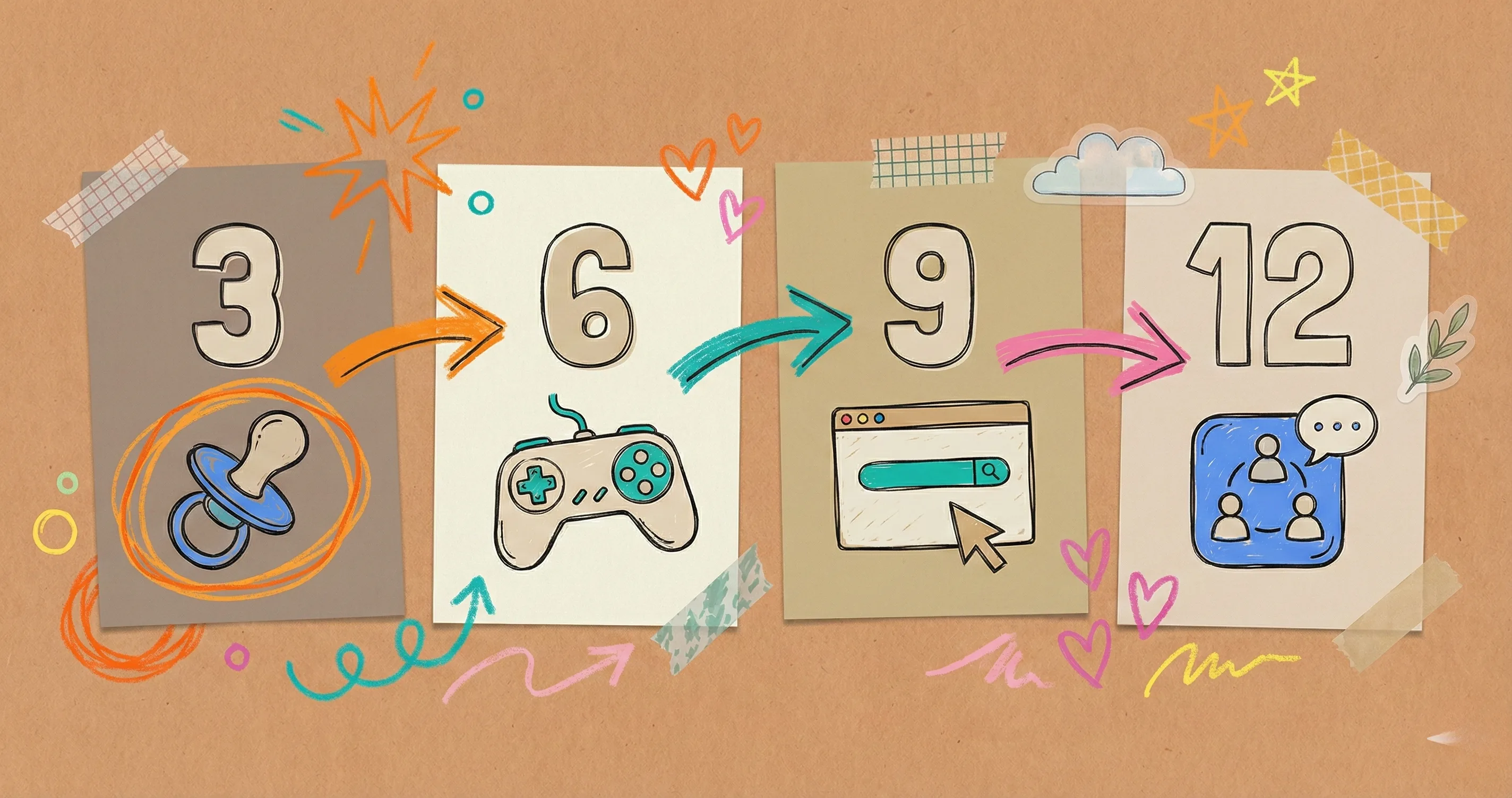
The 3 6 9 12 rule is one of the clearest screen time frameworks available to parents, yet it remains surprisingly unknown outside of Europe. Created by French psychiatrist Serge Tisseron in 2008, the rule takes a fundamentally different approach from the time-counting guidelines most American parents are familiar with. Instead of asking “how many hours per day?” it asks: “is my child developmentally ready for this type of technology?”
That distinction matters. A two-year-old watching 20 minutes of Bluey with a parent and a two-year-old scrolling YouTube alone present very different developmental scenarios — but a minutes-per-day guideline treats them the same way. The 3-6-9-12 rule addresses this gap by matching each category of digital exposure to the cognitive stage where a child can handle it safely.
This guide explains what each milestone means, the developmental research behind the 3 6 9 12 rule for screen time, how it compares to AAP recommendations, and practical steps for implementing the framework in your family.
What Is the 3 6 9 12 Rule?
The 3 6 9 12 rule screen time framework defines four developmental milestones for introducing technology to children. Rather than setting a universal daily time limit, it specifies which types of digital access are appropriate at each age.
Serge Tisseron, a psychiatrist and psychoanalyst at Université Paris Cité, developed the framework after observing that parents needed clearer guidance than “limit screen time.” He published it in 2008, and it has since been adopted by several European public health campaigns, including Luxembourg’s BEE SECURE initiative.
The four milestones are straightforward:
- Before age 3: No screens
- Before age 6: No personal gaming console
- Before age 9: No unsupervised internet access
- Before age 12: No unsupervised social media
Each threshold is tied to a major transition in a child’s life: entering preschool, starting elementary school, mastering reading and writing, and moving to middle school. Tisseron chose these moments deliberately because each represents a measurable shift in cognitive ability.
The Four Age Milestones Explained
Before age 3: No screens
The first milestone is the most strict. Tisseron recommends that children under 3 have no exposure to screens at all — including television playing in the background. The reasoning is rooted in how very young brains develop. Children under 3 are building the foundational skills of language, spatial awareness, and social attachment through direct sensory interaction with the physical world and with caregivers.
Screens, even “educational” ones, introduce a one-way flow of stimulation that young children cannot process the way older children can. A 2-year-old does not distinguish between a real person speaking to them and a character on a screen. The interaction looks passive either way, but only the real-world version involves the back-and-forth exchange that drives language acquisition. For a deeper look at the evidence behind this threshold, see our guide on screen time for toddlers.
Before age 6: No personal gaming console
The second milestone targets gaming specifically. Children between 3 and 6 can begin to engage with carefully chosen screen content under parental supervision, but Tisseron warns against giving them a personal gaming device. The distinction is between shared, supervised media use and solo, on-demand access.
At this age, children are developing the rudiments of executive function — the ability to plan, wait, and regulate impulses. A personal gaming console or tablet gives a child near-unlimited access to highly stimulating content before those self-regulation circuits are operational. The result is predictable: the child cannot stop on their own, and every shutdown becomes a conflict.
Before age 9: No unsupervised internet access
By age 6, children can use digital tools with guidance. But the open internet — where one click leads to the next in an infinite chain — requires a level of judgment that most children do not develop until around age 9. This milestone coincides with children mastering reading and writing, which Tisseron identified as a proxy for the abstract reasoning needed to evaluate online content.
Before age 9, children are highly susceptible to persuasive design. They cannot reliably distinguish advertising from content, credible sources from unreliable ones, or appropriate material from inappropriate. Supervised internet use (where a parent is present and guiding) is fine. Handing a child a browser and walking away is not.
Before age 12: No unsupervised social media
The final milestone addresses social media specifically. Tisseron placed this threshold at age 12 — the transition to middle school — because social media demands cognitive skills that are still developing throughout late childhood: the ability to manage a public identity, understand social consequences of shared content, resist peer pressure in real time, and cope with comparison and rejection.
This milestone has gained particular relevance as legislative momentum around children’s social media access has accelerated globally. For a broader look at how to evaluate your child’s readiness for social platforms, see our guide on when kids should get social media.
The Research Behind Each Threshold
Tisseron did not pull these ages out of thin air. Each milestone aligns with documented developmental windows that have been studied independently across multiple disciplines.
Age 3: Language and sensorimotor development
The period from birth to age 3 is the most critical window for language acquisition. Research consistently shows that language development depends on contingent interaction — a caregiver responding to a child’s babbling, pointing, and gestures in real time. Screens cannot provide this. A 2023 meta-analysis in JAMA Pediatrics found that each additional hour of daily screen time before age 3 was associated with measurably lower expressive language scores by age 5.
The sensorimotor argument is equally strong. Children under 3 learn spatial relationships, cause and effect, and object permanence through physical manipulation — stacking blocks, filling containers, exploring textures. Two-dimensional screens do not offer these inputs.
Age 6: Executive function maturation
Executive function — the set of cognitive skills that includes impulse control, working memory, and cognitive flexibility — undergoes a major growth period between ages 3 and 7. Research from the National Institute of Mental Health shows that the prefrontal cortex, which governs these functions, is one of the last brain regions to mature. At age 6, most children are just beginning to develop the capacity to stop an enjoyable activity voluntarily.
This is why a personal gaming device at age 5 creates problems that have nothing to do with willpower. The neural hardware for self-stopping is literally not finished yet.
Age 9: Critical evaluation capacity
Around age 9, children transition from concrete operational thinking to early abstract reasoning (in Piagetian terms). This shift enables them to begin evaluating claims, recognizing bias, and understanding that not everything presented as fact is true. Before this transition, children tend to accept screen content at face value — making unsupervised internet browsing a minefield of misinformation, manipulative design, and inappropriate content.
Age 12: Social cognition and identity management
Adolescent social cognition — the ability to manage multiple social identities, predict others’ reactions, and regulate emotional responses to social feedback — develops rapidly between ages 10 and 14. Social media demands all of these skills simultaneously. Research on cyberbullying, social comparison, and adolescent mental health consistently shows that children under 12 are more vulnerable to the negative effects of social platforms because their social-cognitive toolkit is still under construction.
3 6 9 12 Rule vs AAP Guidelines: How Do They Compare?
The 3 6 9 12 rule for kids and AAP guidelines are not competing frameworks. They answer different questions. The AAP asks “how much?” Tisseron’s framework asks “what kind?” Used together, they give parents a more complete picture than either framework offers alone.
| Dimension | 3 6 9 12 Rule (Tisseron) | AAP Guidelines |
|---|---|---|
| Focus | Type of access by age | Daily time limits by age |
| Under 2 | No screens before age 3 | No screens under 18 months (except video calls) |
| Ages 2–5 | Supervised only; no personal gaming device before 6 | Max 1 hour/day of high-quality content |
| Ages 6–9 | No unsupervised internet before 9 | Consistent limits; prioritize sleep, activity, homework |
| Ages 9–12 | No unsupervised social media before 12 | No specific social media guidance (defers to families) |
| Origin | European (France, 2008) | United States (updated 2024) |
| Enforcement style | Milestone-based gates | Daily time budgets |
The most practical difference: the AAP gives you a daily number to aim for, while Tisseron’s milestones give you a decision framework for what types of technology to allow at all. A parent can follow both simultaneously — limiting a 4-year-old to one hour per day (AAP) of supervised, co-viewed content (3 6 9 12) without any contradiction.
For detailed age-by-age time recommendations from AAP and WHO, see our screen time recommendations by age guide.
How to Follow the 3 6 9 12 Rule at Home
Understanding the framework is one thing. Implementing it in a household where screens are everywhere is another. Here are practical strategies for each milestone.
Ages 0–3: Create a screen-free default
- Keep TVs off as background noise during playtime and meals
- When video calls with grandparents happen (which Tisseron allows as an exception), treat them as interactive conversations, not passive viewing
- Build a rotation of non-screen activities: sensory bins, picture books, outdoor play, music
- Be realistic about your own phone use — children under 3 notice when a parent is absorbed in a device, and it disrupts the contingent interaction they need
Ages 3–6: Introduce screens on your terms
- Choose the content yourself. Slow-paced, interactive shows (Bluey, Sesame Street, Daniel Tiger) outperform fast-paced animation for this age group
- Watch together whenever possible. Co-viewing transforms passive consumption into a shared learning experience
- Do not give a child their own tablet or gaming device. Shared family devices make supervision natural and reduce the “it’s mine” ownership battles
- Use a simple earn-before-watch system: finish a puzzle, help set the table, then watch a show together
Ages 6–9: Supervised digital exploration
- Allow internet use for specific, parent-directed tasks (looking up a homework question together, watching a nature documentary)
- Keep devices in common areas — no screens in bedrooms
- Begin teaching digital literacy basics: “How do you know this website is telling the truth?” and “Why do you think this ad is showing you this?”
- Gaming can expand, but continue to vet games for age-appropriateness and keep play sessions time-bounded
Ages 9–12: Gradual independence with guardrails
- Internet access can become more independent, with clear boundaries about which sites are appropriate and periodic check-ins
- Discuss online safety in concrete terms: what to do if a stranger messages them, why they should never share personal information, how to recognize scams
- Social media accounts remain off-limits until 12. If peer pressure is intense, have the conversation about why — not just “because I said so”
- Using Timily’s Collaborative App Blocking, parents and kids can sit down together to decide which apps are available and which stay locked, turning the rule into a shared agreement rather than a unilateral decree
When Exceptions Make Sense
No framework survives contact with real life without some flexibility. Tisseron himself has acknowledged that his framework is a guideline, not a law. Here are common situations where bending the rules is reasonable.
Video calls. Both the AAP and Tisseron exempt video calls from the “no screens before 3” rule. A live video call with a grandparent is interactive, contingent communication — closer to a real conversation than to passive viewing.
Educational apps under supervision. A parent using a math app with their 4-year-old for 15 minutes is fundamentally different from a 4-year-old scrolling YouTube alone. The quality and context of the interaction matters as much as the medium. For guidance on choosing genuinely educational content, see our guide on active vs passive screen time.
Travel and emergencies. Long flights, hospital waiting rooms, or days when a parent is ill and needs the child occupied — these are not failures of parenting. They are life. Occasional exceptions do not undo the benefit of a consistent baseline.
Neurodivergent children. Some children with ADHD, autism, or sensory processing differences use screens as a regulation tool. The age milestones can still apply as a general framework, but individual thresholds may need adjustment in consultation with a child’s pediatrician or therapist.
Is the 3 6 9 12 Rule Right for Your Family?
The 3 6 9 12 rule for screen time works best for families who find time-based limits insufficient. If your struggle is less about “how many hours” and more about “my 7-year-old found something disturbing online” or “my 10-year-old is begging for Instagram,” this framework gives you a clear, research-backed answer to point to.
It also works well as a complement to daily time limits. You can set AAP-recommended time budgets and use the 3 6 9 12 milestones to determine what types of access are appropriate. The two approaches are not mutually exclusive — they reinforce each other.
Where the framework may need adaptation:
- Families where school requires technology. Many schools issue tablets or laptops to children under 9. Tisseron’s milestones can still apply to recreational use while accepting that educational use follows the school’s guidelines.
- Households with older siblings. A 4-year-old with a 12-year-old sibling will inevitably see screens more than a 4-year-old in a screen-free household. The goal is not perfection — it is intentionality.
- Cultural and family differences. Tisseron designed the rule for a French context. Some of its assumptions (such as the school transition ages) map onto different systems differently. Adapt the spirit of each milestone even if the exact age does not perfectly match your child’s school calendar.
Tisseron’s approach is a starting point, not a straitjacket. Its greatest value is that it shifts the conversation from minutes to readiness — from policing a timer to making thoughtful, age-appropriate decisions about what kind of digital world you are opening your child to.
Timily’s Task and Chore System can help at every stage of the framework. By connecting offline responsibilities to earned screen access, it reinforces the 3 6 9 12 principle that screens are something children grow into — not something handed to them by default.