
You have tried setting limits. You have tried taking devices away. You have tried the "no screens until homework is done" rule. And yet here you are, still arguing about the same thing every single evening. If your household struggles with screen time rules that actually work, you are far from alone. A 2025 Pew Research study found that the majority of parents feel their current approach to screen time management is not working the way they hoped.
The problem is rarely a lack of rules. Most families have plenty of rules. The problem is that those rules were created by parents, delivered to children as non-negotiable mandates, and enforced through willpower alone. That model is fundamentally broken — not because parents are doing it wrong, but because the model itself ignores how children process authority, fairness, and motivation.
This guide introduces a different approach: a collaborative framework where your family creates, agrees on, and enforces screen time rules together. Not as a free-for-all where kids set their own limits, but as a structured process where everyone has a voice and the final agreement belongs to the whole family.
Why Most Screen Time Rules Fail
Before building a system that works, it helps to understand exactly why the current one does not. Most screen time rules fail for three specific, predictable reasons.
They feel arbitrary to kids
"One hour of screen time per day." It sounds reasonable to an adult. But to a nine-year-old, it is a number pulled from thin air by someone who gets to use their own phone whenever they want. When children do not understand the reasoning behind a rule — or worse, when they see the rule applied inconsistently — they experience it as unfair. And unfair rules invite resistance.
The AAP updated its guidance in 2024 and 2025 to emphasize that consistent screen time rules focused on balance, content quality, and family communication produce better outcomes than rigid time caps alone. Yet most families are still operating on the old "set a number and enforce it" model.
They lack an enforcement mechanism
A rule without enforcement is a suggestion. And suggestions do not survive contact with a child who wants fifteen more minutes of their favorite game. Most parents end up as the sole enforcement mechanism, which means every limit becomes a personal confrontation. The child is not defying a system. They are defying you. That is exhausting for parents and relationship-damaging for both sides.
They do not account for buy-in
This is the biggest gap in most screen time strategies. Developmental psychology has consistently shown that children who participate in creating rules are significantly more likely to follow them. A rule that a child helped write feels like their rule. A rule imposed from above feels like your rule — and your rule is something to be resisted, tested, or circumvented at every opportunity.
If your screen time rules are causing family arguments, the issue is almost certainly one of these three problems. The good news is that all three have the same solution: involve your child in the process.
The Collaborative Rule-Setting Framework
The core idea is simple: rules created together are rules followed together. Here is a step-by-step framework for making that happen in your household.
Step 1: Start with a conversation, not a lecture
Pick a calm moment — not the middle of an argument, not right after confiscating a device. Sit down with your child and open with something like: "I feel like we keep fighting about screen time, and I don't think either of us likes that. I want us to figure out a plan that works for both of us."
This framing matters. You are positioning yourself and your child on the same team, solving a shared problem. You are not a boss issuing new policies. You are a collaborator inviting their input.
Step 2: Let them speak first
Ask your child what they think is fair. What amount of screen time feels right to them? What apps or games matter most? What rules feel frustrating and why? Listen without immediately correcting. You will be surprised how often children suggest limits that are close to — or sometimes even stricter than — what you would have proposed. When the limit comes from them, they own it.
Step 3: Share your concerns as a parent
After listening, share your perspective honestly: "Here's what I worry about — sleep, homework getting done, physical activity." Present data if it helps. Children's Hospital Los Angeles recommends prioritizing 9 to 12 hours of sleep and at least 60 minutes of physical activity before allotting screen time. Sharing this kind of information treats your child as capable of understanding reason, not just obeying commands.
Step 4: Negotiate and agree
Meet in the middle where possible. The goal is not for parents to get everything they want disguised as collaboration. If your child pushes for 90 minutes and you were thinking 60, maybe 75 minutes with a bonus structure works. The screen time rules kids follow are rules where they can see their own fingerprints on the agreement.
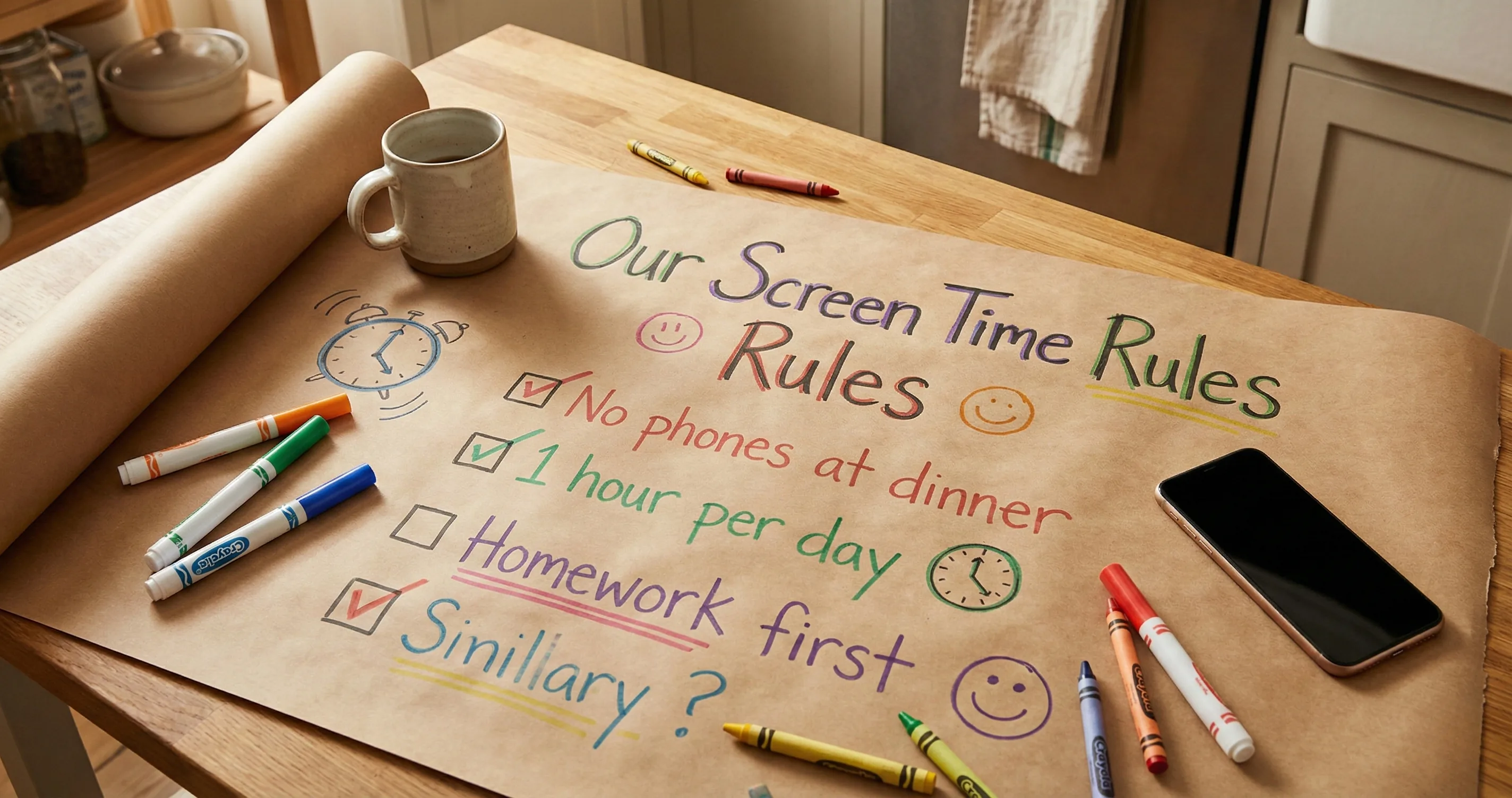
Step 5: Write it down
A verbal agreement fades. A written one sticks. Put the agreed-upon rules on paper or a whiteboard where everyone can see them. This is not a legal document. It is a visible reminder that this is what we all decided together. When a child pushes back later, you do not have to argue. You can simply point to the agreement: "This is what we decided. Do you want to renegotiate at our next check-in?"
How to Create a Family Screen Time Agreement
A family screen time agreement template does not need to be complicated. In fact, simpler is better. The more complex the document, the harder it is to follow and the easier it is to argue about loopholes. Here is what a solid agreement should include.
The daily or weekly time budget
Specify how much entertainment screen time is allowed on school days versus weekends. The Mayo Clinic recommends no screen exposure within one hour of bedtime, so factor that into your timing. Some families prefer a weekly total (for example, 7 hours per week) that gives children flexibility to distribute time across days. Others prefer daily caps. Either works — the key is that the number is agreed upon, not imposed.
What counts and what does not
Define categories. Most families find it helpful to separate entertainment screen time (YouTube, gaming, social media) from educational or creative screen time (coding projects, learning apps, video calls with relatives). AACAP guidelines suggest different treatment for passive versus active screen use. Making this distinction in your agreement gives children more perceived control and reduces arguments about "but I was learning."
How screen time is earned
This is where the agreement becomes powerful. Rather than screen time being an entitlement that gets taken away, make it something earned through completed responsibilities. Homework, chores, reading, physical activity, or focus sessions can all be earning mechanisms. A screen time contract for family use works best when the earning pathways are specific and measurable: "30 minutes of reading earns 20 minutes of screen time" is clear and fair.
Device-free zones and times
Agree on when and where screens are off-limits for everyone — including parents. Common choices: dinner table, bedrooms at night, the first 30 minutes after school. When these rules apply universally, children do not experience them as punishment.
What happens when rules are broken
Pre-agree on consequences. If your child helped choose the consequence, they are far less likely to feel it is unfair when it is applied. Common consequences include losing the next day's screen time, starting the following day with a lower balance, or needing to earn back lost time through extra tasks.
A review date
Build in a specific date to revisit the agreement — every four to six weeks works well. This tells your child the system is not permanent. If something feels unfair after living with it, they know there is a structured opportunity to change it. This dramatically reduces the urgency of daily negotiations. Some families find it helpful to use a screen time rules printable posted on the fridge as a daily visual reminder of what everyone agreed to.
Sample Screen Time Rules by Age
Screen time rules for kids need to match their developmental stage. What works for a five-year-old will frustrate a twelve-year-old, and what a teenager needs would overwhelm a first-grader. Here is a framework based on current screen time guidelines from the AACAP and AAP, adjusted for practical family use. For a more detailed breakdown, see our full guide on screen time rules by age.
Ages 3 to 5: Simple structure, high supervision
- Time: Up to 1 hour on weekdays, up to 2 hours on weekends. All co-viewed or closely supervised.
- Earning: Simple tasks like putting away toys, getting dressed independently, or helping set the table earn a "screen time star." Three stars equal a show.
- Rules to agree on: Which shows or apps are approved (keep the list short and visible). No screens during meals. No screens within an hour of bedtime.
- Key principle: At this age, the agreement is mostly parent-led, but even toddlers can participate by choosing between two approved options.
Ages 6 to 9: Growing autonomy, clear boundaries
- Time: 1 to 1.5 hours on school days, 2 to 2.5 hours on weekends. Begin distinguishing between entertainment and educational screen time.
- Earning: Homework completion, 20 minutes of reading, one household chore, or a structured focus session each earn a defined amount of screen time.
- Rules to agree on: Which apps require permission. What happens if screen time is not earned. Weekend versus weekday differences.
- Key principle: Children this age can genuinely negotiate. Let them propose the earning structure and adjust together.
Ages 10 to 13: Increasing responsibility, decreasing oversight
- Time: 1.5 to 2 hours of entertainment screen time on school days. Weekends more flexible based on earned balance. Educational and creative screen time tracked separately.
- Earning: A points-based system works well at this age. Tasks earn points; screen time costs points. This teaches basic resource management alongside screen time responsibility.
- Rules to agree on: Social media access and boundaries. Online safety basics. Privacy expectations on both sides (parent and child). What constitutes "educational" versus "entertainment" use.
- Key principle: Tweens need to feel trusted. Gradually extend screen time privileges as they demonstrate responsible use, and explicitly name what you are doing: "You've been managing your time well, so we're adding 15 minutes."
Enforcing Rules Without Becoming the Screen Time Police
The best agreement in the world means nothing if enforcement falls apart. And the number one reason enforcement fails is that it depends entirely on the parent standing over the child, watching the clock, and physically intervening when time is up. That model turns you into the screen time police — and nobody wants that job.
Let a system hold the boundary
The most effective thing you can do is remove yourself from the enforcement equation. When a neutral system — whether it is a timer, an app, or a points tracker — tells the child their time is up, the frustration is directed at the system, not at you. This is the same reason a parking meter does not start arguments. The rules are impersonal, predictable, and the same every time.
Tools like Timily are designed for exactly this: the child earns screen time through tasks and focus sessions, sees their balance, and knows when it runs out. The parent sets the framework. The system does the enforcement. The relationship stays intact.
Use visual tracking
Children respond well to seeing their progress. A whiteboard chart, a sticker system, or a digital tracker that shows earned versus spent screen time makes the abstract concrete. When a child can see they have 25 minutes remaining, the end of screen time is not a surprise imposed by a parent — it is a reality they have been watching approach. This alone eliminates a huge percentage of end-of-session meltdowns.
Be consistent — especially in the first two weeks
Behavioral research consistently shows that the first two weeks of a new system are critical. If you enforce the agreement strictly during this period, children learn that the rules are real. If you give in "just this once," you teach them that pushing back works — and you will face twice as much resistance going forward. Consistency in the early phase is an investment that pays dividends for months.
Praise the process, not just compliance
When your child stops their screen time on their own, name it: "You turned it off right on time without me saying anything. That's real self-control." Specific praise reinforces the behavior you want to see more of. Generic praise ("good job") is far less effective than identifying the exact action you are celebrating.
What to Do When Rules Get Broken
Rules will get broken. This is not a sign that the system failed. It is a normal part of children testing boundaries, learning consequences, and developing self-regulation. What matters is how you respond.
Stay calm and point to the agreement
This is the biggest advantage of having a written agreement. Instead of an emotional confrontation ("I told you no more screen time!"), you have a neutral reference point: "We agreed that going over the time limit means no screen time tomorrow. That's what we wrote down together." The calmer you are, the more effective this is. The agreement does the heavy lifting — you just enforce what was already decided.
Apply the pre-agreed consequence immediately
Delayed consequences lose their power. If the agreed-upon consequence for breaking a rule is losing the next day's screen time, apply it the very next day. Do not lecture. Do not add extra punishment in the heat of the moment. The consequence was already chosen — by your child, in collaboration with you. Trust the process.
Distinguish between testing and struggling
A child who sneaks extra screen time after everyone is asleep is testing the system. A child who has a meltdown every single time the screen turns off might be struggling with transitions. These require different responses. Testing calls for consistent consequences. Struggling calls for adjusting the transition routine — perhaps adding a five-minute warning, a physical transition activity, or a post-screen ritual that gives them something to look forward to.
Revisit the agreement when patterns emerge
If the same rule gets broken repeatedly, it might not be the right rule. Maybe the time limit is genuinely too restrictive for your child's age. Maybe the earning mechanism is too complicated. Maybe the consequences are not meaningful enough. A pattern of rule-breaking is data, not defiance. Use it to improve the system at your next review date.
Never use screen time as an emotional weapon
Resist the urge to revoke screen time as punishment for unrelated behavior. "You were rude to your sister, so no iPad for a week" breaks the system because it disconnects screen time from the agreement. The agreement governs screen time. Other behavior issues need their own strategies. Mixing the two erodes trust in the entire framework.
Putting It All Together
Screen time rules fail when they are one-sided, vague, and enforced through sheer parental willpower. They succeed when they are collaborative, specific, visible, and backed by a system that does not require you to be the bad guy every evening.
Here is where to start based on your biggest challenge:
- If your rules exist but nobody follows them: Restart with the collaborative framework in Section 2. Let your child help rewrite the rules from scratch.
- If you have no formal rules at all: Use the agreement template in Section 3 as your starting point. Sit down this weekend and draft one together.
- If enforcement is the struggle: Focus on Section 5. Move enforcement away from yourself and into a system, a visual tracker, or an app that holds the boundary neutrally.
- If rules keep getting broken: Review Section 6. Look for patterns, adjust what is not working, and revisit the agreement at your next check-in.
The families who build screen time rules that stick are not stricter than everyone else. They are more collaborative. They treat their children as partners in the process, not subjects of a policy. And they use systems — not arguments — to hold everyone accountable.
Your family's screen time agreement will not be perfect on day one. It does not have to be. It just has to be yours — created together, written down, and revisited as your family grows.