
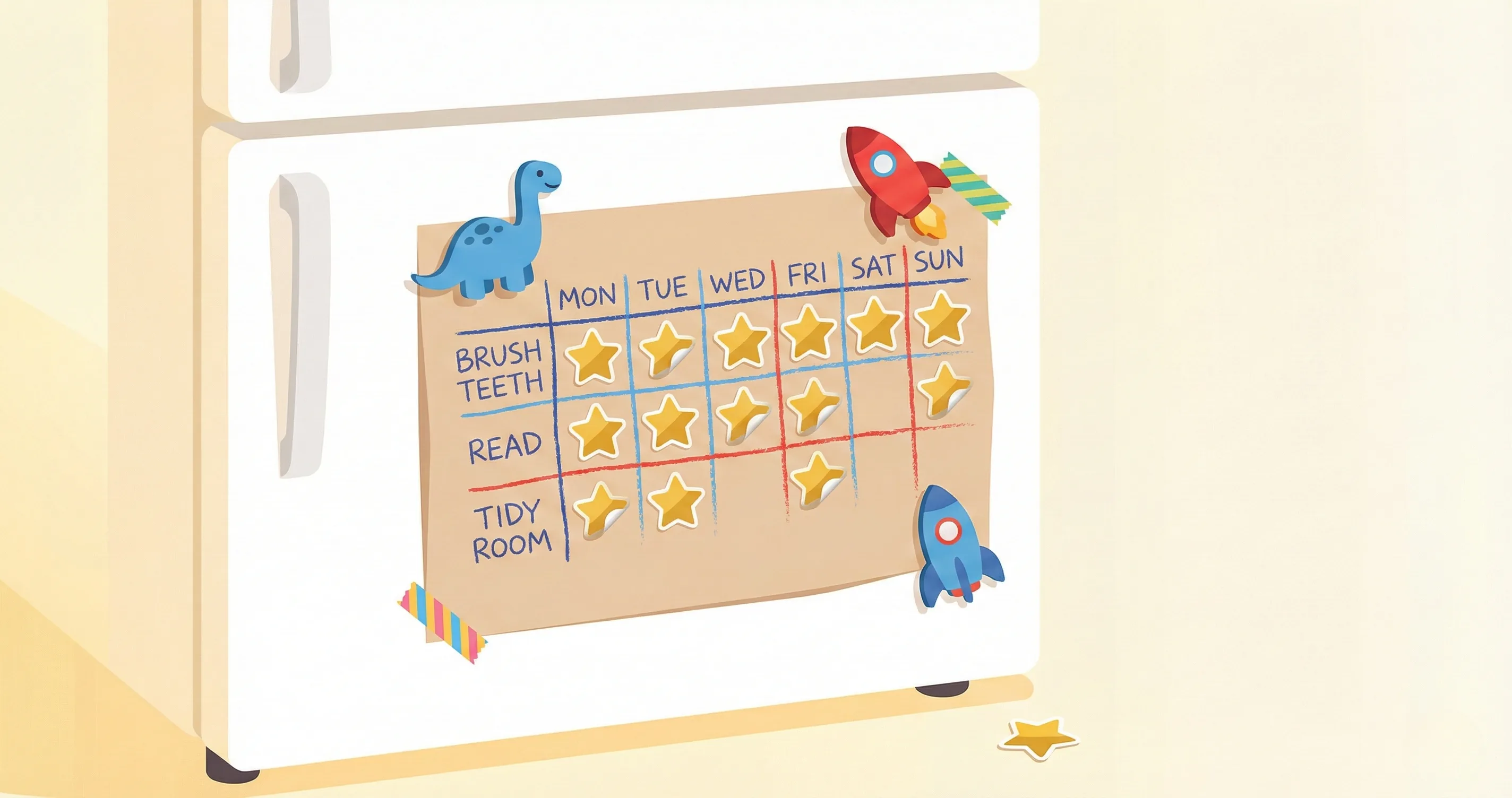
You bought the chart. You chose the stickers. Your child was thrilled — for about eleven days. Then the stickers stopped going up, the chart curled at the edges, and by week three it was just another piece of paper buried under school notices on the fridge. If this sounds familiar, you are not failing at parenting. You are experiencing the most predictable failure of every behavior reward chart — the system works brilliantly until it doesn’t.
The truth is that a reward chart for kids is one of the most recommended tools in child psychology. They are also one of the most abandoned. The gap between those two facts is where this guide lives. We will walk through exactly why most behavior charts for kids stop working, what the behavioral science actually says about motivation, and how to build a system — paper or digital — that survives well past the three-week graveyard.
The Reward Chart Graveyard: Why Week 3 Is Where Charts Go to Die
Ask any parent who has tried a sticker reward chart and the story is remarkably consistent. Week one is exciting. The child races to complete tasks, collects stickers with genuine enthusiasm, and the household runs like clockwork. Week two holds, but the energy dips. By week three, the chart is forgotten, half-filled, and gathering dust.
This is not a failure of willpower. It is a predictable pattern rooted in how the brain processes novelty. When a child first encounters a reward chart, the novelty itself is rewarding. The brain releases dopamine not just for the stickers, but for the new experience of earning them. Once that novelty fades — and it always fades — the chart has to stand on its own merits. Most cannot.
Three forces conspire to kill the average reward chart:
- Novelty decay. The stickers that felt exciting on day one feel ordinary by day fourteen. The visual format never changes, so there is nothing new to discover.
- Parent inconsistency. Life gets busy. You forget to add the sticker after dinner. You miss a day, then two. The child notices and stops trying because the tracking feels unreliable.
- Reward distance. As Psychology Today notes, “Promising a huge reward, far away in time, for perfect behavior is a set-up for failure.” When the prize requires four weeks of perfect behavior, the goal feels impossible and motivation collapses.
The chart itself was never the problem. The design was. Understanding what makes a behavior reward chart effective means fixing these three forces — not buying a fancier chart.
The Behavioral Science Behind Reward Charts (What Motivates Kids)
Before fixing your chart, it helps to understand why a behavior reward chart works at all — and when they backfire.
Operant conditioning: the foundation
Reward charts are built on operant conditioning, the principle that behaviors followed by positive outcomes are more likely to be repeated. When a child puts away their toys and earns a star, the star reinforces the behavior. This is well-established science, and it works. Reward charts are particularly effective for children aged 3 to 8, according to the Raising Children Network Australia, because children in this range are developmentally primed to respond to concrete, visible reinforcement.
The overjustification trap
Here is where it gets complicated. The overjustification effect, documented extensively in developmental psychology, shows that when children who naturally love an activity receive external rewards for it, their intrinsic motivation can actually diminish once the rewards stop. In other words, if your child already enjoys brushing their teeth and you start rewarding them with stickers for doing it, you risk turning a natural habit into a transaction.
Evolutionary parenting researcher Tracy Cassels, Ph.D., puts it bluntly: “Sticker charts rarely work long-term, and when they do, they can backfire because the child begins to expect a reward for everything.” The consensus in communities like Reddit’s r/ScienceBasedParenting echoes this — minimize reliance on sticker charts and use them as temporary scaffolding, not permanent infrastructure.
The takeaway is not that reward charts are bad. It is that they need to be designed with these psychological realities in mind. Use charts for new or challenging behaviors, not behaviors the child already does willingly. Keep the chart temporary. And plan the exit from the start.
5 Design Mistakes That Doom Most Reward Charts
Most reward charts fail not because of the concept, but because of avoidable design errors. Here are the five most common mistakes — and how to make a reward chart effective by avoiding each one.
Mistake 1: Too many behaviors at once
Parents often launch a chart tracking five, six, or seven behaviors simultaneously. Make the bed. Brush teeth. Do homework. Be kind to your sister. Feed the dog. The child looks at the chart and feels overwhelmed rather than motivated. Start with one or two target behaviors. Once those are consistent, add another. Simplicity is not a limitation — it is the design.
Mistake 2: Rewards that are too big and too far away
A trip to the amusement park after 30 days of perfect behavior sounds motivating to an adult. To a six-year-old, 30 days is an eternity. The reward might as well not exist. Effective charts use small, frequent rewards (a sticker earns 15 minutes of a favorite activity) layered with occasional bigger milestones (ten stickers earns a special outing). The key is keeping the next reward within one to three days of reach.
Mistake 3: Using the chart for behaviors kids already do
This triggers the overjustification effect described above. If your child already says “please” and “thank you” without prompting, adding it to the chart does not reinforce the behavior — it teaches the child that politeness is transactional. Reserve the chart for behaviors that genuinely need building: new routines, challenging transitions, or specific struggles like morning resistance or homework avoidance.
Mistake 4: No plan for fading the chart
A reward chart without an exit strategy becomes a crutch. The child learns to perform only when a sticker is available. From the beginning, plan the phase-out: “We will use this chart for four weeks. After that, you will have built the habit and will not need it anymore.” This framing respects the child’s intelligence and sets the expectation that the goal is independence, not permanent dependence on external rewards.
Mistake 5: Static, unchanging design
A chart that looks the same on day 30 as it did on day one has no chance of maintaining a child’s interest. The visual monotony is a novelty killer. Effective charts evolve: new sticker designs, changing colors, level-ups, or theme rotations. This is where gamification principles become powerful — and where digital systems have a decisive advantage over paper.
How to Build a Reward Chart That Survives Past Week 3
Now that you know what kills most charts, here is a step-by-step framework for building one that actually lasts — whether you are setting up a chore chart with rewards or a behavior-focused system.
Pick behaviors that are specific, observable, and genuinely challenging for your child. “Be good” is too vague. “Put shoes in the basket when you come home” is perfect. The child needs to know exactly what earns the reward.
Let them help choose the chart design, pick the stickers, and decide on the rewards. Children who participate in creating the system feel ownership over it. Ask them what reward would motivate them — you may be surprised that they often choose experiences (playing a board game together, choosing the movie for family night) over material items.
For children aged 3 to 5, rewards should come the same day. For ages 6 to 8, within two to three days. For ages 9 to 12, weekly milestones work. The younger the child, the shorter the feedback loop needs to be. A chart that requires a month of effort before any payoff will fail for any child under ten.
This is the number one reason paper charts fail. Parents forget. It is not laziness — life is genuinely busy. But from the child’s perspective, an untracked day feels like the system does not matter. If you struggle with consistency, this is the strongest argument for switching to a digital reward chart app kids can interact with directly — one that tracks automatically and sends reminders.
When the child earns a reward, make it a moment. Verbal acknowledgment matters as much as the reward itself. And every two to three weeks, refresh the chart with new reward chart ideas: different stickers, a new visual layout, or a new target behavior. This rotation fights novelty decay and keeps the system feeling alive.
After four to six weeks of consistent behavior, begin spacing out the rewards. Move from daily stickers to every-other-day check-ins, then to weekly recognition, then to nothing. The goal is for the behavior to become automatic. When you reach that point, the chart has done its job.
Paper vs. Digital: Why Families Are Switching to Reward Apps
Paper charts have one significant advantage: they are tangible. A child can physically place a sticker, see their progress on the wall, and feel the satisfaction of filling in a row. That tactile experience matters, especially for younger children.
But paper charts have three critical weaknesses that digital systems solve.
Problem 1: Inconsistency
Paper charts depend entirely on the parent remembering to update them. Miss a day and the child’s trust in the system erodes. Digital apps like Timily track progress automatically, send reminders, and never forget a completed task. The system stays consistent even when parents have a hectic day.
Problem 2: Novelty burnout
A paper chart looks the same from start to finish. A digital reward system can incorporate animations, sound effects, progress bars, level-ups, streaks, and visual celebrations that maintain engagement far longer than static stickers. This is not gimmickry — it is applied gamification, and it directly addresses the novelty decay that kills paper charts at week three.
Problem 3: Multi-household coordination
For families with shared custody or children who split time between homes, a paper chart on one refrigerator creates gaps. Digital systems sync across devices, so both parents see the same progress regardless of which house the child is in. The tracking stays continuous, and the child’s effort is never lost.
Does this mean paper charts are obsolete? Not for every family. For children under five, a simple paper chart with large, colorful stickers can be the perfect starting point. But for families with kids over five who have tried paper and hit the week-three wall, a digital reward chart offers a meaningful upgrade.
Age-by-Age Guide: Tailoring Reward Systems for 3–5, 6–8, 9–12
A reward chart that works for a four-year-old will bore a ten-year-old. Here is how to tailor the system to your child’s developmental stage.
Ages 3–5: Keep it simple and immediate
- Number of behaviors: One, maximum two.
- Chart type: Large, colorful paper chart with oversized stickers. The physical act of placing the sticker is part of the reward.
- Reward timing: Same day. A three-year-old cannot connect effort to a reward that comes next week.
- Best rewards: Extra story time, choosing a song to dance to, picking the snack for tomorrow. Small, immediate, experience-based.
- Fade timeline: Two to three weeks per behavior. At this age, habits form relatively quickly when reinforced consistently.
Ages 6–8: Introduce points and short-term goals
- Number of behaviors: Two to three.
- Chart type: Paper or digital. This is the transitional age where digital systems start to become more effective than paper.
- Reward timing: Within one to three days. Points systems work well here — earn points daily, redeem them every few days.
- Best rewards: Screen time earned through effort, choosing the family activity for the weekend, a small privilege like staying up 15 minutes later. Screen time is particularly effective as a reward at this age when it is earned through a system rather than given by default.
- Fade timeline: Four to six weeks. Gradually replace the chart with verbal acknowledgment as the behavior becomes routine.
Ages 9–12: Autonomy and self-tracking
- Number of behaviors: Three to four, but let the child choose which ones to focus on.
- Chart type: Digital strongly preferred. Pre-teens respond poorly to “baby charts” on the fridge. A digital app feels more mature and gives them agency.
- Reward timing: Weekly milestones with daily micro-feedback (progress bars, streaks, points).
- Best rewards: Greater autonomy (later bedtime on weekends, choosing their own screen time schedule within boundaries), social experiences (having a friend over, a movie outing).
- Fade timeline: Six to eight weeks. At this age, the goal is self-regulation. The chart should progressively hand control to the child until they are managing their own habits.
Making the Transition from Paper Charts to Digital Systems
If your family has been using paper charts and you are ready to move to a digital system, the transition does not need to be abrupt. Here is how to make it smooth.
Week 1: Run both systems in parallel. Keep the paper chart on the fridge and introduce the app alongside it. Let the child see that the digital system tracks the same behaviors but adds elements they enjoy — sounds, animations, progress streaks. Most children naturally gravitate toward the digital version within a few days.
Week 2: Let the child choose. Ask whether they want to continue with paper, digital, or both. Giving them the choice increases buy-in. Nearly every child over six will choose the app.
Week 3 and beyond: Go fully digital. Remove the paper chart and let the app handle tracking, reminders, and reward delivery. The parent’s role shifts from manual tracker to system designer — setting the rules, choosing the reward thresholds, and reviewing progress.
The biggest advantage of this transition is what happens to the parent’s experience. With a paper chart, the parent is the enforcer, the tracker, and the reward giver. With a digital system like Timily, the app handles the enforcement and tracking. The parent gets to be the encourager — celebrating wins rather than policing stickers.
The Bottom Line
Reward charts are not broken. They are just usually built wrong. The research is clear: concrete, visible reinforcement helps children develop new habits, especially between the ages of 3 and 12. But only when the chart is designed with the brain’s need for novelty, the parent’s need for consistency, and the child’s need for achievable goals all taken into account.
If your past charts have ended up in the recycling bin by week three, the problem was not the idea. It was the execution. Start with one or two behaviors. Keep rewards close. Track consistently. Refresh the design. And when paper runs out of steam, do not force it — move to a digital system that does what paper cannot: stay fresh, stay consistent, and keep your child engaged long enough for the habit to actually form.
The best behavior reward chart is not the prettiest one on the fridge. It is the one your child is still using a month from now.