
You are standing in the grocery store. Your child is melting down in aisle seven. You hear yourself say, “If you stop crying right now, you can have 30 minutes of iPad when we get home.” It works. The crying stops. And then the guilt hits: Am I bribing my kid? If you have ever wondered how to motivate kids without bribing, you are not alone.
If this sounds familiar, you are not alone. Most parents have been there. The real question is not whether you have ever bribed your child — nearly every parent has. The question is whether there is a better way to get the same result without the guilt and without the long-term consequences. The answer is yes, and it starts with understanding how to motivate kids without bribing — by replacing reactive offers with structured, intentional systems.
This guide breaks down the real difference between rewards and bribes, explains why one builds lasting motivation while the other erodes it, and gives you practical strategies you can start using today.
What’s the Difference Between a Reward and a Bribe?
On the surface, rewards and bribes look almost identical. In both cases, a child does something and gets something in return. But the difference between reward and bribe parenting comes down to two things: timing and intent.
Bribes are reactive
A bribe happens in the heat of the moment. The child is already doing something unwanted — throwing a tantrum, refusing to leave the playground, whining about homework — and the parent offers something to make it stop. The message the child receives is: my bad behavior created an opportunity to negotiate.
Classic bribe examples:
- “Stop screaming and I’ll give you the tablet.”
- “If you behave at grandma’s, I’ll buy you a toy.” (said while the child is already acting up)
- “Just five more minutes of quiet and you can have ice cream.” (said during a meltdown)
Rewards are proactive
A reward is set up before the behavior occurs. The child knows in advance what is expected and what they will earn for meeting that expectation. The message is entirely different: my effort leads to good things.
Classic reward examples:
- “When you finish your homework, you earn 20 minutes of screen time.”
- “If you complete your chores this week, you can choose a fun activity on Saturday.”
- “Every time you read for 15 minutes, you earn a point toward your goal.”
The content of the reward can be identical. The difference is entirely in how and when it is presented. A bribe says, “I’ll give you this if you stop.” A reward says, “You’ll earn this when you do.”
Why Bribing Feels Like It Works (But Doesn’t Last)
Bribing is seductive because it works instantly. The tantrum stops. The whining ends. You get through the grocery store in peace. But the short-term relief masks a pattern that gets worse over time.
The escalation problem
When a child learns that bad behavior leads to an offer, they learn to produce bad behavior on demand. The tablet that stopped the crying this week will not work next week — the child will need something bigger. Psychologists call this the overjustification effect: when external rewards are used reactively, the child’s baseline expectation rises and the same incentive loses its power.
The negotiation trap
Bribing teaches children that every situation is negotiable. “What do I get if I behave?” becomes the default question before any expectation is met. The child stops seeing good behavior as its own standard and starts seeing it as a bargaining chip. This is exhausting for parents and corrosive for the child’s developing sense of responsibility.
The motivation drain
Here is the deeper problem. When children are consistently bribed, they lose the internal drive to do things because those things matter. A 2024 meta-analysis on motivation and reward found that reactive external incentives can diminish intrinsic motivation over time — the child stops wanting to do the right thing for its own sake and only acts when the payoff is visible. This is especially true for tasks the child once did willingly, like helping around the house or being kind to a sibling.
The irony is painful: the more you bribe, the less motivated your child becomes, which leads to more bribing. It is a cycle that gets harder to break the longer it runs.
The Psychology Behind Effective Rewards
If bribing erodes motivation, what makes a reward system actually work? The answer comes from one of the most well-researched frameworks in psychology: Self-Determination Theory (SDT), developed by Edward Deci and Richard Ryan.
SDT identifies three core needs that drive intrinsic motivation kids screen time habits and beyond. When these needs are met, children are naturally more motivated — not because of what they get, but because of how they feel.
Autonomy: “I have a choice”
Children need to feel that they have some control over their actions. A well-designed reward system offers choices: which chores to do, when to complete them, how to use the earned time. Bribes, by contrast, remove autonomy entirely — the parent decides in the moment what the child gets, and the child has no say in the structure.
Competence: “I can do this”
Kids who feel capable are more likely to try. Effective reward systems are designed so the child can succeed. The tasks are clear, achievable, and appropriately challenging. Each completed task reinforces the child’s belief in their own ability. Bribes skip this entirely — there is no task to master, just a transaction to survive.
Relatedness: “We are in this together”
A positive reinforcement approach works best when it feels collaborative rather than controlling. When parents and children design the system together — choosing the tasks, setting the earning rates, agreeing on the rewards — it strengthens the relationship. Bribes do the opposite: they create an adversarial dynamic where parent and child are on opposing sides of a negotiation.
Research consistently shows that when autonomy, competence, and relatedness are supported, children develop stronger internal motivation. They begin to want to do well — not because someone is dangling a reward, but because the system makes them feel capable, respected, and connected.
5 Ways to Motivate Kids Without Crossing into Bribery
Understanding the theory is one thing. Making it work in your actual kitchen on a Tuesday evening is another. Here are five concrete strategies that keep you firmly on the reward side of the line.
1. Set expectations before the moment
The single most important habit is to establish rules and rewards before anyone is upset. Sit down with your child during a calm moment — not during a conflict — and agree on what behaviors earn what rewards. Write it down. Put it on the fridge. When the rules exist in advance, they feel fair. When they are improvised during a crisis, they feel like bribes.
For screen time specifically, a structured screen time reward system removes the guesswork. The child knows exactly what they need to do and exactly what they earn. No negotiation needed.
2. Use when/then language, not if/then threats
“When you finish your reading, then you can have screen time” sounds almost identical to “If you don’t finish your reading, no screen time.” But the emotional impact is vastly different. The first is forward-looking and motivating. The second is punitive and fear-based. “When/then” language frames the task as something the child is capable of completing. It assumes success.
3. Make the reward proportional and predictable
A reward should feel earned, not extravagant. Fifteen minutes of screen time for completing homework is proportional. A new video game for one day of good behavior is not — and it sets an unsustainable precedent. Keep rewards small, consistent, and predictable. Predictability is what separates a system from a surprise offer, and a system is what prevents the slide into bribery.
4. Celebrate the effort, not just the outcome
When your child finishes a task, acknowledge the work itself: “You stuck with that even when it was hard — that took real focus.” This kind of specific praise reinforces the process, not just the prize. Over time, the child begins to value their own effort independently of the reward. This is exactly how to build intrinsic motivation children can carry with them long after the reward chart comes down.
5. Let the child track their own progress
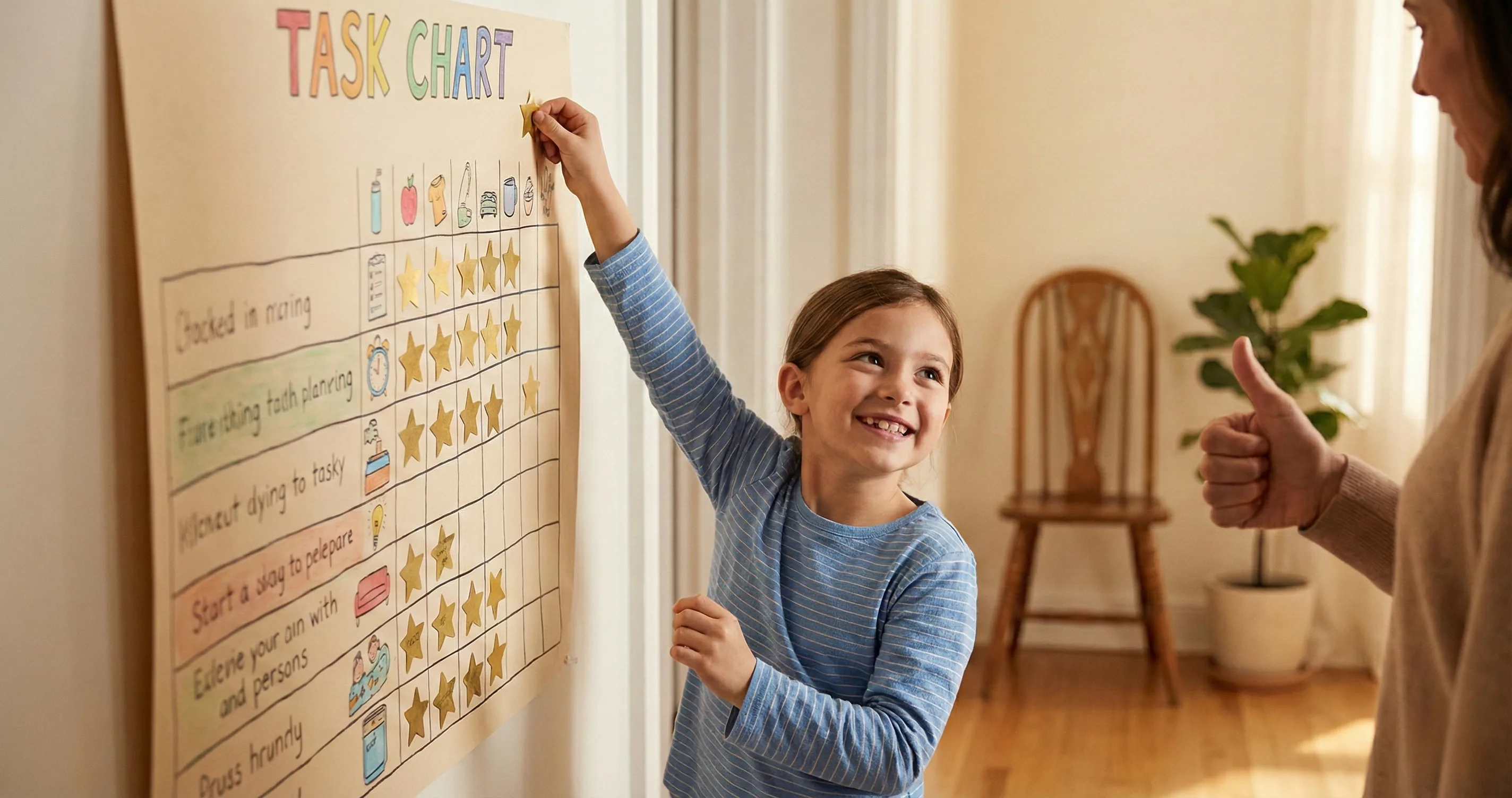
Give your child ownership of the system. Let them mark off tasks, track their points, and decide when to “spend” earned time. Ownership transforms a parent-imposed structure into a child-driven project. When kids can see their progress building — and feel the pride of watching their efforts accumulate — the reward becomes secondary to the sense of accomplishment.
How Structured Earning Builds Intrinsic Motivation
There is a common fear among parents that any reward system will kill their child’s intrinsic motivation. “If I reward them for reading, won’t they stop reading when the reward disappears?”
The research says: it depends on the system. Poorly designed rewards — ones that feel controlling, unpredictable, or disconnected from effort — do undermine intrinsic motivation. But structured earning systems that give kids autonomy and competence feedback actually strengthen it.
Why structured earning is different from random rewards
In a structured earning system, the child knows the rules in advance. They choose to participate. They see a direct link between their effort and the outcome. This is fundamentally different from a parent sporadically handing out treats or reactively offering screen time to stop a tantrum.
Consider what happens when screen time is used as a reward within a structured system. The child does not experience it as a bribe because they understand the framework. They earned it. That sense of earning — of cause and effect, of effort and outcome — is what builds the foundation for internal drive.
The transition from external to internal
The goal of any good reward system is to make itself unnecessary. Here is how that happens in practice:
- Phase 1: External motivation. The child does the task because they want the reward. This is where you start, and it is completely okay.
- Phase 2: Habit formation. After weeks of consistent practice, the behavior becomes routine. The child does homework at 4 pm not because they are thinking about screen time, but because that is what 4 pm means in their day.
- Phase 3: Internalized value. Eventually, the child begins to feel good about the task itself. They notice that doing homework feels better than avoiding it. The reward is still there, but it is no longer the primary driver.
This progression does not happen overnight. It requires consistency — which is exactly why a structured system matters more than individual rewards or punishments. Timily is designed around this principle: kids earn screen time through focus sessions and real-life tasks, building habits that gradually shift from external to internal motivation.
Common Scenarios: Reward or Bribe?
Theory is useful, but parenting happens in the messy specifics. Here are six real-world scenarios to help you see the rewards vs bribes kids distinction in action.
Scenario 1: The homework battle
- Bribe: Your child is refusing to do homework, whining, and slamming their book shut. You say, “If you just do your math, I’ll let you play Roblox.”
- Reward: Before homework time, the rule is already posted: “Complete homework with focus, earn 20 minutes of screen time.” Your child knows this before they even open their book.
Scenario 2: The grocery store meltdown
- Bribe: Your child is screaming in the cereal aisle. You say, “Stop crying and you can pick one treat.”
- Reward: Before leaving the house, you say, “If you help me find five items from the list without fussing, you can pick one treat at the end.”
Scenario 3: The morning routine
- Bribe: Your child is still in pajamas 10 minutes before the bus. You say, “Get dressed right now and I’ll let you bring your tablet to school.”
- Reward: A chart on the bathroom door shows the morning steps: brush teeth, get dressed, pack bag. Completing all three by 7:30 earns a check mark. Five check marks in a week earn a privilege the child chose.
Scenario 4: Screen time at bedtime
- Bribe: Your child refuses to put down the iPad at 8 pm. You say, “If you give it to me now, you can have extra time tomorrow.”
- Reward: The rule is established: screen time ends at 7:45 with a 5-minute wind-down. Consistently stopping on time earns a bonus 10 minutes on the weekend.
Scenario 5: Sibling conflict
- Bribe: Your kids are fighting over a toy. You say, “Whoever stops first gets a cookie.”
- Reward: You have a family agreement: when siblings resolve a conflict by talking instead of fighting, both earn a point toward a family activity.
Scenario 6: The restaurant
- Bribe: Your child is climbing under the table. You hand them your phone and say, “Just sit still.”
- Reward: Before going out, you explain: “At the restaurant, if you use good manners and stay in your seat, you can pick what we do after dinner.”
Notice the pattern. The content of the reward barely changes. What changes is the timing, the clarity, and who is in control of the decision. In every bribe scenario, the parent is reacting to chaos. In every reward scenario, the family has a plan.
Making the Shift: From Reactive Bribes to Intentional Rewards
If you have been relying on bribes — and most parents have at some point — the path forward is not about guilt. It is about gradually building a system that replaces the impulse to bribe with a structure that makes bribing unnecessary.
Start small. Pick one recurring situation where you find yourself bribing most often. Create a simple, clear rule with your child during a calm moment. Write it down. Follow it consistently for two weeks before evaluating.
Expect some resistance in the first few days. Your child has learned that pushing back leads to offers. When the offers stop and a system takes their place, there will be an adjustment period. This is normal and it passes faster than most parents expect.
What you will notice, usually within the first two to three weeks, is that the arguments decrease. The negotiations shorten. Your child begins to reference the system instead of lobbying you directly: “I did my chores, so I earned my time, right?” That question — framed as a statement of accomplishment rather than a plea — is the sound of intrinsic motivation taking root.
The goal was never to eliminate rewards. It was to use them in a way that builds your child up instead of training them to manipulate the moment. When you replace bribes with structured earning, you are not just solving a behavior problem. You are teaching your child how effort, patience, and follow-through lead to good outcomes — a lesson that extends far beyond screen time and far beyond childhood.