
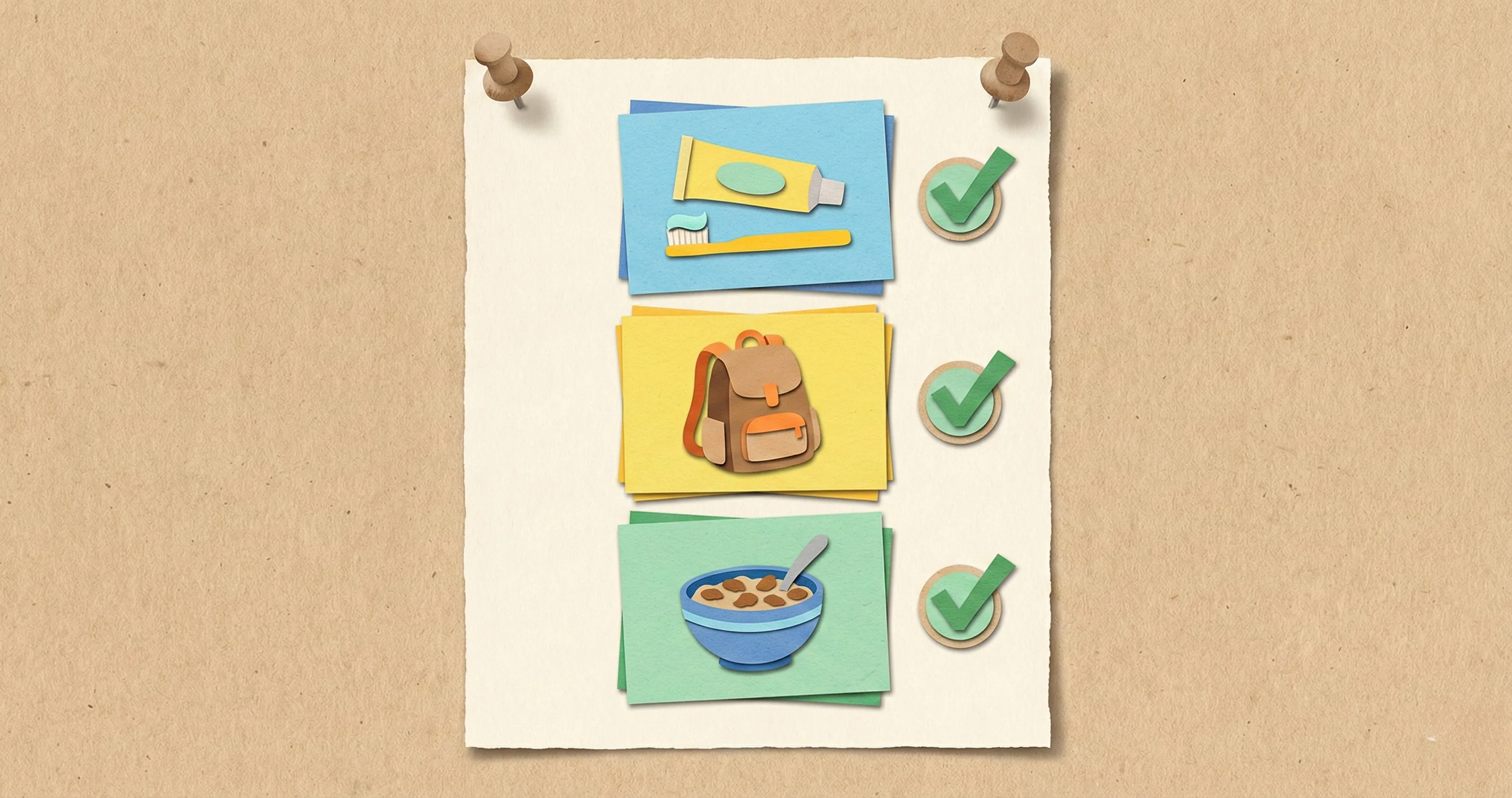
Every parent knows the scene. You have said "put your shoes on" four times. Breakfast is half-eaten and getting cold. Someone cannot find their backpack. You are already late. A morning routine for preschoolers and kids solves this — not by adding more rules, but by replacing your voice with a system your child can follow on their own. When mornings run on structure instead of nagging, everyone leaves the house calmer.
This guide gives you a complete five-step system to build a morning routine for kids that sticks — starting with preschoolers (ages 3-5) where the morning chaos peaks, then scaling through kindergarten and elementary. You will learn why mornings fall apart, how to create a morning routine chart kids actually use, and how to gamify the routine so kids look forward to completing it. No theory fluff. Just the steps, the science behind them, and practical tools you can set up today.
Why Are Mornings So Hard for Families?
Mornings are hard because they demand the exact cognitive skills children are still developing. Understanding why the chaos happens is the first step toward designing a system that prevents it.
The Executive Function Gap
Executive functions are the brain's management system — the skills that handle planning, time awareness, task switching, and impulse control. Adults use executive functions constantly without thinking about it. You know you need to shower, eat, get dressed, and leave by 8:15, and you sequence those tasks automatically.
Children cannot do this. The prefrontal cortex, where executive functions live, does not fully mature until the mid-twenties. A 6-year-old told to "get ready for school" faces a genuinely overwhelming cognitive challenge. They have to remember what "ready" means, decide which task to start with, resist the urge to play with the toy they just spotted, monitor the clock, and sequence everything in the right order. That is five executive function demands packed into one vague instruction.
This is not defiance. It is a developmental gap. And the solution is not more willpower — it is external structure that does the executive function work for them.
Why Nagging Makes It Worse
Repeating instructions feels necessary in the moment, but it actually trains the opposite of what you want. When a child learns that the real deadline is not "put your shoes on" but the fourth or fifth time you say it — with rising frustration — they calibrate to that. Your first three reminders become background noise.
Worse, nagging creates a negative emotional association with mornings. The child wakes up knowing conflict is coming. That stress response further impairs their already-developing executive functions. It is a cycle: weak executive skills lead to nagging, nagging increases stress, stress weakens executive performance.
A visual, structured routine breaks the cycle by removing you as the source of instructions and replacing you with a system the child interacts with directly.
What Makes a Morning Routine Work?
Effective morning routines share two qualities: they are visual, and they give the child a sense of ownership. Without both, even the best-designed routine will be ignored within a week.
Visual Structure Over Verbal Instructions
Children process visual information faster and more reliably than auditory instructions. A kids morning checklist mounted on the wall does something your voice cannot: it stays consistent, patient, and available at a glance. The child does not need to remember what comes next. They look at the chart.
Research on visual schedules in classroom settings consistently shows that children follow picture-based sequences with less adult prompting. The same principle applies at home. A laminated chart with photos of each task — toothbrush, cereal bowl, backpack, shoes — becomes the authority on what to do next. You stop being the nagging parent and become the encouraging coach.
Ownership and Choice
A morning routine for kids imposed entirely by parents feels like another rule. A routine the child helped create feels like their system. The difference in compliance is enormous.
Give your child choices within the structure. They cannot choose whether to brush their teeth, but they can choose whether brushing happens before or after getting dressed. They cannot skip breakfast, but they can choose between two options the night before. These small choices create buy-in without sacrificing the structure you need.
Children who participate in designing their morning routine are far more likely to follow it independently. They defend their own creation rather than resisting yours.
The 5-Step Morning Routine System
Here is the complete system. Follow these five steps in order and you will have a working morning routine for kids within one week.
-
Step 1: Map the Non-Negotiables List the five to seven tasks that must happen every single morning before leaving the house. These are the non-negotiable actions: wake up, get dressed, brush teeth, eat breakfast, pack bag, put on shoes, get to the door. Write them in the order they need to happen. Keep the list tight — every extra task adds cognitive load. If it can move to the evening (like picking out clothes or packing the bag), move it.
-
Step 2: Set a Realistic Timeline Time each task for three mornings to find out how long the routine actually takes — not how long you think it should take. Most parents underestimate by 10 to 15 minutes. Add a five-minute buffer for the unexpected (a spill, a missing sock, a meltdown about hair). Work backward from your departure time to determine when the routine must begin. If the routine takes 35 minutes and you leave at 8:00, the wake-up alarm is at 7:20, not 7:30. Pair this with a focus timer approach so kids can see the time remaining visually.
-
Step 3: Make It Visual (Morning Routine Chart Kids) Turn the task list into a morning routine chart kids can see and interact with. For ages 3 to 5, use photos of your child doing each task. For ages 6 to 8, use simple icons with words. For ages 9 and up, a written checklist works fine. Mount the chart at their eye level — on the fridge, bathroom mirror, or bedroom door. Add a way to mark completion: magnets that move, checkboxes to tick, or cards that flip. The physical act of marking a task done provides instant feedback.
-
Step 4: Add Gamification (Gamify Morning Routine Kids) Attach points to each completed task. A simple scale works: 5 points per task, 10 bonus points for completing the full routine before the timer runs out. Introduce streaks for consecutive days of on-time completion. A 5-day streak might earn a bonus reward. The principles of gamification work here because they replace external pressure (your nagging) with internal motivation (their desire to earn, compete, and progress).
-
Step 5: Connect to Rewards Create a reward menu with your child. Mix small daily rewards (choose the breakfast music, pick a snack for lunch) with bigger weekly goals (family movie night pick, extra playground time, earned screen time). Points from the morning routine feed into the same reward system as other daily tasks. This connection gives the routine lasting motivation beyond the first week of novelty.
Morning Routine by Age: Preschoolers to Pre-Teens
What belongs on the checklist — and how it is presented — depends entirely on your child's age. A morning routine chart printable designed for a 10-year-old will overwhelm a 4-year-old. A system designed for a preschooler will bore a 10-year-old. Here is how to calibrate.
Ages 3-5: The Morning Routine for Preschoolers
This is where the morning routine for preschoolers starts — and where most families need the most help. At this age, the routine is parent-led with visual support. The child is not managing the routine — they are following it step by step with your guidance.
- Tasks (3-5 max): Use the toilet, get dressed (clothes laid out the night before), eat breakfast, brush teeth, put on shoes
- Chart format: Large photos of your child doing each task, laminated and mounted at their eye level. Velcro check marks they can move from "to do" to "done"
- Timing: Allow 30 to 40 minutes. At this age, rushing causes meltdowns
- Gamification: Keep it simple. A sticker for each completed task. Five stickers fills a row. A full row earns a small reward (choosing the bedtime story, a special breakfast item)
The goal at this age is not independence. It is familiarity. You are building the neural pathways that will allow independence later.
Ages 6-8: The Morning Routine for Kindergarten and Early Elementary
The morning routine for kindergarten and early elementary is where independence starts to grow. Children in this range can handle a longer checklist and begin managing transitions between tasks on their own. Your role shifts from directing every step to checking in at key points.
- Tasks (5-7): Wake up and make bed, get dressed, eat breakfast, brush teeth and hair, pack school bag, check weather and grab jacket if needed, shoes and out the door
- Chart format: Icons with text. A whiteboard checklist they wipe clean each morning. Or a printed chart with daily checkboxes for the week
- Timing: 25 to 35 minutes. Set a single timer for the whole routine
- Gamification: Points per task (5 each), a bonus for beating the timer (10 points), and a streak tracker on the fridge. Connect points to a reward menu they helped create
Set two checkpoints: one after getting dressed ("Let me see your outfit — looking great!") and one at the door. Between those checkpoints, step back and let the chart guide them.
Ages 9-12: The Independent Routine
By this age, the child should own the routine almost entirely. Your role is to set the expectation, provide the system, and step out of the way.
- Tasks (5-7): Wake up independently (their own alarm), personal hygiene, get dressed, breakfast, pack bag and check schedule, shoes and out the door, bonus: one household contribution (empty dishwasher, feed pet)
- Chart format: A written checklist, a phone-based list, or a morning routine app for kids they manage themselves
- Timing: 20 to 30 minutes. They set their own alarm based on the departure time you give them
- Gamification: Weekly streaks with escalating rewards. A 5-day streak earns a small privilege. A 20-day streak earns something bigger. Let them track their own progress and report in
At this stage, the biggest risk is micromanaging. If your 10-year-old is consistently completing the morning routine for kids you built together, resist the urge to correct the order or method. The outcome matters more than the process.
Morning Routine Chart vs App: Which Works Better?
Both a physical morning routine chart and a digital app work. The best choice depends on your child's age, your family's tech comfort level, and how much tracking you want to do.
When a Paper Chart or Printable Works
A physical morning routine chart printable is ideal for preschoolers and children under 7. They need something tangible they can touch, move, and interact with. The act of peeling a sticker or flipping a card from "to do" to "done" provides sensory feedback that a screen tap cannot replicate.
Paper charts also work well for families who want to minimize screen time in the morning. If your goal is a screen-free routine until the child leaves the house, a laminated chart with magnets or dry-erase markers keeps screens out of the equation entirely.
The downside: paper charts do not track streaks automatically, they wear out, and they cannot send you progress updates if you are in another room.
When an App Works Better
A morning routine app for kids offers advantages that paper cannot match: automatic streak tracking, built-in timers, instant reward calculations, and progress history over weeks and months. For children aged 8 and up who are comfortable with devices, an app can feel more engaging than a paper chart.
Timily's Task and Chore System lets parents set up morning routine tasks that kids check off as they complete them. Each completed task earns points that feed directly into the Reward and Redemption System, where kids can spend their points on privileges, screen time, or custom rewards the family defines together. The gamification is built in — streaks, points, and progress happen automatically without you managing a spreadsheet.
The app format also solves the multi-child problem. With paper charts, you need a separate chart for each child. A task app handles multiple profiles, different task lists by age, and individual reward tracking in one place.
What to Do When the Routine Falls Apart
Every routine will hit rough patches. Vacations disrupt it. Illness breaks streaks. Developmental leaps change what your child can handle. Knowing the common failure points — and how to fix them — keeps you from abandoning the system prematurely.
Common Pitfalls and Quick Fixes
- The routine takes too long. Cut one task or move it to the evening. If getting dressed is the bottleneck, choose clothes the night before. If breakfast drags, switch to something faster on weekday mornings
- The child rushes through tasks without doing them properly. Add a quick "quality check" to one task per day (rotating). "Today I am checking teeth brushing. Let me see." This keeps accountability without inspecting everything
- Weekends destroy the weekday habit. Keep a simplified weekend version of the routine. Even three tasks (get dressed, eat breakfast, brush teeth) maintain the habit loop. Going from full routine to no routine on Saturday makes Monday feel like starting over
- Siblings finish at different speeds. Give faster kids a "bonus task" that earns extra points rather than letting them wait and get bored. Reading a book, doing a small chore, or reviewing their school schedule all work
- The rewards lose their appeal. Rotate the reward menu monthly. Let the child swap out items they have lost interest in for new ones. Stale rewards produce stale effort
Adjusting for ADHD and Neurodiverse Kids
Children with ADHD, autism spectrum conditions, or other neurodiverse profiles often need modified morning routines. The core structure is the same, but the implementation requires more support.
- Reduce transitions. Every switch between tasks is a potential derailment. Keep tasks in the same physical space when possible. Brush teeth and do hair in the same bathroom trip rather than splitting them
- Use timers carefully. Visual timers help many ADHD kids, but countdown pressure can trigger anxiety in some. Test both approaches and follow your child's lead
- Increase visual cues. Standard charts may not be enough. Add arrows between tasks, color-code by location (blue for bathroom tasks, green for kitchen), or use a "now/next" card system that shows only the current and upcoming task
- Shorten the reward cycle. Daily rewards work better than weekly ones for children whose brains crave immediate feedback. A small reward earned before leaving the house — a favorite song in the car, five minutes of a podcast — can be more motivating than a distant weekly prize
- Expect more reset days. ADHD brains have inconsistent executive function from day to day. A bad morning does not mean the system is broken. Build in a "fresh start" mechanism: no matter what happened yesterday, today's streak chance is intact