
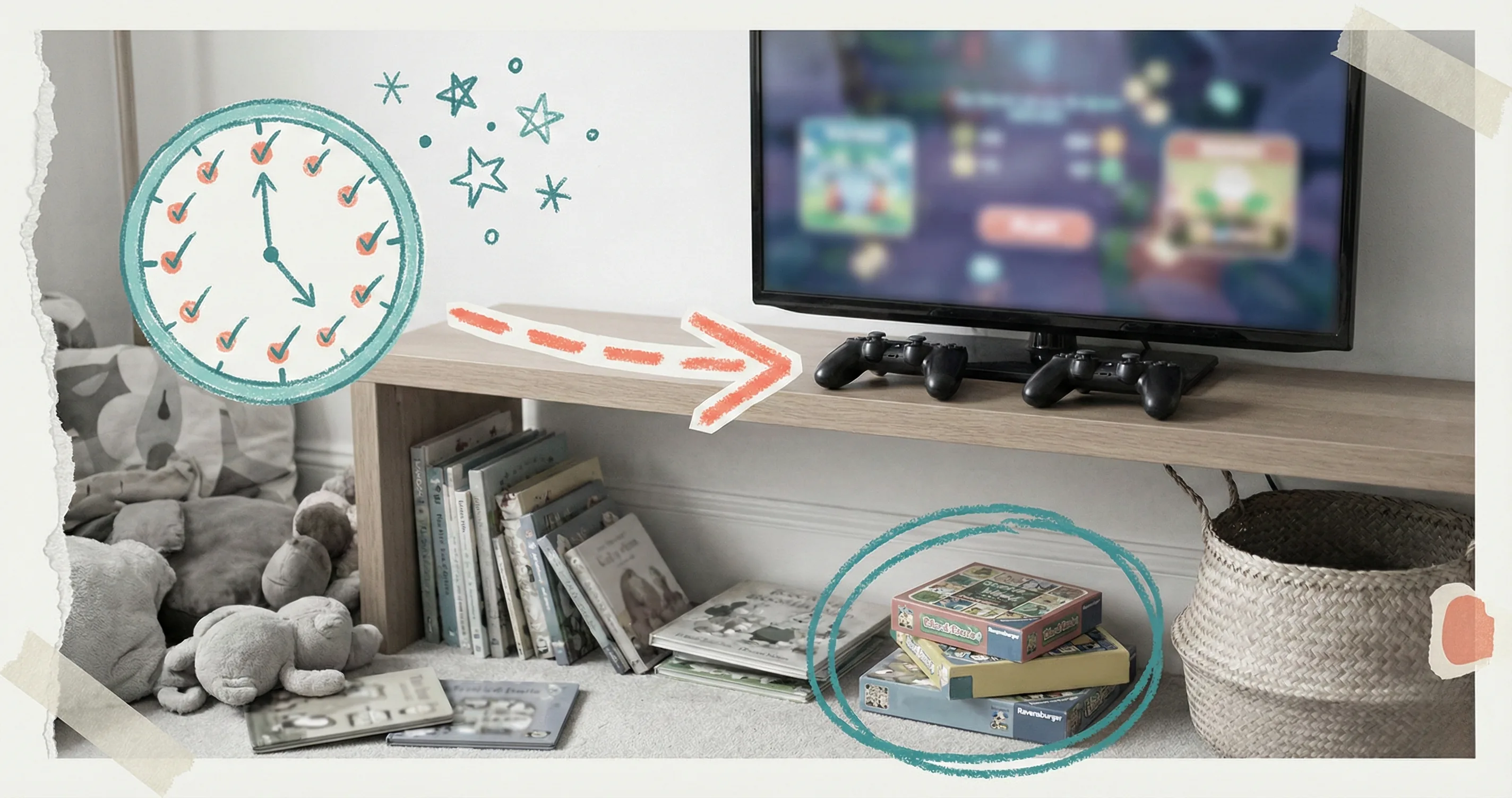
Your child wants to play one more round. You want them to stop. The argument that follows is the same one that plays out in millions of homes every single day. But here is the thing most parents miss: the fight over gaming is almost never about the game itself. It is about the absence of clear, agreed-upon rules. Healthy gaming habits kids develop do not happen by accident — they happen when families set up a system that makes gaming feel like a privilege earned, not a right being taken away. This guide gives you the exact steps to build video game rules for kids that your children will actually respect.
Research consistently shows that moderate gaming is not harmful. In fact, it can sharpen cognitive skills, build social connections, and teach persistence. The problems start when gaming displaces sleep, homework, physical activity, and real-world relationships. The goal is not to eliminate gaming. It is to put it in its proper place — and give your child the tools to keep it there on their own.
Are Video Games Bad for Kids? What Research Actually Shows
The headlines swing between extremes. One week video games cause violence. The next week they boost intelligence. The truth, as usual, is more nuanced. A large body of research, including guidelines from the American Academy of Pediatrics, points to a clear pattern: the dose makes the poison.
The Benefits of Moderate Gaming
Kids who play video games in moderation — roughly one to two hours per day — often show measurable benefits compared to non-gamers:
- Problem-solving and strategic thinking. Games that require planning, resource management, or puzzle-solving exercise the prefrontal cortex, the same brain region responsible for executive function
- Social connection. Multiplayer games give kids a shared activity and a reason to communicate, cooperate, and negotiate with peers
- Persistence and resilience. Failing a level and trying again teaches kids that setbacks are temporary and effort leads to progress
- Motor skills and reaction time. Action games can improve hand-eye coordination and visual-spatial processing
None of this means gaming is automatically good for every child. It means gaming in moderation, with appropriate content, is a legitimate activity — not something parents need to feel guilty about allowing. Understanding these benefits is the first step toward building healthy gaming habits kids can carry into adolescence.
Where Problems Start
The research is equally clear about when gaming crosses the line. Problems emerge when:
- Gaming consistently displaces sleep (playing past bedtime, struggling to wake up)
- Academic performance drops because homework is skipped or rushed to get to the console
- Physical activity decreases significantly — the child chooses the screen over going outside every time
- The child becomes irritable, anxious, or aggressive when gaming time ends or is restricted
- Real-world friendships suffer because the child prefers online interaction exclusively
If you see these patterns, the issue is not gaming itself. The issue is that gaming has outgrown its boundaries. That is exactly what healthy video game limits are designed to prevent. For families dealing with more serious warning signs, our guide on video game addiction in kids covers when to seek professional help.
How to Set Video Game Rules for Kids
Rules only work when they are clear, consistent, and created with your child's input. A top-down decree of "one hour per day, no exceptions" might last a week before the pushback begins. Here is how to set gaming rules kids will actually follow.
Time Limits by Age
There is no one-size-fits-all number, but these ranges are supported by pediatric research and practical experience:
- Ages 3 to 5: 20 to 30 minutes per session, with a parent present. At this age, games should be educational or creative, and the parent should be engaged alongside the child
- Ages 6 to 9: 30 to 60 minutes per day on school days, up to 90 minutes on weekends. This age group benefits from a visual timer so they can see how much time remains
- Ages 10 to 12: 60 to 90 minutes per day on school days, up to two hours on weekends. Preteens can begin managing their own time budget with weekly check-ins
- Ages 13 and up: Focus on total screen time budgets rather than strict gaming-only limits. Teens who have grown up with earn-based systems often self-regulate effectively
These are starting points, not commandments. Your child's temperament, school workload, and extracurricular schedule should all factor in. The critical thing is that whatever number you choose, your child knows what it is before they pick up the controller. Clear time boundaries are one of the foundations of healthy gaming habits kids internalize over time.
Content and Rating Guidelines
Time limits are only half the equation. What your child plays matters as much as how long they play. The ESRB rating system is a useful starting point:
- E (Everyone): Suitable for all ages. Think Minecraft, Mario, Animal Crossing
- E10+ (Everyone 10+): Mild cartoon violence or minimal suggestive themes. Fortnite falls here
- T (Teen): More intense violence, crude humor, or mild language. Appropriate for 13 and up with parental awareness
- M (Mature 17+): Not recommended for children. Games like Grand Theft Auto or Call of Duty carry this rating for a reason
Beyond ratings, watch for games with predatory monetization: loot boxes, in-app purchases, and mechanics designed to pressure spending. These deserve a separate conversation with your child about how companies design games to extract money. Most games also have built-in safety settings — see our Minecraft parental controls guide for an example of how to lock down chat, multiplayer, and purchases on every platform.
Where and When Gaming Happens
Location and timing rules are often more effective than time limits alone:
- Gaming in common areas only. When the console or tablet is in the living room, you have natural oversight without surveillance
- No gaming before homework and chores are complete. This is the foundation of the earn-based system we cover next
- No gaming within one hour of bedtime. The blue light and stimulation from gaming disrupt melatonin production and make falling asleep harder
- No gaming during meals. Mealtimes are for conversation and connection, not controllers
Write these rules down. Post them where everyone can see them. Rules that exist only in a parent's head are rules that get disputed constantly. For more on building effective screen rules across all devices, see our guide on screen time rules that actually work.
The Earn-Based Gaming System
This is where most gaming habit guides stop: set limits, enforce them, repeat. But enforcement-based systems create an adversarial dynamic. You become the gatekeeper. Your child becomes the negotiator. Every day is a negotiation. The earn-based system flips this dynamic entirely.
How It Works: Tasks, Points, Game Time
Instead of giving your child a daily gaming allowance and policing when it runs out, the earn-based system requires them to unlock gaming time through real-world tasks. The structure is straightforward:
-
Step 1: Define the earning tasks. These are the daily responsibilities your child needs to complete: homework, chores, reading time, physical activity, or any other priority your family values. Each task earns a set number of points.
-
Step 2: Set the exchange rate. Decide how many points equal how much gaming time. For example, 10 points might equal 15 minutes of gaming. Keep the math simple enough for your child to calculate on their own.
-
Step 3: Let the child manage their budget. Once points are earned, the child decides when to use them. They might save all their points for a longer weekend session or spend them in small daily increments. The choice — and the lesson in budgeting — is theirs.
-
Step 4: Review and adjust weekly. Sit down every Sunday and review how the system worked. Were the tasks too easy? Too hard? Did the exchange rate feel fair? Adjust together.
The power of this system is that it removes you from the role of enforcer. You are not saying "stop playing." The system is saying "you have used your earned time." The child's frustration shifts from you to their own choices — and that is exactly where the self-regulation lesson lives. This earn-before-you-play approach is one of the most effective ways to build healthy gaming habits kids maintain independently.
Setting Up a Family Gaming Agreement
A family gaming agreement is a written document that everyone signs. It covers time limits, content rules, earning mechanics, and consequences for breaking the agreement. When arguments arise (and they will), you point to the agreement instead of arguing from authority.
Timily's Task and Chore System (Feature D) and Reward and Redemption System (Feature E) make this process digital. Kids complete assigned tasks, earn points automatically, and redeem those points for gaming time or other privileges. The app handles the tracking so you do not have to keep a mental spreadsheet, and the child can see their progress in real time.
Healthy Video Game Limits Without the Power Struggle
Even with an earn-based system, transitions off the screen can be rough. A child deep in a game experiences what psychologists call flow state — a condition of total absorption where time seems to disappear. Ripping them out of flow abruptly triggers a stress response. The meltdown that follows is not defiance. It is a neurological reaction to a sudden context switch. If this is a pattern in your home, our guide on screen time tantrums dives deeper into the emotional dynamics.
Use Transition Warnings, Not Abrupt Cutoffs
The fix is simple but requires consistency:
- 15-minute warning: "You have 15 minutes left. Start wrapping up your current round."
- 5-minute warning: "Five minutes. Finish what you are doing and find a save point."
- Time is up: "That is your time. Save and close."
These warnings work because they give the child's brain time to shift gears. The transition from game world to real world happens gradually instead of like a switch being flipped. Over time, children internalize this pattern and start self-monitoring — checking their remaining time and planning their stopping point without being told. Smooth transitions are a hallmark of healthy gaming habits kids practice without even realizing it.
Let Kids Choose When to Use Their Earned Time
Autonomy is the secret weapon in balanced gaming kids respond to. When a child earns 60 minutes of gaming time, let them decide when to use it. Right after school? After dinner? Split across two sessions? The act of choosing gives them ownership over the experience and teaches time management in a low-stakes environment.
The only non-negotiables should be the "when" rules you already established: not before homework, not within an hour of bedtime, not during meals. Within those guardrails, the child is the decision-maker. This approach reduces arguments because the child does not feel controlled — they feel trusted.
Balanced Gaming for Kids: The Weekly Check-In
Rules set on day one will not stay perfect forever. Your child grows. Games change. School workloads shift. The weekly check-in is how you keep the system alive and relevant — and how you ensure healthy gaming habits kids started with continue to evolve alongside them.
What to Review Each Week
Keep it short — five to ten minutes on a Sunday evening. Cover these points:
- Hours played this week. Did gaming stay within the agreed limits? If not, what happened?
- Tasks completed. Did the child earn their gaming time through the agreed-upon tasks, or were there shortcuts?
- Mood and behavior. Was the child more irritable on heavy gaming days? Did they sleep well? Were transitions smooth or combative?
- Content check. What games did they play? Any new games you should review? Any concerns about online interactions?
- The child's feedback. Do they feel the system is fair? What would they change? This question matters most — it keeps the child invested as a co-owner of the rules
When to Adjust the Rules
Not every check-in requires a change. But watch for these signals:
- The system feels too easy. If the child earns maximum gaming time every day without effort, the tasks are not challenging enough. Add more or increase the point threshold
- The system feels too hard. If the child rarely earns gaming time and is becoming resentful, the bar is too high. Lower the earning requirements or add bonus opportunities
- Age transitions. When your child moves from elementary to middle school, their capacity for self-regulation grows. Update the system to reflect that — more autonomy, longer earning cycles, bigger weekly budgets
- Summer and holidays. Routines shift during breaks. Adjust limits accordingly rather than pretending the school-year rules still fit. A slightly more generous summer policy prevents the feeling that vacation is just school without the learning
The weekly check-in is also where you can apply the gamification principles that make habit-building engaging — streaks for consecutive weeks of staying within limits, bonus points for self-initiated rule-following, or milestone rewards for months of consistent balance.
Gaming and Physical Health
Healthy gaming habits kids develop are not just about time and content. The physical side matters too. Extended gaming sessions affect posture, eyesight, and overall physical activity levels. These are easy problems to prevent and hard problems to fix once they are established.
Movement Breaks and the 20-20-20 Rule
The 20-20-20 rule is the simplest intervention for digital eye strain: every 20 minutes of screen time, look at something 20 feet away for at least 20 seconds. For kids, pair this with a quick movement break — 10 jumping jacks, a walk to the kitchen for water, or a stretch.
Build movement breaks into the gaming rules from the start:
- Set a timer for every 30 minutes. When it goes off, the child pauses for a two-minute movement break
- Make it part of the earn-based system: completing a movement break during a gaming session earns a small bonus point
- For younger kids, turn the break into a mini-challenge: "Do five jumping jacks and touch your toes three times before you unpause"
The goal is not to interrupt fun. It is to build a physical habit that sticks. Children who grow up taking regular movement breaks during screen time carry that habit into adulthood.
Gaming Posture and Eye Health
Poor posture during gaming can lead to neck strain, back pain, and repetitive stress injuries — even in children. A few simple setup rules prevent most issues:
- Screen at eye level. The top of the monitor or tablet should be at or slightly below eye level. Looking down at a screen in your lap for an hour strains the neck
- Feet on the floor. If the child's feet dangle from the chair, use a footrest or a lower chair. Proper leg position supports the spine
- Arms at 90 degrees. Elbows should rest at roughly a right angle when holding a controller or using a keyboard. This prevents wrist strain
- Room lighting. Gaming in a dark room forces the eyes to constantly adjust between a bright screen and dark surroundings. Keep ambient lighting on — it reduces eye fatigue significantly
These ergonomic basics take two minutes to set up and save years of potential discomfort. Make the posture check part of the pre-gaming routine: "Before you start, check your screen height, feet, and lighting." Physical awareness is an often-overlooked component of healthy gaming habits kids need to learn early.
Your Next Step
Healthy gaming habits kids build today shape their relationship with screens for years to come. You do not need to ban games or become the screen-time police. You need a system that makes gaming time earned, bounded, and balanced — and that gives your child a voice in how it works.
Start this week. Pick one section from this guide — time limits, the earn-based system, or the weekly check-in — and implement it. Talk to your child about why the rules exist and how they get a say in shaping them. Then use the weekly check-in to iterate. The perfect system does not exist on day one. It evolves through conversation, adjustment, and a shared commitment to keeping gaming what it should be: fun.
The controller is not the enemy. The absence of a plan is. Now you have the plan.