
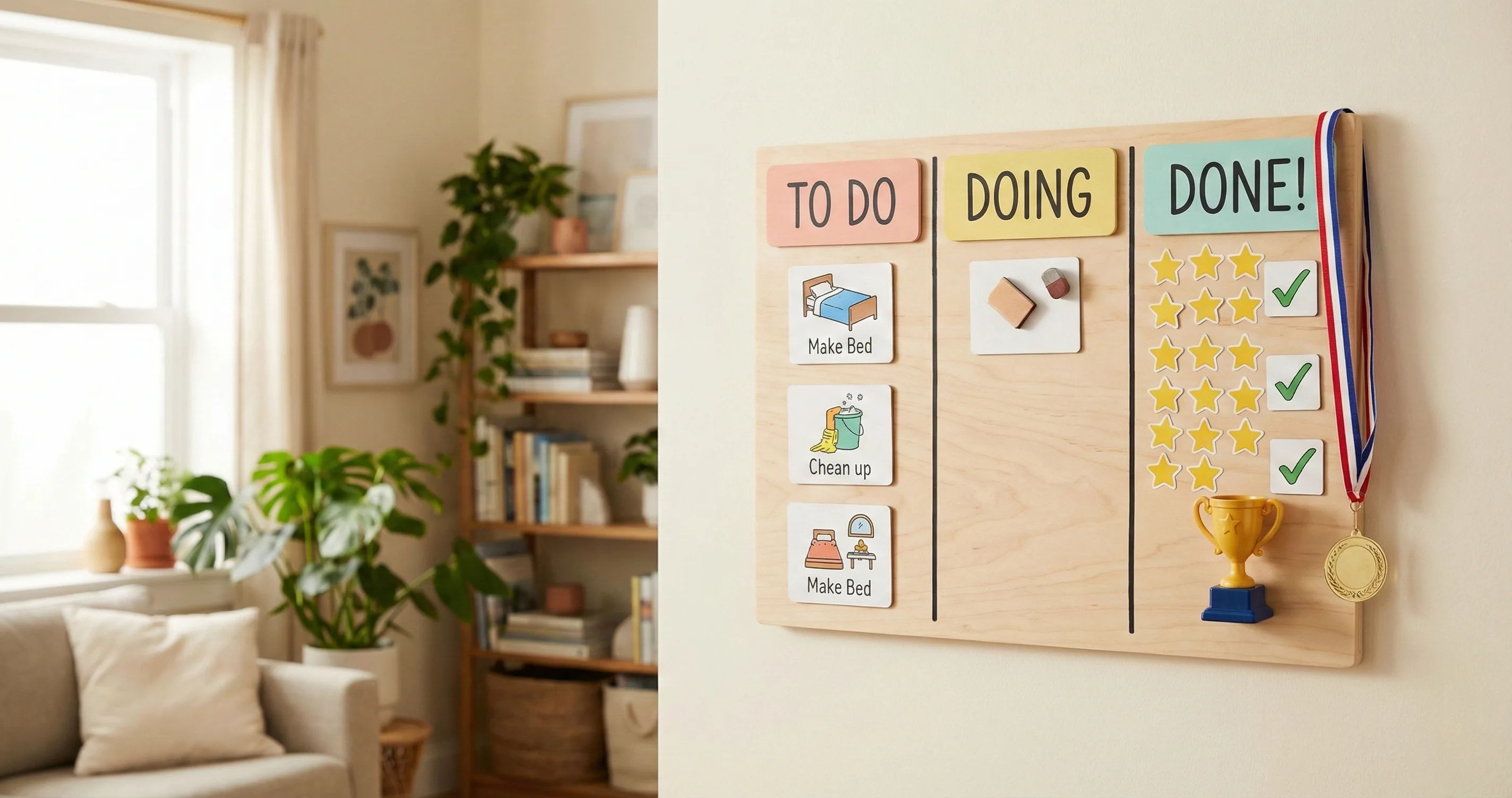
Your child can spend two hours grinding through levels in a video game without a single complaint. But ask them to spend ten minutes unloading the dishwasher and suddenly they act like you have asked them to climb Everest. The difference is not about willpower or laziness. It is about design. Games are engineered to keep players engaged. Chores are not. When you gamify chores, you borrow the exact design principles that make screens so compelling and apply them to the tasks you actually want your child to do.
This is not about turning your home into an arcade or bribing your child with prizes. It is about understanding what makes any activity feel rewarding — progress, feedback, and a sense of accomplishment — and building those elements into the routines your family already has. When you gamify chores and homework, you stop fighting against your child's natural desire for stimulation and start working with it.
The result? Fewer reminders, less nagging, and kids who actually want to check things off their list.
What Is Gamification (and Why Does It Work for Kids)?
Gamification is the practice of applying game design elements — points, rules, competition, rewards — to non-game activities. It is not a new concept. Frequent flyer programs, fitness trackers, and employee loyalty systems all use gamification. What is relatively new is applying it intentionally to children's daily routines.
The reason it works so well for kids comes down to brain chemistry. When a child earns a point, completes a streak, or levels up, their brain releases dopamine — the same neurotransmitter that fires during gameplay, social media scrolling, and eating something delicious. Dopamine is not inherently good or bad. It is the brain's signal that says "this was worth doing — do it again."
Games exploit this loop masterfully. Every completed quest, every unlocked achievement, every leaderboard position triggers a small dopamine hit that keeps the player coming back. The insight behind gamification for daily routines is simple: if you can create the same feedback loops around brushing teeth, finishing homework, or tidying up, the brain responds the same way.
The progress loop
At the heart of every engaging game is what designers call a progress loop: action, feedback, reward, repeat. The child does something (action), sees immediate confirmation (feedback), receives something for it (reward), and then wants to do the next thing. Most household routines are missing all three of those elements after the action. The child empties the dishwasher and gets nothing. No feedback. No visible progress. No reward. Just the expectation that they will do it again tomorrow.
Gamification for kids daily routine fixes this by adding the missing pieces. And the best part? It does not require expensive tools, apps, or complicated systems. A whiteboard and some magnets can do the job for younger children. The principle matters more than the platform.
The 5 Game Mechanics That Motivate Kids
Not all gamification is created equal. Some mechanics work brilliantly for children. Others fall flat or even backfire. Here are the five that research and practical experience show are most effective for game-based motivation kids respond to.
1. Points
Points are the simplest gamification mechanic and the foundation of almost every system. The child completes a task, they earn points. Points accumulate toward rewards. The power of points is that they make invisible effort visible. A child who clears the table cannot see the value of what they did. But a child who earns 10 points for clearing the table — and can see their total climbing toward 100 — has a tangible record of their effort.
Tips for using points effectively:
- Assign higher values to harder or less-liked tasks (taking out the trash might be worth 15 points while making the bed is worth 5)
- Keep point values consistent — changing them arbitrarily feels unfair
- Never take points away as punishment. Points should only go up. The absence of earning is consequence enough
2. Streaks
Streaks tap into a psychological phenomenon called loss aversion. Once a child has built a 5-day streak of completing their morning routine, the thought of breaking that streak becomes a powerful motivator on its own. Streaks work because they transform each day from an isolated event into part of a larger chain.
The key with streaks is to keep them forgiving, especially early on. A single missed day should not reset everything to zero. Consider a "freeze" mechanic: one free pass per week to preserve the streak. This prevents the demoralization that comes from losing a long streak to one bad morning.
3. Levels
Levels give children a sense of progression and identity. Instead of being "a kid who does chores," they become "a Level 4 Home Helper" or "a Silver Star Homework Champion." It sounds silly to adults, but for children ages 5 to 12, titles and status carry real weight.
Levels also solve the problem of rewards becoming stale. At Level 1, the reward might be choosing a bedtime story. At Level 5, it might be picking the family movie on Friday. At Level 10, it might be earning extra screen time or a special outing. The escalation keeps the system fresh.
4. Unlockable rewards
Unlike fixed rewards ("do this, get that"), unlockable rewards are hidden until the child reaches a threshold. Think of them like treasure chests in a game. The child knows something is waiting at 200 points, but they do not know exactly what. This introduces what psychologists call a variable ratio reinforcement schedule — the same mechanism that makes games so engaging for children aged 5 to 12.
Build a reward menu with your child that includes items at different thresholds: small rewards (50 points), medium rewards (150 points), and big rewards (500 points). Let them choose from the menu when they reach each tier.
5. Challenges and quests
Daily tasks can feel monotonous. Challenges break the pattern by introducing time-limited, bonus-earning opportunities. "Weekend warrior challenge: complete all Saturday chores before noon and earn double points." Or "Mystery Monday: one random chore today is worth triple."
Challenges keep the system from feeling like a predictable grind. They are the gamification equivalent of a surprise event in a video game — unexpected, exciting, and powerful enough to re-engage a child who has started to coast.
How to Gamify Your Child's Daily Routine
Theory is useful, but you need a practical plan. Here is a step-by-step process to gamify chores and routines into a system that actually sticks. If you want to turn chores into a game in your household, follow these steps in order.
-
Step 1: Pick one routine to gamify first. Choose a single routine that causes the most friction. Many parents start by trying to gamify morning routine kids struggle with most — getting dressed, brushing teeth, packing bags. Others start with after-school chores or homework time. Gamifying everything at once overwhelms both you and your child. Start with the routine where you nag the most, because that is where gamification will have the most immediate impact.
-
Step 2: Define the tasks and assign point values. Break the routine into specific, completable tasks and assign point values based on effort and importance. Harder tasks earn more points. Be specific: "clean your room" is vague, but "make bed, put clothes in hamper, clear desk" gives three separate wins. Each completed task triggers a small dopamine hit — so more granular tasks mean more motivation moments.
-
Step 3: Create a reward menu together. Sit down with your child and build a reward menu with items at different point thresholds. Mix small daily rewards (pick a snack, extra 10 minutes before bed) with bigger weekly goals (family movie night pick, a new book, earned screen time). The key word is "together" — children who help design the reward system are significantly more invested in it.
-
Step 4: Make progress visible. Use a physical chart, whiteboard, or app where your child can see their points accumulating in real time. Progress visualization is the single most motivating element of any gamified system. When children can see how close they are to the next reward, they push themselves to finish. A jar filling with marbles, a thermometer chart coloring up, or a digital progress bar all work.
-
Step 5: Add streaks and bonus challenges. Once the basic system is running smoothly (usually after one to two weeks), layer in streaks and bonus challenges. A 5-day morning routine streak might earn a bonus of 50 points. A surprise "speed challenge" — finish all tasks in under 15 minutes — adds excitement. These layers prevent the initial enthusiasm from fading.
-
Step 6: Review and evolve the system weekly. Every Sunday, spend five minutes reviewing the week with your child. What felt fair? What felt too easy or too hard? Adjust point values, add new tasks, or rotate rewards. A system that evolves stays engaging. A system that stays static gets ignored.
Gamification Ideas by Age Group
What motivates a 5-year-old is very different from what motivates a 12-year-old. The mechanics are the same, but the implementation needs to match your child's developmental stage. Here is how to gamify chores effectively at each developmental stage.
Ages 4 to 6: The sticker chart era
Young children need immediate, tangible feedback. Abstract point totals do not mean much to a child who is still learning to count past twenty. Instead:
- Sticker charts where each completed task earns a physical sticker they place themselves. The act of peeling and sticking is itself rewarding
- Marble jars where each task adds a marble. When the jar is full, the family does something special together
- Simple visual levels: "You are a Star Helper! Three more stickers and you become a Super Star Helper!" Keep it to three or four levels maximum
- Same-day rewards. At this age, a reward earned on Monday and received on Friday might as well not exist. Keep the loop tight
At this age, the gamification should feel like play, not like a system. Use bright colors, silly names, and celebrate every small win loudly.
Ages 7 to 9: The points and quests phase
Children in this age group can handle more complex systems. They understand accumulation, delayed gratification (to a point), and the concept of working toward a goal:
- Point systems with a running total on a whiteboard or chart. Points carry over from day to day
- Weekly quests: "Complete all homework sessions this week without reminders = 100 bonus points." Quests add narrative and challenge
- Tiered rewards: Small rewards at 50 points, medium at 200, big at 500. Let them choose when to "spend" or keep saving
- Simple streaks: Track consecutive days on a calendar with a special sticker or mark. Aim for 7-day streaks to start
This is also the age where sibling competition can be introduced carefully. A family leaderboard (with emphasis on personal bests, not just rankings) can add motivation — but watch for signs that it is creating resentment rather than engagement.
Ages 10 to 12: The leveling-up stage
Preteens want autonomy and status. The gamification system should reflect that:
- Level titles that carry real privileges. A "Level 5 Home Manager" might earn the privilege of choosing their own bedtime on weekends or managing their own screen time budget
- Achievement badges for specific milestones: "30-Day Streak Champion," "Homework Hero," "Kitchen Commander." Display these somewhere visible — preteens care about recognition more than they admit
- The ability to propose and earn bonus points for tasks beyond the standard list. This gives them agency and teaches initiative
- Longer-term goals: Saving up for a bigger reward over two to four weeks. This age group can handle delayed gratification and benefits from the planning it requires
For this age group, consider transitioning from a parent-managed system to a self-tracked one. The child logs their own points and verifies with you at the end of the day. This builds trust and self-regulation — skills that matter far more than whether the dishes got done.
Common Gamification Mistakes Parents Make
The impulse to gamify chores is powerful, but the execution is not foolproof. Here are the five most common mistakes that cause family gamification systems to fail — and how to avoid each one.
Mistake 1: Making rewards too big, too fast
If your child earns a new toy on day one, where do you go from there? Start small. The first rewards should be experiences (choosing dinner, picking the movie) or small privileges (10 extra minutes before bed). Save bigger rewards for higher levels. Inflation kills gamification the same way it kills currency — when everything costs more, nothing feels valuable.
Mistake 2: Gamifying everything at once
A system with 25 tasks, 8 reward tiers, and 3 different streak trackers is not gamification — it is bureaucracy. Start with one routine, three to five tasks, and one reward threshold. Add complexity only after the simple version is working. Behavioral researchers call this scaffolding: build the foundation first, then add layers gradually.
Mistake 3: Using points as punishment
Deducting points for bad behavior fundamentally changes the emotional feel of the system. Instead of "I can earn things," the child starts thinking "I can lose things." That is the restriction model dressed up in game clothes, and it creates the same resentment. If you need consequences, keep them separate from the gamification system entirely.
Mistake 4: Not involving the child in design
A system imposed from the top down feels like just another set of parental rules. When children help design the system — choosing task values, picking rewards, naming the levels — they become co-owners. Co-owners do not rebel against their own creation. This is the same principle behind why the best chore apps let kids participate in setting up their own reward menus.
Mistake 5: Expecting the system to last forever unchanged
Every gamification system has a shelf life. What excites your child at age 7 will bore them at age 9. Plan for evolution from the start. Schedule monthly "system reviews" where you and your child redesign elements together. The goal is not a permanent system. It is a series of systems that build lasting habits.
Digital Tools That Make Gamification Easy
You can absolutely gamify chores with paper, stickers, and a whiteboard. But dedicated gamification apps for kids add features that are hard to replicate manually: automatic streak tracking, real-time progress visualization, and the ability to adjust rewards on the fly.
What to look for in a gamification app
Not all family task apps are truly gamified. Many are just digital checklists with a coat of paint. A genuinely gamified tool should include:
- Visual progress tracking that the child can see and interact with
- Flexible reward mechanics (points, streaks, or levels — ideally all three)
- Parent controls that let you adjust the system without starting over
- A child-friendly interface that makes checking off tasks feel rewarding, not clinical
- The ability to connect tasks to meaningful rewards (not just virtual badges, but real-world outcomes like screen time or privileges)
The screen time connection
Here is what no competitor article on gamification addresses: the most powerful reward in a gamified system for most kids ages 5 to 12 is screen time itself. When you connect task completion directly to screen time earning, you create a closed loop that is remarkably effective. The child is not just doing chores for an abstract "point." They are doing chores because every completed task gets them closer to something they genuinely want.
This is the approach Timily takes — connecting gamified daily routines directly to earned screen time. Instead of screen time being something you restrict and your child resents, it becomes something they earn and feel proud of. The gamification is the bridge between "do your chores" and "enjoy your screen time," and it eliminates the friction that usually sits between those two moments.
Making It Stick: Your First Week
If you have read this far, you have the complete framework. But reading about gamification and implementing it are two different things. Here is how to make your first week count:
- Day 1 (Sunday): Sit down with your child. Pick one routine. Define three to five tasks. Assign points. Create a small reward menu. Write it all down or set it up in an app
- Days 2 to 5: Run the system. Celebrate every point earned. Resist the urge to add complexity. Focus on building the habit of using the system itself
- Day 6: Check in. Ask your child what is working and what is not. Make one small adjustment
- Day 7: Award any earned rewards. Review the streak. Talk about what next week might look like
By the end of the first week, you will have data on what motivates your specific child. Some respond most to streaks. Others are all about the points. Some love the surprise bonus challenges. Use that information to customize the system for week two and beyond.
The science is clear: gamification works because it aligns with how children's brains are wired. Points, streaks, and levels are not tricks. They are tools. And when you use them to build productive habits instead of just consuming entertainment, you are giving your child a framework for motivation that will serve them long after the sticker charts come down.
The chores still need to get done. The homework still has to happen. But when you gamify chores with the right principles, the path from "you have to" to "I want to" becomes a whole lot shorter.