
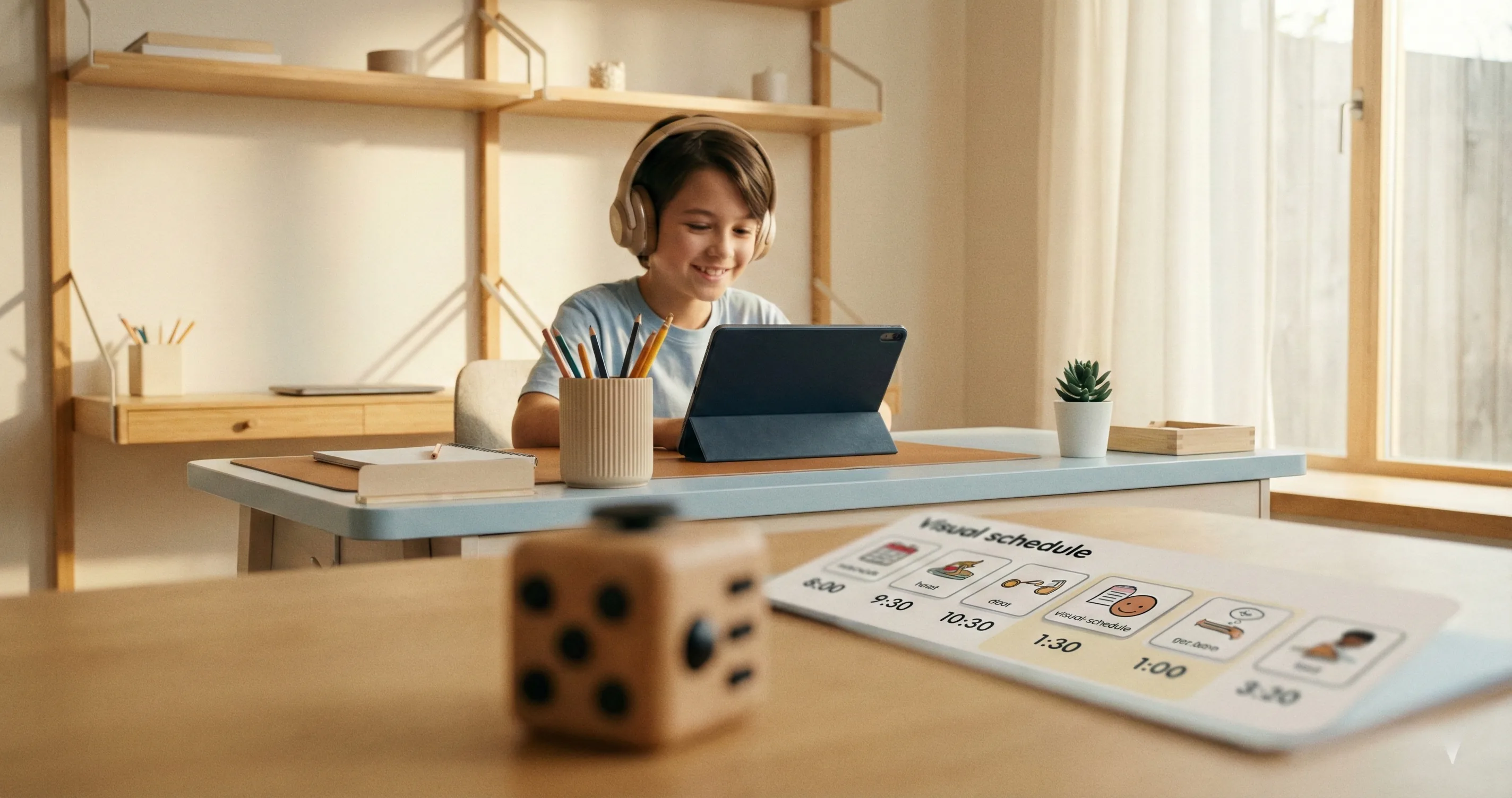
If you are the parent of a child with ADHD, you already know that standard screen time advice does not work for your family. ADHD and screen time is one of the most common daily conflicts — the "just set a timer and take it away" approach that works for some households leads to explosive meltdowns, prolonged arguments, and a cycle of guilt in yours. You are not doing anything wrong. The problem is that most ADHD screen time management advice was designed for neurotypical brains, and your child's brain works differently.
A 2023 meta-analysis published in PubMed found that screen time is associated with increased ADHD symptoms, but the relationship runs deeper than "too much screen time is bad." Research published in Nature/Scientific Reports the same year revealed that the association is mediated by impulsivity — meaning the very traits that define ADHD are the ones that make screen time so difficult to manage with conventional tools.
This guide takes a different approach. Instead of offering another list of restrictions your ADHD child will struggle to follow, it explains why reward-based systems are uniquely suited to how the ADHD brain processes motivation — and gives you a practical framework for building one at home.
Why Standard Screen Time Rules Don’t Work for ADHD Kids
Walk into any pediatrician's office and ask about screen time. You will get the same advice: set firm limits, stick to a schedule, remove the device when time is up. For many families, this works well enough. For families managing ADHD, it is a recipe for daily conflict.
The compliance gap
Standard screen time rules assume a baseline level of impulse control and emotional regulation. They assume the child can hear "five more minutes," process the information, begin winding down, and accept the transition. ADHD disrupts every single step in that sequence. The child may not register the warning. They may register it but lack the executive function to begin transitioning. Or they may understand the rule perfectly but lack the impulse control to stop an activity that is flooding their brain with dopamine.
The result is not non-compliance. It is neurological mismatch. The rule was designed for a brain that processes transitions, time awareness, and impulse control in a way that the ADHD brain simply does not.
Why restriction triggers opposition
Children with ADHD experience rejection sensitivity at higher rates than neurotypical peers. When screen time is framed as something that gets taken away — as a punishment or a hard stop — it can trigger an emotional response that is disproportionate to the situation. The child is not overreacting. Their brain is interpreting the loss as a genuine threat, and their emotional response reflects that interpretation.
This is why the "just be consistent" advice falls short. You can be perfectly consistent with a system that is fundamentally incompatible with your child's neurology, and the fights will still happen every day.
The rigidity problem with standard parental controls
Most screen time ADHD kids face involves parental control apps designed around blocking and rigid time limits. Set 60 minutes, and the screen locks when the timer hits zero. For an ADHD child in a state of hyperfocus, this abrupt cutoff creates the neurological equivalent of slamming on the brakes at full speed. The typical ADHD screen time meltdown that follows is predictable: arguments, tears, and a child who views the technology as an adversary rather than a tool.
How ADHD Affects Screen Time Behavior
Understanding the specific mechanisms is essential. ADHD does not just make screen time management harder in a general sense. It creates specific, predictable patterns that standard advice fails to address.
The dopamine deficit
ADHD brains operate with lower baseline levels of dopamine, the neurotransmitter responsible for motivation, reward, and pleasure. This deficit creates what researchers call a "reward deficiency" — the brain is constantly seeking stimulation to bring dopamine levels closer to where a neurotypical brain operates at rest.
Screens are extraordinarily efficient dopamine delivery systems. Video games, social media, and streaming content provide rapid, variable reward — exactly the kind of stimulation an ADHD brain craves. This is not a character flaw or a lack of discipline. It is the brain doing precisely what it is wired to do: seeking the dopamine it needs. So does screen time make ADHD worse? A 2023 meta-analysis found that excessive screen exposure is associated with increased symptom severity — but the relationship runs both ways, as impulsivity also drives higher screen use.
Research from CHADD (Children and Adults with ADHD) confirms this pattern is common in neurodivergent children.
This also explains why asking an ADHD child to "just stop" feels so different from asking a neurotypical child. For the neurotypical child, stopping screen time means giving up something enjoyable. For the ADHD child, it means returning to a state of understimulation that feels genuinely uncomfortable.
Hyperfocus and the attention paradox
One of the most misunderstood aspects of ADHD is hyperfocus. Parents often say, "My child can't have ADHD — they can focus on video games for hours." But hyperfocus is not good attention. It is a dysregulation of attention. The ADHD brain locks onto high-dopamine activities and loses the ability to disengage voluntarily.
When a child with ADHD enters hyperfocus on a screen, their awareness of time, their surroundings, and even physical needs like hunger and bathroom use can fade. This is not willful ignoring of rules. It is a neurological state in which the brain's attention switching mechanism has effectively shut down.
Executive function and transition difficulty
Executive function — the brain's ability to plan, prioritize, shift between tasks, and regulate behavior — is consistently impaired in ADHD. Screen time transitions require all of these skills simultaneously. The child must recognize that time is ending, plan their stopping point, shift their attention from the screen to the next activity, and regulate the emotional disappointment of stopping.
Neurotypical children may struggle with one of these steps on a bad day. ADHD children struggle with all of them, every day. This is why transition moments are the flashpoint for most ADHD screen time conflicts.
Why Reward-Based Systems Align with ADHD Neurology
If ADHD brains are driven by dopamine-seeking, the most logical intervention is not to fight that drive but to work with it. This is the core insight behind reward-based screen time systems, and it is backed by both neuroscience and behavioral psychology.
Motivation through earning, not losing
In a restriction-based model, the child starts with screen time and faces losing it. Every interaction with the system is framed around loss. For an ADHD brain that already processes loss and rejection more intensely, this creates chronic stress around screen time.
A reward system for ADHD child screen time flips this dynamic. The child starts at zero and earns screen time through completed tasks, focus sessions, or daily responsibilities. Every interaction with the system is framed around gain. Instead of "you lost 10 minutes because you didn't clean your room," it becomes "you earned 15 minutes because you finished your homework." The behavioral outcome may be similar, but the neurological experience is fundamentally different.
The AAP has noted that structured, predictable routines are especially important for ADHD children. An earn-first system provides exactly this: a clear, predictable framework where effort leads to reward.
The power of immediate feedback
ADHD brains discount future rewards more steeply than neurotypical brains. Telling an ADHD child "if you're good all week, you can have extra screen time on Saturday" is neurologically equivalent to telling them "you'll never get it." The reward is too far away to generate motivational dopamine.
Effective reward systems for ADHD kids provide immediate or near-immediate feedback. Finish a 20-minute focus session and see points appear instantly. Complete a chore and watch the progress bar move. This immediacy is not a luxury — it is a neurological necessity for maintaining ADHD motivation.
Visual progress and gamification
Research on gamification ADHD kids daily tasks consistently shows that visual progress indicators — progress bars, point counters, streak trackers — significantly improve task completion in ADHD children. The reason is straightforward: these visual cues create micro-doses of dopamine as the child sees themselves moving toward a goal.
This is the same principle that makes video games so engaging for ADHD brains. Games provide constant visual feedback, clear goals, and a sense of progression. A well-designed screen time reward system borrows these principles and applies them to real-life tasks. The child is essentially "playing a game" where the levels are homework, chores, and focus sessions, and the reward is screen time they genuinely earned.
Setting Up a Screen Time Reward System for ADHD Kids
Theory is useful. But what does this actually look like at home? Here is a practical framework designed specifically for ADHD families. The key principles are short earn cycles, visual tracking, and flexibility within structure.
Step 1: Define earnable activities
Work with your child to identify tasks that earn screen time. For ADHD kids, these should be:
- Specific and concrete. Not "be good today" but "finish math homework" or "load the dishwasher." ADHD brains need clarity, not ambiguity.
- Short enough to complete in one session. A task that takes 45 minutes may feel insurmountable. Break it into two 20-minute tasks, each earning its own reward.
- Varied. ADHD brains crave novelty. Rotate tasks weekly or offer a menu of options so the child has choice within structure.
Step 2: Set clear, visible exchange rates
Create a simple chart or use an app that shows exactly what each task earns. For example:
- Complete a 20-minute focus session = 10 minutes of screen time
- Finish homework without reminders = 15 minutes
- Complete a household chore = 10 minutes
- Read for 20 minutes = 10 minutes
- Self-regulate a screen time transition without a meltdown = 5 bonus minutes
The last item is critical. Rewarding the transition itself — the moment most ADHD families dread — changes the incentive structure. Instead of fighting against transitions, the child has a reason to manage them well.
Step 3: Make progress visible
For ADHD children, "out of sight, out of mind" is not an exaggeration. It is how their working memory functions. If the reward system lives on a spreadsheet or in a parent's head, it effectively does not exist for the child.
Use a visual tracker the child can see throughout the day. This could be a physical chart on the fridge, an app with a progress bar, or a jar that fills with tokens. The visual representation provides the ongoing dopamine micro-hits that keep ADHD motivation alive between tasks.
Step 4: Keep earn cycles short
This is where most parents go wrong with ADHD reward systems. They set up weekly goals: "earn 300 points this week and you get two hours of weekend screen time." For a neurotypical child, this might work. For an ADHD child, a week is an eternity. The reward is too distant to generate motivation.
Instead, use daily earn cycles. The child earns and spends within the same day. They can see their balance build in real time, spend it in the afternoon or evening, and start fresh the next day. This daily reset prevents the discouragement that comes from falling behind on a weekly goal.
Step 5: Build in transition supports
Even with a reward system in place, transitions will still be hard. ADHD brains need external scaffolding for transitions that neurotypical brains handle internally. Build these into the system:
- Visual countdown timers that the child can see (not just hear). A visual timer showing sand running out or a circle shrinking provides the external time awareness that ADHD impairs.
- A consistent "landing pad" activity. After screens end, the child always goes to the same next activity — a snack, a walk, reading, or drawing. This predictability reduces the anxiety of "what happens after screens" that fuels resistance.
- A 2-minute buffer. Allow the child to save their game, finish their video, or reach a natural stopping point. This respects the hyperfocus state while maintaining the boundary.
For a more detailed guide on building a screen time reward system for kids, including printable templates and age-specific adjustments, see our dedicated guide.
Best Apps and Tools for ADHD Screen Time Management
Not all screen time management tools are created equal, and for ADHD families, the differences matter enormously. The best apps for kids with ADHD focus share specific design principles that align with ADHD neurology.
What to look for in an ADHD-friendly app
When evaluating screen time tools for an ADHD child, prioritize these features:
- Earn-first design. The app should let children earn screen time through tasks, not just block them after a limit is reached. This aligns with the reward-based approach that works with ADHD motivation.
- Visual progress indicators. Points, bars, streaks, or other visual feedback that provide ongoing motivation between tasks.
- Flexible transitions. The app should support buffer periods and countdowns rather than hard cutoffs that trigger meltdowns.
- Short task cycles. The ability to set up brief, focused tasks (10 to 25 minutes) that match ADHD attention spans rather than requiring sustained effort over long periods.
- Positive framing. The language and design should emphasize what the child earned, not what they lost. This distinction matters for ADHD rejection sensitivity.
Categories of tools
Managing ADHD and screen time typically benefits from a combination of tools rather than a single solution:
- Reward-based screen time apps. These let children earn screen time through completing tasks and focus sessions. Timily falls into this category, using a points-based system where children earn screen time through real-world activities. For a detailed comparison of options, see our guide to earn screen time apps.
- Visual timers. Physical or digital timers that show time passing visually. These support the external time awareness that ADHD children need.
- Task management apps with gamification. Apps that turn daily responsibilities into game-like experiences with points, levels, and rewards.
- Focus timer apps. Tools that break work into short intervals with breaks, based on the Pomodoro method, which is widely recommended for ADHD.
What to avoid
Certain app designs actively work against ADHD neurology:
- Hard lockout apps that shut down the device without warning or buffer. These guarantee a meltdown for most ADHD children.
- Surveillance-heavy apps that monitor every action. ADHD children already struggle with self-esteem. Feeling spied on compounds this.
- Complex setup processes that require the child to learn elaborate systems. ADHD executive function impairment means the system needs to be intuitive from day one.
When to Involve a Professional
Reward-based screen time systems are effective for most ADHD families, but they are not a substitute for professional support when it is needed. Consider involving a professional if:
- Screen time meltdowns are escalating in intensity or duration despite consistent use of a structured system for more than four weeks.
- Your child shows signs of screen dependency — lying about screen use, sneaking devices at night, or becoming physically aggressive when devices are removed.
- Screen time is significantly interfering with sleep, school performance, or social relationships beyond what you would expect for their ADHD diagnosis.
- You suspect a co-occurring condition such as anxiety, depression, or oppositional defiant disorder that may be complicating screen time behavior.
- Your child's ADHD medication may need adjustment. If screen time transitions were manageable and have become significantly worse, medication changes or dosing timing may be a factor.
Who to consult
Different professionals offer different types of support:
- A pediatric psychologist or behavioral therapist can help design individualized behavior plans that integrate screen time management with broader ADHD strategies.
- An occupational therapist can address sensory processing issues that may be contributing to screen time dependency or transition difficulty.
- Your child's prescribing physician can evaluate whether medication timing or dosage adjustments might improve executive function during key transition periods.
The goal is not to eliminate screen time. For ADHD children, screens are often a legitimate source of regulation, social connection, and learning. The goal is to build a system where screen time serves the child rather than controlling them — and to get professional support when that system needs more expertise than any parent should be expected to have on their own.
Moving Forward: A Better Approach to ADHD and Screen Time
Managing ADHD and screen time is genuinely harder than managing screen time with a neurotypical child. That is not a failure of parenting. It is a reflection of real neurological differences that require different strategies.
The core principle is simple: stop fighting your child's neurology and start working with it. ADHD brains are motivated by reward, driven by immediacy, and sustained by visual feedback. Build a screen time system that leverages these traits rather than punishing them, and the daily fights begin to subside.
Start small. Pick one or two earnable tasks. Set up a simple visual tracker. Keep the earn cycles daily. Reward transitions, not just compliance. And remember that progress with ADHD is rarely linear — there will be hard days. The system does not need to be perfect. It needs to be consistent, visible, and built on earning rather than losing.
Your ADHD child is not broken. Their screen time system might be. Change the system, and you change the dynamic.