
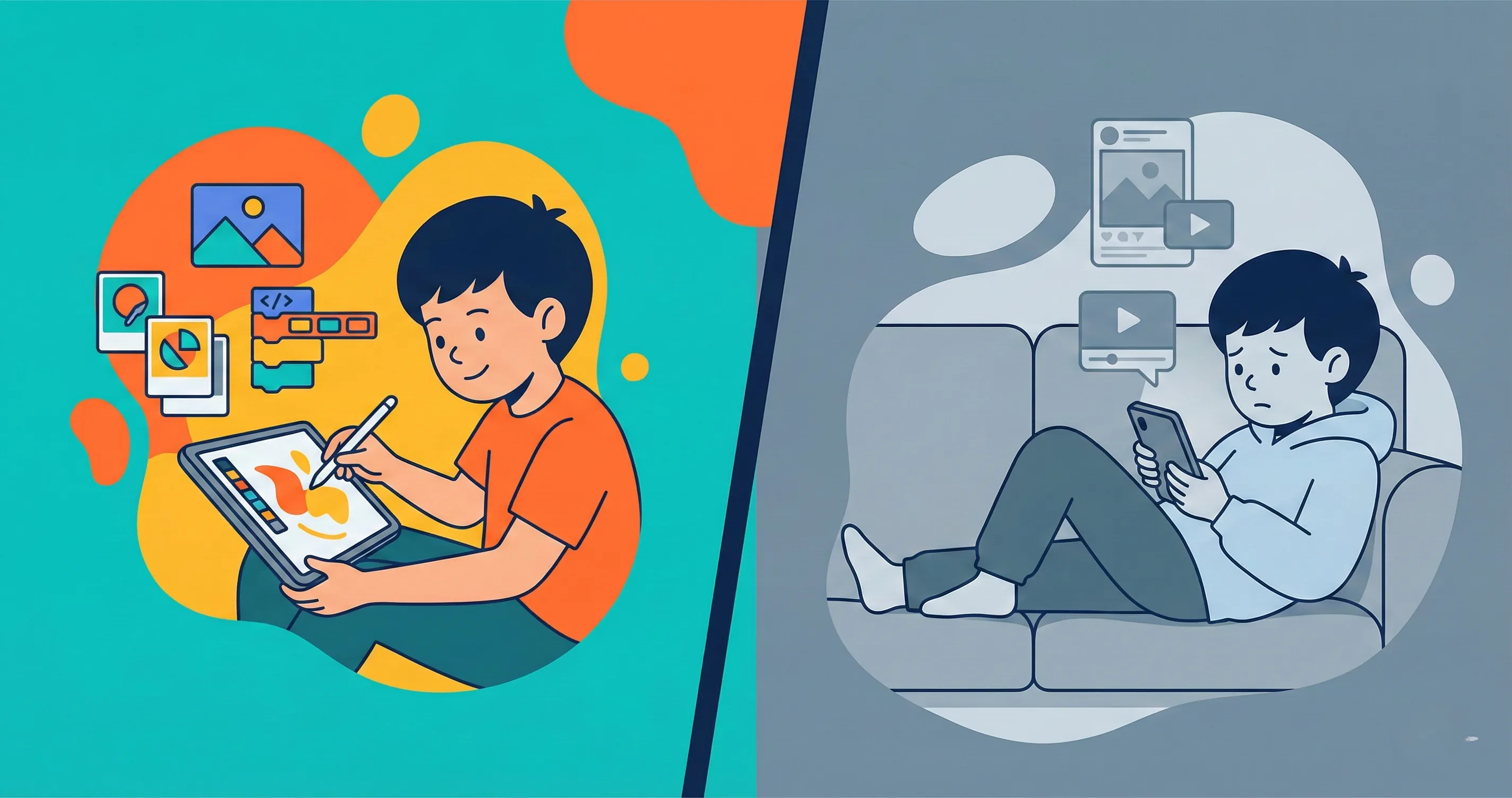
The pediatric conversation around screens has shifted. For years, the central question was how much screen time is too much. Now, researchers and clinicians are asking a more useful question: what kind? The distinction between active vs passive screen time is one of the most important concepts in modern digital parenting — and most families have never heard of it. A child who spends 90 minutes coding a robot and a child who spends 90 minutes scrolling TikTok have had fundamentally different neurological experiences, even though the clock reads the same.
This guide breaks down the types of screen time, explains why the quality of screen use matters more than the quantity, and gives you a practical framework for shifting your family’s screen habits toward more active, intentional use. No guilt. No zero-screen absolutism. Just the evidence, and what to do with it.
What Is Active vs Passive Screen Time?
The terms are straightforward, but the distinction has real clinical weight. Active screen time refers to any device use where the child is cognitively engaged — thinking, creating, deciding, or interacting with the content in a meaningful way. Passive screen time, by contrast, involves consuming content with minimal cognitive effort: watching autoplay videos, scrolling feeds, or binge-watching episodes without pausing to think about what they are seeing.
Active screen time: the hallmarks
- The child is making decisions, solving problems, or creating something
- There is a clear goal or learning outcome (building a level, finishing a lesson, writing code)
- The experience has a natural stopping point or a sense of completion
- The child can describe what they did and what they learned afterward
Passive screen time: the hallmarks
- The child is consuming content without interacting with it
- There is no endpoint — autoplay or infinite scroll keeps the content coming
- The experience is designed to maximize watch time, not learning or growth
- Afterward, the child often cannot recall specific details of what they watched
A useful mental test: if you turned off the screen mid-session, would your child notice immediately because they were in the middle of something, or would they only notice because the stimulation stopped? The first is active. The second is passive.
Why the Distinction Matters More Than Total Hours
The American Academy of Pediatrics (AAP) updated its screen time guidance in 2016 to move beyond simple hourly caps, acknowledging that the content and context of screen use matter as much as duration. This shift reflects a growing body of evidence showing that educational screen time vs entertainment produce measurably different outcomes in children.
A 2023 JAMA Pediatrics study examined the cognitive effects of different types of screen use on children ages 8–12 and found that children who predominantly engaged in passive consumption showed lower scores on executive function tests, while those whose screen time was mostly interactive and creative showed no significant cognitive differences from low-screen-time peers.
The implications are significant. A family that reduces total screen time from four hours to two hours — but the remaining two hours are still passive scrolling — may see fewer benefits than a family that keeps three hours but shifts the ratio toward active use. Quality changes the equation fundamentally.
What the research tells us
- Passive screen time before age 5 is associated with language delays (Madigan et al., 2020, JAMA Pediatrics), while co-viewed educational content is associated with vocabulary growth. The risk starts early: children under 1 exposed to passive screens are 6x more likely to experience language delay (Expressable)
- Interactive educational apps produce learning gains comparable to teacher-led instruction in early math and literacy (Griffith et al., 2020)
- Passive consumption, particularly algorithm-driven video feeds, is linked to increased anxiety and reduced attention spans in school-age children (Twenge & Campbell, 2018)
- Creative screen use — digital art, music production, coding — activates the prefrontal cortex in ways that passive consumption does not
This does not mean passive screen time has zero value. A child who watches a nature documentary or a well-crafted film is gaining cultural literacy and expanding their worldview. The concern is when passive consumption becomes the dominant mode — when scrolling replaces thinking, and watching replaces making.
Examples of Active Screen Time for Kids (by Age)
The definition of productive screen time kids can engage in varies significantly by developmental stage. What counts as active and educational for a five-year-old is not the same as what challenges a twelve-year-old. Here is a practical breakdown.
Ages 2–5: guided and co-viewed
At this age, screen time is most beneficial when a caregiver is present and engaged. The child’s ability to transfer knowledge from a screen to real life depends heavily on adult mediation.
- Interactive educational apps (Khan Academy Kids, Busy Shapes, Endless Alphabet) with a parent nearby
- Video calls with relatives — genuinely interactive and emotionally meaningful
- Co-viewed educational shows (Sesame Street, Bluey, Numberblocks) with conversation during and after
- Simple digital drawing or coloring apps on a tablet
Ages 6–9: creative and exploratory
Children in this range can begin using screens more independently for creative and educational purposes, though oversight remains important.
- Coding platforms (Scratch Jr., Tynker, Code.org) where kids build games and animations
- Digital art and design (Procreate, Tayasui Sketches)
- Educational gaming (Prodigy Math, Osmo, DragonBox)
- Research projects — using a search engine to answer a question they genuinely have
- Recording and editing short videos or stop-motion animations
Ages 10–13: productive and project-based
Older children can handle longer periods of active screen time and benefit from more sophisticated tools.
- Real coding languages (Python via Codecademy, JavaScript via freeCodeCamp)
- 3D modeling and game design (Blender, Roblox Studio, Minecraft Education)
- Music production (GarageBand, BandLab)
- Writing and blogging on kid-safe platforms
- Documentary watching followed by discussion or a related project
- Online courses in subjects they are passionate about
The common thread across every age group: active screen time produces something. A drawing, a game, a song, an answer to a question, a story. Passive screen time, by definition, does not.
How Passive Screen Time Affects the Brain Differently
Understanding the neuroscience helps explain why parents instinctively feel uneasy watching their child scroll for hours, even when they cannot articulate exactly why. The brain processes active and passive screen time through different pathways, with measurably different outcomes.
The dopamine loop
Passive consumption — particularly short-form video and social media feeds — triggers rapid dopamine release in the brain’s reward system. Each new video, each scroll, delivers a small hit of novelty. The brain adapts by requiring more stimulation to achieve the same level of satisfaction, which is why children often escalate from 20 minutes of passive scrolling to two hours without noticing the time pass.
Active screen time, by contrast, produces dopamine through effort and accomplishment. Finishing a coding challenge, completing a digital artwork, or solving a puzzle provides a deeper, more sustained sense of reward that does not create the same escalating dependency.
Attention and executive function
A 2022 study published in Nature Human Behaviour found that passive screen time was associated with measurable reductions in sustained attention in children, while active screen use was not. The researchers hypothesized that passive consumption trains the brain to expect constant external stimulation, weakening the internal attention systems that children need for schoolwork, reading, and focused play.
This helps explain a pattern many parents recognize: after an hour of passive scrolling, a child struggles to settle into homework or a book. After an hour of coding or building in Minecraft, the transition is often smoother — because the brain was already in an active, focused state.
Sleep disruption
Both active and passive screen time before bed can disrupt sleep through blue light exposure. But passive consumption carries an additional risk: the lack of a natural stopping point. A child working on a project can reach a logical endpoint. A child scrolling a feed has no built-in reason to stop. This is why passive screen time is disproportionately linked to delayed bedtimes and sleep problems in children.
Counterintuitively, highly stimulating interactive content can also be problematic at bedtime. A 2012 study by Dr. Victoria Dunckley found that just 30 minutes of interactive screen time disrupted sleep quality, compared to 2 hours of passive screen time needed to produce the same effect. The takeaway: active screen time is better for development during the day, but its stimulating nature means it should still end well before bedtime.
When “Interactive” Still Isn’t Healthy: The Engagement Trap
Not all “interactive” screen time is truly active or beneficial. Many apps and games are designed to feel participatory while offering none of the cognitive benefits of genuine active use. The distinction matters because parents often assume that if their child is tapping, swiping, or clicking, the experience must be better than passive watching. That assumption can be dangerously wrong.
Addictive game loops disguised as interaction
Games like Fortnite use variable reward schedules — the same psychological mechanism behind slot machines — to keep players engaged far past the point of enjoyment. Roblox layers in-game purchase pressure on top of social dynamics, creating an environment where children spend money to maintain status rather than developing skills. Mobile games with loot box mechanics offer randomized rewards that trigger dopamine spikes without any problem-solving, creativity, or learning involved.
Social media platforms present a similar trap. Likes, comments, and follower counts feel “interactive,” but the underlying neurological response closely mirrors passive consumption. The child is not creating or learning — they are refreshing a feed to see if their number went up. That is a dopamine loop, not active engagement.
The test: is this truly active?
Ask yourself one question: Is the child creating something, learning something, or solving a genuine problem? If they are just tapping to trigger the next reward, it is dressed-up passive consumption — regardless of how “interactive” the app claims to be.
Checklist: Is this app truly active?
- Does it require critical thinking or creativity? If the child is making real decisions or producing something original, it qualifies. If they are following a repetitive loop for rewards, it does not.
- Would the child be doing something if the screen were off? Active screen time replaces an activity (drawing, building, composing). Passive consumption fills a void — it is an escape from boredom, not a choice toward something.
- Is there a natural stopping point, or is it designed to keep them playing? Active apps have endpoints: a finished project, a completed lesson. Engagement-trap apps use streaks, timers, and social pressure to prevent stopping.
- Does it leave the child energized or drained? After genuine active screen time, children are often eager to show what they made. After engagement-trap apps, they are typically irritable, resistant to stopping, or zoned out.
Teaching children to recognize the difference between real interactivity and manufactured engagement is one of the most valuable digital literacy skills a parent can pass on. It helps them become critical consumers of technology — not just users of it.
How to Shift Your Family’s Screen Time from Passive to Active
Knowing the difference between active and passive screen time is the first step. The harder part is changing entrenched habits. Children default to passive consumption because it requires zero effort and delivers instant gratification. Shifting toward active use takes strategy.
Step 1: audit the current ratio
Before changing anything, spend one week observing. For each screen session, note whether it was active or passive. Most families discover that 70–80% of their child’s screen time is passive — even when they assumed it was more balanced. The audit itself often motivates change.
Step 2: introduce the “create before you consume” rule
This is one of the most effective behavioral nudges for families. The rule is simple: before any passive screen time (YouTube, TikTok, Netflix), the child must complete a period of active screen time first — 20 minutes of coding, drawing, or an educational app. This does not eliminate passive use. It ensures that active use always comes first, when energy and attention are highest.
Step 3: curate the active options
Children will not spontaneously choose a coding app over YouTube. The active options need to be visible, accessible, and occasionally introduced with enthusiasm. Set up a “creative apps” folder on the home screen. Sit with your child and try a new app together. Make the first experience social and low-pressure.
Step 4: use structure to support the shift
Unstructured screen time almost always drifts toward passive use. A tool like Timily’s Focus Timer can help children allocate dedicated blocks for active screen time — a 25-minute creative session before switching to entertainment. The structure removes the decision fatigue that leads kids to default to scrolling.
Step 5: reframe the conversation
Instead of “you watch too much TV,” try “what did you make today?” Shift the family vocabulary from restricting passive time to celebrating active time. When children hear consistent positive reinforcement for creative screen use, the internal motivation follows. For more on building age-appropriate screen time rules, see our dedicated guide.
The Role of Co-Viewing: Turning Any Screen Time into Active Time
Here is a finding that surprises many parents: you can turn passive screen time into active screen time without changing the content at all. The mechanism is co-viewing — watching alongside your child and engaging in dialogue about what you are seeing.
A 2023 study published in Pediatrics found that children who watched television with a parent and discussed the content afterward demonstrated comprehension and vocabulary gains comparable to those using interactive educational apps. The content was the same. The variable was the conversation.
Why co-viewing works
When a parent asks questions during a show — “Why do you think she did that?” “What would you have done?” “What do you think happens next?” — the child’s brain shifts from passive reception to active processing. They must retrieve information, form opinions, and articulate thoughts. The neural pathways involved are fundamentally different from those engaged during silent consumption.
Practical co-viewing strategies
- Watch the first episode of a new show together and discuss before letting your child continue independently
- Ask one question per episode: “What was the most interesting thing you saw?”
- Connect screen content to real life: “That character reminded me of your friend Sam — what do you think?”
- For older kids, watch a documentary together and do a related activity afterward (cook the food, visit the place, research the topic)
- Make it a ritual, not a chore — Friday movie nights with post-film discussion become family traditions
Co-viewing is not about monitoring or policing. It is about presence. And it is one of the most powerful tools parents have for ensuring quality screen time for kids, even when the content itself is entertainment rather than education.
A Quick Audit: Evaluating Your Child’s Current Screen Diet
Use this framework to evaluate your child’s screen time over one week. No apps required — a notebook works fine. The goal is not to track minutes obsessively, but to get a clear picture of the active-to-passive ratio.
The five-question screen diet check
For each screen session your child has, answer these five questions:
- Was the child creating or consuming? Creating = active. Consuming without interaction = passive.
- Was there a defined endpoint? A finished drawing, a completed level, or a lesson done = active. Infinite scroll or autoplay = passive.
- Could the child describe what they did afterward? If they can explain, narrate, or show you what they accomplished, it was active. If they say “I don’t know, just watched stuff,” it was passive.
- Was there any social component? Collaborating with a friend on a project, video-calling a relative, or co-viewing with a parent all add active elements.
- How was the child’s mood afterward? Active screen time typically leaves children in a neutral or positive state. Passive binges often produce irritability, resistance to stopping, or difficulty transitioning to other activities.
Interpreting your results
- If 60%+ is active: Your child has a healthy screen diet. Maintain the current approach and look for opportunities to introduce new creative tools as they grow.
- If 40–60% is active: There is room to improve. Try the “create before you consume” rule and add one new active app or activity per week.
- If less than 40% is active: The screen diet needs a meaningful shift. Consider a structured approach — Timily’s Collaborative App Blocking feature can help families set boundaries around passive apps while keeping creative and educational apps accessible.
If you notice that your child shows distress or behavioral changes when passive screen time is limited, those may be early signs of screen dependency worth paying attention to.
Bringing It All Together
The conversation about screen time is evolving, and the active vs passive distinction is at the center of that evolution. The evidence is clear: not all screen time is created equal. A child who spends their screen time creating, solving, exploring, and interacting is developing cognitive skills, creativity, and digital literacy. A child whose screen time is dominated by passive consumption is missing those opportunities — and may be experiencing negative effects on attention, mood, and sleep.
The path forward is not to eliminate screens. It is to shift the ratio. Here is the practical summary:
- Learn the difference. Active screen time involves creating, deciding, and interacting. Passive screen time involves consuming without effort. Both have a place, but the ratio matters enormously.
- Audit your child’s screen diet. Spend one week observing the active-to-passive ratio. Most families find it is more skewed than they expected.
- Introduce the “create before consume” rule. Active use first, passive use second. This single change shifts the entire dynamic.
- Co-view when you can. Your presence and conversation transform any content into an active learning experience.
- Use structure to support the shift. Age-appropriate screen time guidelines combined with clear boundaries around passive apps make the change sustainable.
You do not need to become the screen time police. You need to become the screen time curator — helping your child navigate toward the kinds of screen experiences that leave them better off, not just entertained.